
inspo/misc
Jean-Paul Sartre,
Robert Hass,
Rachel Kushner,
David Foster Wallace,
Ellen Ullman,
Mark Fisher,
China Miéville,
Angela Y. Davis,
Jonny Steinberg
miscellaneous inspo

One difference between sadness and depression is that, while sadness apprehends itself as a contingent and temporary state of affairs, depression presents itself as necessary and interminable: the glacial surfaces of the depressive's world extend to every conceivable horizon. In the depths of the condition, the depressive does not experience his or her melancholia as pathological or indeed abnormal: the conviction of depression that agency is useless, that beneath the appearance of virtue lies only venality, strikes sufferers as a truth which they have reached but others are too deluded to grasp. There is clearly a relationship between the seeming "realism" of the depressive, with its radically lowered expectations, and capitalist realism.
reminds me of Franzen on the same subject (tho much more eloquent and meaningful here)

[...] The act of narrration never leaves us. The need for story is in our bodies, in the evolution of our minds. We sleep. The brain is doing its housekeeping, weaving today's experiences into the synaptic connections of all that happened before this day. Shifting moments. Pathways strengthened, or fading.
Meanwhile, we lie sleeping, trying to make sense of it all. We have no choice; we must understand what flickers in our mind. We desperately try to make it coherent - turn the chemical charges into a story, narrate the dream to ourselves. The narration fails. The story will not adhere. The memory of it evaporates upon waking. We fail, we fail. Yet night by night we try. There is no escaping the body that makes us. Sleep is full of storeis trying to unfold.
At seven in the morning, an Edward Hopper white light slashed the facade of the building, and a legless man in a wheelchair sat before the employee entrance, selling yellow number-two Ticonderoga pencils. He was always there, friendly, and I was happy to see him. I bought a pencil every day.
I liked the store in the early morning, the escalators rumbling up and down for no one, the empty selling floor, the mannequins posed to fool you, threatening to come to life. Then up the odd staircase. Past the glass box. Into the gloom of the attic.
Weeks went by. Months. I reached my nine-month anniversary. Two hundred and seventy pencils in a box on the floor.
cool device
[...] You may find that, once you're released from having to understand it all, a certain fascination gets through. It can be like those times you hear someone playing the piano beautifully or a sax wailing through jazz improvisations, and the sounds ignite a longing in you, a desire to take up the difficulties, and learn how to play that music.

[...] My longed-for circle of family is choking me. The silk bow ties on my cheap business blouses--that middle-class disguise I'd wished for--are choking me. The good family name for my son is a strangle, since it forces me to drive with a restless kid hours in murderous traffic to dine with polite people who never, not in decades, stop being strangers. [...]
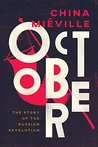
With all the seriousness in the world, like burnt-out matches telling grim stories of the conflagration they will soon start, the ashes of Russia’s Provisional Government debated which of them to make dictator.
wow the imagery is beautiful
The specifics of Russia, 1917, are distinct and crucial. It would be absurd, a ridiculous myopia, to hold up October as a simple lens through which to view the struggles of today. But it has been a long century, a long dusk of spite and cruelty, the excrescence and essence of its time. Twilight, even remembered twilight, is better than no light at all. It would be equally absurd to say that there is nothing we can learn from the revolution. To deny that the sumerki of October can be ours, and that it need not always be followed by night.

My certainties breakfast on doubts. And there are days when I feel like a stranger in Montevideo and anywhere else. On those days, days without sunshine, moonless nights, no place is my own and I do not recognize myself in anything or anyone. Words do not resemble what they refer to or even correspond to their own sounds. Then I am not where I am. I leave my body and travel far, heading nowhere, and I do not want to be with anybody, not even with myself, and I have no name nor wish to have any: then I lose all desire to call myself or be called.
<3

Ronnie’s loft had the same high ceilings and industrial grime as Sandro’s, but it was more cluttered. The cakey smell from the fortune cookie factory on the ground floor filled the room, a rising sweetness in the middle of the night. The floor Ronnie occupied had been an Asian import foods warehouse before Ronnie took it over, and he had kept a lot of what had been left behind. Huge barrels that said MSG on them, where he stored the clothes he bought and wore and then threw away instead of laundering. Against one wall were crates of canned lychee packed in heavy syrup, whose labels he said he found beautiful, and meant to do something with at some point. There was a 1954 calendar on the wall, an Asian woman whose prettiness was meant to promote some product, her face faded to grayish-green, smiling under all that lapsed time.
pretty
He had both liked and hated Brasília’s stiff white meringues, which perfectly blotted the ugly history that paid for them. His father’s rubber-harvesting operations in the Amazon had made the Brazilian government enough money to build an all-inclusive concrete utopia, a brand-new capital. The money had poured in. The rubber workers were still there — they were still there now, in 1977—and there were many more of them because their children were all tappers as well. Neither Sandro’s father nor the Brazilian overseers and middlemen ever bothered to tell the rubber workers the war was over. They simply kept them going, doing their labor up there in the remote northwestern jungle. The tappers didn’t know. They believed that someday there would be an enormous payment, if not to their children, maybe to their children’s children. “What is time to an Indian?” his father had said to Sandro that night in the hotel, the Palace of Something or Other, another interplanetary meringuelike building for industrialists and diplomats. “What is time?” his father asked. “What the hell is it? Who is bound to time, and who isn’t?” Sandro became angry. What am I doing here with this old bastard? “Go tell them, Sandro,” his father had said. “Go on up there. It’s only three thousand kilometers, most of it on dirt roads. Go let them know the war is over and they can all go home, okay?”
It was the last time he saw his father.
Everything a cruel lesson. This, what fathers were for. His father taking Sandro, four years old, to the tire factory gates during a strike. The workers carrying a coffin and Sandro saying, “Papa, is it a funeral?” His father laughing and nodding. For me. I’m dead, right? Holding up his hands, slapping his own cheeks, then holding up his hands again. What do you say, Sandro? Do I look dead to you?
damn