
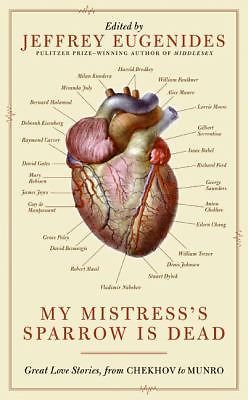
by
Jeffrey Eugenides
(editor)
[...] One of Chekhov’s admirers, Serafima Remizova, was highly disappointed with this ending. “I read your story,” she wrote to Chekhov in a letter, “and I should like to ask you to write the continuation of it. You have abandoned your heroes . . . at the most critical moment in their lives, when they are about to make a decision. But which one? . . . It is important for someone like you, Anton Pavlovich, who can see into the human heart, to show . . . how happiness can be found in such a situation.”
But the inconclusiveness of Chekhov’s ending, his failure to show how happiness can be found in such a predicament (along with the suggestion that perhaps it can’t be found), is exactly what makes this story one of the greatest love stories of all time. It ends where the preliminaries of love end, after the stirrings of attraction, after the trysts and renunciations and the renunciations of those renunciations, when desire has attained its object and the real, the heavy problems begin.
I’ve read “The Lady with the Little Dog” countless times over the years and my interpretation continually changes. When I was younger (and more sophisticated), I was sure the ending was ironic. The emotional deadness of the lovers’ marriages was sure to infect their own new relationship in time. Reading the story now, older (and more innocent), I couldn’t help finding in Chekhov’s last line a glimmer of optimism. The story seemed to me, this time through, to be about that miracle you come across every once in a long while: two unexceptional people, for no demonstrable reasons, being exceptionally in love.