
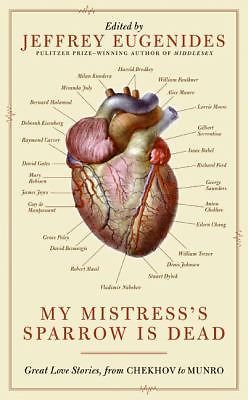
by
Jeffrey Eugenides
(editor)
xi
When it comes to love, there are a million theories to explain it. But when it comes to love stories, things are simpler. A love story can never be about full possession. The happy marriage, the requited love, the desire that never dims—these are lucky eventualities but they aren’t love stories. Love stories depend on disappointment, on unequal births and feuding families, on matrimonial boredom and at least one cold heart. Love stories, nearly without exception, give love a bad name.
We value love not because it ’s stronger than death but because it ’s weaker. Say what you want about love: death will finish it. You will not go on loving in the grave, not in any physical way that will at all resemble love as we know it on earth. The perishable nature of love is what gives love its profound importance in our lives. If it were endless, if it were on tap, love wouldn’t hit us the way it does.
When it comes to love, there are a million theories to explain it. But when it comes to love stories, things are simpler. A love story can never be about full possession. The happy marriage, the requited love, the desire that never dims—these are lucky eventualities but they aren’t love stories. Love stories depend on disappointment, on unequal births and feuding families, on matrimonial boredom and at least one cold heart. Love stories, nearly without exception, give love a bad name.
We value love not because it ’s stronger than death but because it ’s weaker. Say what you want about love: death will finish it. You will not go on loving in the grave, not in any physical way that will at all resemble love as we know it on earth. The perishable nature of love is what gives love its profound importance in our lives. If it were endless, if it were on tap, love wouldn’t hit us the way it does.
xiv
The stories in this volume fall within the continuum laid out by Catullus’s first two Lesbia poems: from voyeuristic longing to disenchanted entanglement. The narrator of “Spring in Fialta” recounts the many missed romantic opportunities he ’s had with a woman named Nina, whom he ’d first met, and kissed, on a pitch-black Russian winter night years and years before. Nina recurs in the narrator’s life like a theme in a piece of music, and every time the strings announce her arrival, the cymbals clash and she disappears. I’d been under the impression lately that I was cooling ever so slightly on Nabokov, that sober middle age had made me less susceptible to his lush lyricism. But rereading “Spring in Fialta” reminded me how much better Nabokov is than everybody else. Not only does the story impart to the reader a profound wistfulness, in which the evanescence of love expands to suggest the fragility of life and time and memory itself, but Nabokov manages, at the same time, to weave into the story secondary and tertiary levels of meaning. There ’s what’s happening with the weather, for instance, the “cloudy and dull” spring of Fialta that, in the background of the narrated events, is slowly transforming, thawing, dripping, and brightening, in order to flash out at the end with the story’s tragic revelation. Along with this, Nabokov has studded the story with recurring details—of the circus coming to town, of speeding automobiles—all of which will figure in the denouement. The literary craft in all this mirrors the literary imagination (the seeing of patterns, the orchestrating of fate) that the narrator brings to his random meetings with Nina throughout the years, a literary imagination that every lover possesses and is a veritable Shakespeare of. “Spring in Fialta” isn’t only about a love fated never to be. It reenacts the story-making we inevitably engage in whenever we fall in love.
truly one of the best short stories in the canon
The stories in this volume fall within the continuum laid out by Catullus’s first two Lesbia poems: from voyeuristic longing to disenchanted entanglement. The narrator of “Spring in Fialta” recounts the many missed romantic opportunities he ’s had with a woman named Nina, whom he ’d first met, and kissed, on a pitch-black Russian winter night years and years before. Nina recurs in the narrator’s life like a theme in a piece of music, and every time the strings announce her arrival, the cymbals clash and she disappears. I’d been under the impression lately that I was cooling ever so slightly on Nabokov, that sober middle age had made me less susceptible to his lush lyricism. But rereading “Spring in Fialta” reminded me how much better Nabokov is than everybody else. Not only does the story impart to the reader a profound wistfulness, in which the evanescence of love expands to suggest the fragility of life and time and memory itself, but Nabokov manages, at the same time, to weave into the story secondary and tertiary levels of meaning. There ’s what’s happening with the weather, for instance, the “cloudy and dull” spring of Fialta that, in the background of the narrated events, is slowly transforming, thawing, dripping, and brightening, in order to flash out at the end with the story’s tragic revelation. Along with this, Nabokov has studded the story with recurring details—of the circus coming to town, of speeding automobiles—all of which will figure in the denouement. The literary craft in all this mirrors the literary imagination (the seeing of patterns, the orchestrating of fate) that the narrator brings to his random meetings with Nina throughout the years, a literary imagination that every lover possesses and is a veritable Shakespeare of. “Spring in Fialta” isn’t only about a love fated never to be. It reenacts the story-making we inevitably engage in whenever we fall in love.
truly one of the best short stories in the canon
xv
[...] One of Chekhov’s admirers, Serafima Remizova, was highly disappointed with this ending. “I read your story,” she wrote to Chekhov in a letter, “and I should like to ask you to write the continuation of it. You have abandoned your heroes . . . at the most critical moment in their lives, when they are about to make a decision. But which one? . . . It is important for someone like you, Anton Pavlovich, who can see into the human heart, to show . . . how happiness can be found in such a situation.”
But the inconclusiveness of Chekhov’s ending, his failure to show how happiness can be found in such a predicament (along with the suggestion that perhaps it can’t be found), is exactly what makes this story one of the greatest love stories of all time. It ends where the preliminaries of love end, after the stirrings of attraction, after the trysts and renunciations and the renunciations of those renunciations, when desire has attained its object and the real, the heavy problems begin.
I’ve read “The Lady with the Little Dog” countless times over the years and my interpretation continually changes. When I was younger (and more sophisticated), I was sure the ending was ironic. The emotional deadness of the lovers’ marriages was sure to infect their own new relationship in time. Reading the story now, older (and more innocent), I couldn’t help finding in Chekhov’s last line a glimmer of optimism. The story seemed to me, this time through, to be about that miracle you come across every once in a long while: two unexceptional people, for no demonstrable reasons, being exceptionally in love.
[...] One of Chekhov’s admirers, Serafima Remizova, was highly disappointed with this ending. “I read your story,” she wrote to Chekhov in a letter, “and I should like to ask you to write the continuation of it. You have abandoned your heroes . . . at the most critical moment in their lives, when they are about to make a decision. But which one? . . . It is important for someone like you, Anton Pavlovich, who can see into the human heart, to show . . . how happiness can be found in such a situation.”
But the inconclusiveness of Chekhov’s ending, his failure to show how happiness can be found in such a predicament (along with the suggestion that perhaps it can’t be found), is exactly what makes this story one of the greatest love stories of all time. It ends where the preliminaries of love end, after the stirrings of attraction, after the trysts and renunciations and the renunciations of those renunciations, when desire has attained its object and the real, the heavy problems begin.
I’ve read “The Lady with the Little Dog” countless times over the years and my interpretation continually changes. When I was younger (and more sophisticated), I was sure the ending was ironic. The emotional deadness of the lovers’ marriages was sure to infect their own new relationship in time. Reading the story now, older (and more innocent), I couldn’t help finding in Chekhov’s last line a glimmer of optimism. The story seemed to me, this time through, to be about that miracle you come across every once in a long while: two unexceptional people, for no demonstrable reasons, being exceptionally in love.
1
Toward the end of March, in St. Louis, slush fills the gutters, and dirty snow lies heaped alongside porch steps, and everything seems to be suffocating in the embrace of a season that lasts too long. Radiators hiss mournfully, no one manages to be patient, the wind draws tears from your eyes, the clouds are filled with sadness. Women with scarves around their heads and their feet encased in fur-lined boots pick their way carefully over patches of melting ice. It seems that winter will last forever, that this is the decision of nature and nothing can be done about it.
:)
Toward the end of March, in St. Louis, slush fills the gutters, and dirty snow lies heaped alongside porch steps, and everything seems to be suffocating in the embrace of a season that lasts too long. Radiators hiss mournfully, no one manages to be patient, the wind draws tears from your eyes, the clouds are filled with sadness. Women with scarves around their heads and their feet encased in fur-lined boots pick their way carefully over patches of melting ice. It seems that winter will last forever, that this is the decision of nature and nothing can be done about it.
:)
7
"Mother, do you know what Ceil Johnson said to me today? She said that Beryl Feringhaus—you know, the real-estate people—was heartbroken because she thought Sonny Bruster was going to get engaged to her.” My sister giggled. Her long hair was tangled, and my mother yanked a comb through it.
“Maybe you ought to cut your hair,” my mother said, trying to hide her own excitement and to stay practical. During this period, my mother was living in the imminence of wealth. Whenever she stopped what she was doing and looked up, her face would be bright with visions.
god
"Mother, do you know what Ceil Johnson said to me today? She said that Beryl Feringhaus—you know, the real-estate people—was heartbroken because she thought Sonny Bruster was going to get engaged to her.” My sister giggled. Her long hair was tangled, and my mother yanked a comb through it.
“Maybe you ought to cut your hair,” my mother said, trying to hide her own excitement and to stay practical. During this period, my mother was living in the imminence of wealth. Whenever she stopped what she was doing and looked up, her face would be bright with visions.
god
17
“Sonny’s a very intelligent boy,” my mother said. “He comes from a good family.”
“I don’t care,” my sister said. “I don’t want to waste myself on him.”
“Waste yourself ?” My mother laughed derisively. I got up and went to the door of my sister’s room. My sister was sitting at her dressing table, her hair shining like glass and her eyes closed. My mother was walking back and forth, gesturing with the hairbrush. “He ’s the one who’s throwing himself away,” she said. “Who do you think we are, anyway? We ’re nobodies.”
“I’m pretty!” my sister objected angrily.
My mother shrugged. “The woods are full of pretty girls. What ’s more, they’re full of pretty, rich girls. Now, Sonny’s a very nice boy—”
“Leave me alone!” My sister pulled her hair up from her shoulders and held it in a soft mop on the top of her head. “Sonny’s a jerk! A jerk!”
“He ’s nice-looking!” my mother cried.
“Oh, what do you know about it?” my sister cried. “You’re old, for God ’s sake!”
brutal
“Sonny’s a very intelligent boy,” my mother said. “He comes from a good family.”
“I don’t care,” my sister said. “I don’t want to waste myself on him.”
“Waste yourself ?” My mother laughed derisively. I got up and went to the door of my sister’s room. My sister was sitting at her dressing table, her hair shining like glass and her eyes closed. My mother was walking back and forth, gesturing with the hairbrush. “He ’s the one who’s throwing himself away,” she said. “Who do you think we are, anyway? We ’re nobodies.”
“I’m pretty!” my sister objected angrily.
My mother shrugged. “The woods are full of pretty girls. What ’s more, they’re full of pretty, rich girls. Now, Sonny’s a very nice boy—”
“Leave me alone!” My sister pulled her hair up from her shoulders and held it in a soft mop on the top of her head. “Sonny’s a jerk! A jerk!”
“He ’s nice-looking!” my mother cried.
“Oh, what do you know about it?” my sister cried. “You’re old, for God ’s sake!”
brutal
18
When I came out again, an hour later, my mother was in bed reading a magazine; she looked as if she had been wounded in a dozen places. My sister sat in her room, in front of the mirror. Her hair streamed down the back of her neck and lay in touching, defenseless little curls on the towel she had over her shoulders. She was studying her reflection thoughtfully. (Are flowers vain? Are trees? Are they consumed with vanity during those days when they are in bloom?) She raised her finger and pressed it against her lower lip to see, I think, if she would be prettier if her lip, instead of being so smooth, had a slight break in the center as some girls’ did.
When I came out again, an hour later, my mother was in bed reading a magazine; she looked as if she had been wounded in a dozen places. My sister sat in her room, in front of the mirror. Her hair streamed down the back of her neck and lay in touching, defenseless little curls on the towel she had over her shoulders. She was studying her reflection thoughtfully. (Are flowers vain? Are trees? Are they consumed with vanity during those days when they are in bloom?) She raised her finger and pressed it against her lower lip to see, I think, if she would be prettier if her lip, instead of being so smooth, had a slight break in the center as some girls’ did.
19
[...] It occurred to me that she didn’t know what she was doing; she was not really as sure of everything as she seemed. It was a painfully difficult thought to arrive at, and it clung to me. Why hadn’t I realized it before? Also, she sort of hated me, it seemed to me. I had never noticed that before, either. How could I have been so wrong, I wondered. Knowing how wrong I had been about this, I felt that no idea I had ever held was safe. For instance, we were not necessarily a happy family, with the most wonderful destinies waiting for my sister and me. We might make mistakes and choose wrong. Unhappiness was real. It was even likely. . . . How tired I became of studying my sister’s face. I got so I would do anything to keep from joining the two women on the porch.
[...] It occurred to me that she didn’t know what she was doing; she was not really as sure of everything as she seemed. It was a painfully difficult thought to arrive at, and it clung to me. Why hadn’t I realized it before? Also, she sort of hated me, it seemed to me. I had never noticed that before, either. How could I have been so wrong, I wondered. Knowing how wrong I had been about this, I felt that no idea I had ever held was safe. For instance, we were not necessarily a happy family, with the most wonderful destinies waiting for my sister and me. We might make mistakes and choose wrong. Unhappiness was real. It was even likely. . . . How tired I became of studying my sister’s face. I got so I would do anything to keep from joining the two women on the porch.
60
[...] the very old men—some in their brushed Confederate uniforms—on the porch and the lawn, talking of Miss Emily as if she had been a contemporary of theirs, believing that they had danced with her and courted her perhaps, confusing time with its mathematical progression, as the old do, to whom all the past is not a diminishing road but, instead, a huge meadow which no winter ever quite touches, divided from them now by the narrow bottle-neck of the most recent decade of years.
[...] the very old men—some in their brushed Confederate uniforms—on the porch and the lawn, talking of Miss Emily as if she had been a contemporary of theirs, believing that they had danced with her and courted her perhaps, confusing time with its mathematical progression, as the old do, to whom all the past is not a diminishing road but, instead, a huge meadow which no winter ever quite touches, divided from them now by the narrow bottle-neck of the most recent decade of years.
91
Gabriel had not gone to the door with the others. He was in a dark part of the hall gazing up the staircase. A woman was standing near the top of the first flight in the shadow also. He could not see her face but he could see the terracotta and salmonpink panels of her skirt which the shadow made appear black and white. It was his wife. She was leaning on the banisters listening to something. Gabriel was surprised at her stillness and strained his ear to listen also. But he could hear little save the noise of laughter and dispute on the front steps, a few chords struck on the piano and a few notes of a man’s voice singing.
He stood still in the gloom of the hall, trying to catch the air that the voice was singing and gazing up at his wife. There was grace and mystery in her attitude as if she were a symbol of something. He asked himself what is a woman standing on the stairs in the shadow, listening to distant music, a symbol of. If he were a painter he would paint her in that attitude. Her blue felt hat would show off the bronze of her hair against the darkness and the dark panels of her skirt would show off the light ones. Distant Music he would call the picture if he were a painter.
pretty
Gabriel had not gone to the door with the others. He was in a dark part of the hall gazing up the staircase. A woman was standing near the top of the first flight in the shadow also. He could not see her face but he could see the terracotta and salmonpink panels of her skirt which the shadow made appear black and white. It was his wife. She was leaning on the banisters listening to something. Gabriel was surprised at her stillness and strained his ear to listen also. But he could hear little save the noise of laughter and dispute on the front steps, a few chords struck on the piano and a few notes of a man’s voice singing.
He stood still in the gloom of the hall, trying to catch the air that the voice was singing and gazing up at his wife. There was grace and mystery in her attitude as if she were a symbol of something. He asked himself what is a woman standing on the stairs in the shadow, listening to distant music, a symbol of. If he were a painter he would paint her in that attitude. Her blue felt hat would show off the bronze of her hair against the darkness and the dark panels of her skirt would show off the light ones. Distant Music he would call the picture if he were a painter.
pretty