
1
Introduction: What Is Speculative Violence?
0
terms
18
notes
3
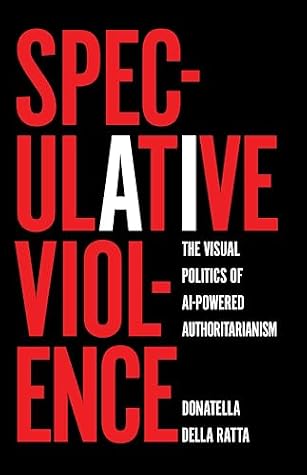
“Speculative violence” names an insidious mode of anticipatory harm concealed within the synthetic aesthetics of AI-generated images: images that can give visual form to future worlds built on destruction, erasure, and forced displacement, making them feel plausible, legitimate, and even acceptable simply by being seen. This book traces the unfolding of speculative violence as an emerging politics of vision, in which power operates by capturing through imagination the not-yet in order to shape and orient beliefs and actions in the now.
“Speculative violence” names an insidious mode of anticipatory harm concealed within the synthetic aesthetics of AI-generated images: images that can give visual form to future worlds built on destruction, erasure, and forced displacement, making them feel plausible, legitimate, and even acceptable simply by being seen. This book traces the unfolding of speculative violence as an emerging politics of vision, in which power operates by capturing through imagination the not-yet in order to shape and orient beliefs and actions in the now.
3
How was I to make sense of this silent violence at work—too subtle to be called manipulation or deceit, harder to detect than fake news, and easier to accept precisely because it appeared to cause no immediate harm? That question marked the beginning of my inquiry into an emerging politics of vision, in which AI-powered technologies help recalibrate the threshold of visibility itself, reshaping not only what futures become imaginable, but which ones acquire legitimacy, plausibility, and the force of inevitability.
How was I to make sense of this silent violence at work—too subtle to be called manipulation or deceit, harder to detect than fake news, and easier to accept precisely because it appeared to cause no immediate harm? That question marked the beginning of my inquiry into an emerging politics of vision, in which AI-powered technologies help recalibrate the threshold of visibility itself, reshaping not only what futures become imaginable, but which ones acquire legitimacy, plausibility, and the force of inevitability.
5
[...] Aligning itself with a growing body of critical scholarship, this book rejects the idea that generative AI is a neutral or radically unprecedented technological aide that simply enhances creativity.
Instead, I situate generative AI within a longer genealogy of visual apparatuses of surveillance and control— such as photography—deeply rooted in colonial practices of classification and categorization designed to dominate people and land, at once continuous with older regimes of knowledge and radically disruptive of them through the introduction of novel modes of preservation, access, recombination, and creation.
8
[...] Even within the relevant scholarship, fascination with AI’s supposed ability to augment, rather than replace, human aesthetic capacities often overrides critical judgment, despite being accompanied by ethical concerns such as the “cannibalization” of artists’ styles and works.
In this book I take a different path. Starting from the premise that the way AI is built—the infrastructure needed for its functioning and the rationale at its core, its logistics and its logic—is inherently violent and bound up with extraction, exploitation, and oppression, I focus on a largely overlooked capacity of generative AI: its ability to enact violence in the image and through the image.
9
[...] While pro-Palestinian content is routinely flagged, suppressed, or shadow-banned across platforms, AI-generat- ed genocidal and urbicidal visions—where the rise of the Third Temple presupposes the disappearance of the al-Aqsa Mosque and, with it, the potential unfolding of an unprecedented conflict—circulate largely unchallenged, likely classified as harmless architectural fantasies or neutral urban renderings.
[...] While pro-Palestinian content is routinely flagged, suppressed, or shadow-banned across platforms, AI-generat- ed genocidal and urbicidal visions—where the rise of the Third Temple presupposes the disappearance of the al-Aqsa Mosque and, with it, the potential unfolding of an unprecedented conflict—circulate largely unchallenged, likely classified as harmless architectural fantasies or neutral urban renderings.
10
[...] I focus on the weaponization of the visual potential of generative AI by far-right, supremacist, fascist, and populist formations; by messianic and reli- gious-nationalist movements; and by reactionary political projects, including MAGA-aligned actors, that deploy synthetic imagery to render exclusionary, authoritarian, and eliminationist futures imaginable, plausible, and apparently inevitable.17 What is at stake in these uses is not persua- sion in the conventional sense but the visual pre-enactment of futures in which violence no longer appears as a choice or a rupture, but as an anticipated horizon: an outcome framed as already unfolding and, ultimately, unavoidable.
[...] I focus on the weaponization of the visual potential of generative AI by far-right, supremacist, fascist, and populist formations; by messianic and reli- gious-nationalist movements; and by reactionary political projects, including MAGA-aligned actors, that deploy synthetic imagery to render exclusionary, authoritarian, and eliminationist futures imaginable, plausible, and apparently inevitable.17 What is at stake in these uses is not persua- sion in the conventional sense but the visual pre-enactment of futures in which violence no longer appears as a choice or a rupture, but as an anticipated horizon: an outcome framed as already unfolding and, ultimately, unavoidable.
12
Speculation becomes a discourse about the future that seeks to generate economic value from uncertainty, transforming the volatility of the invisible and the unknowable into concrete material assets and market commodities. It operates by mobilizing affect while simultaneously making educated guesses based on past data, producing forms of predictive analysis aimed at identifying the most likely scenarios. It thus combines two dimensions that appear contradictory but are, in fact, deeply intertwined. On the one hand, it belongs to the realm of imagination, invoking practices such as prophecy or divination that mobilize different ways of seeing in order to project possible futures. On the other hand, though, these instances coexist “alongside the formal knowledge practices of modernity—risk, evidence, and calculation.” Rather than standing in opposition, these elements must be understood as part of the same system. Contrary to Orientalist narratives that confine magical and visionary instances to the non-Western world while presenting Western capitalism as purely rational and governed by calculative reason, Euro-American finance has, in fact, long relied on quasi-divinatory speculative practices—financial “futures” on the stock market being a clear example.
Speculation becomes a discourse about the future that seeks to generate economic value from uncertainty, transforming the volatility of the invisible and the unknowable into concrete material assets and market commodities. It operates by mobilizing affect while simultaneously making educated guesses based on past data, producing forms of predictive analysis aimed at identifying the most likely scenarios. It thus combines two dimensions that appear contradictory but are, in fact, deeply intertwined. On the one hand, it belongs to the realm of imagination, invoking practices such as prophecy or divination that mobilize different ways of seeing in order to project possible futures. On the other hand, though, these instances coexist “alongside the formal knowledge practices of modernity—risk, evidence, and calculation.” Rather than standing in opposition, these elements must be understood as part of the same system. Contrary to Orientalist narratives that confine magical and visionary instances to the non-Western world while presenting Western capitalism as purely rational and governed by calculative reason, Euro-American finance has, in fact, long relied on quasi-divinatory speculative practices—financial “futures” on the stock market being a clear example.
13
Silicon Valley’s celebration of “disruption” as a guiding principle for tech companies fully translates this speculative dreamwork into the domain of information and digital infrastructures. Disruption is, in fact, not a chaotic force but a disciplined form of speculative dreaming through which existing realities are suspended, devalued, or declared obsolete, brushed away in the name of futures imagined as more profitable, efficient, or inevitable. Famously captured by Meta’s former slogan “Move fast and break things,” “disruption” became a defining mantra of the Silicon Valley tech industry in the early twenty-first century. Prominent tech investors such as Marc Andreessen proclaimed software’s revolutionary destiny to upend entire industries, while Peter Thiel—an investor and board member at Facebook long before it became Meta—reportedly named “dis- ruption” as one of his favorite words.
Silicon Valley’s celebration of “disruption” as a guiding principle for tech companies fully translates this speculative dreamwork into the domain of information and digital infrastructures. Disruption is, in fact, not a chaotic force but a disciplined form of speculative dreaming through which existing realities are suspended, devalued, or declared obsolete, brushed away in the name of futures imagined as more profitable, efficient, or inevitable. Famously captured by Meta’s former slogan “Move fast and break things,” “disruption” became a defining mantra of the Silicon Valley tech industry in the early twenty-first century. Prominent tech investors such as Marc Andreessen proclaimed software’s revolutionary destiny to upend entire industries, while Peter Thiel—an investor and board member at Facebook long before it became Meta—reportedly named “dis- ruption” as one of his favorite words.
14
As longtime tech analyst and critic Gil Duran has argued, the appeal of the “disruption” idea among prominent Silicon Valley entrepreneurs stems in part from what he describes as the “built-in existentialism of the venture capital model.” Risk is not an exception within venture capital but its defining condition. Unlike other types of investments that are more oriented toward long-term, incremental growth, venture capital thrives on highly volatile bets that promise extraordinary returns if they succeed. Because of this internal logic, venture capital is structurally disruptive. Its profitability depends on destabilizing or collapsing existing systems in order to replace them with new ones designed for rapid scaling and extraction. Far from being a mere rhetorical posture or cultural attitude, disruption functions as the economic engine of the model itself, operating its “dreamwork” in a permanent state of anticipation and co-optation of the future.
As longtime tech analyst and critic Gil Duran has argued, the appeal of the “disruption” idea among prominent Silicon Valley entrepreneurs stems in part from what he describes as the “built-in existentialism of the venture capital model.” Risk is not an exception within venture capital but its defining condition. Unlike other types of investments that are more oriented toward long-term, incremental growth, venture capital thrives on highly volatile bets that promise extraordinary returns if they succeed. Because of this internal logic, venture capital is structurally disruptive. Its profitability depends on destabilizing or collapsing existing systems in order to replace them with new ones designed for rapid scaling and extraction. Far from being a mere rhetorical posture or cultural attitude, disruption functions as the economic engine of the model itself, operating its “dreamwork” in a permanent state of anticipation and co-optation of the future.
16
In the dramatically altered political climate of the 2020s, profoundly changed by the COVID-19 pandemic and troubled by the highest number of conflicts and armed violence since the end of World War II, the disruption narrative promoted by the country’s tech elites in the previous decade has taken on a very different—and much more sinister—character.34 In the early 2000s, this technological ethos tended to be couched in the language of social responsibility and universal progress. Mark Zuckerberg’s 2017 Facebook mission statement, which pledged to “bring the world closer together,” epitomized this moment, as the company cast itself as morally accountable not only for connectivity, but for addressing global challenges such as pov- erty, disease, climate change, violence, and intolerance.
This vision closely aligned with what media scholars Richard Barbrook and Andy Cameron famously described as the “Californian Ideology”: a libertarian dream in which free market and free expression would merge, driven by faith in technology’s inherent capacity to deliver both social progress and material prosperity.36 For a time, Silicon Valley appeared to operate—at least rhetorically— under this ethical banner.
By the early 2020s, that framework had openly fractured. In November 2021, three former Google employees filed a lawsuit alleging that the company’s ethic, condensed in its iconic motto “Don’t be evil,” had been violated after they were fired in retaliation for organizing against controversial projects, such as those in collaboration with US Customs and Border Protection during the first Trump administration. The case ended in a confidential settlement in March 2022 bound by a nondisclosure agreement—a markedly different outcome than what emerged from earlier moments of internal resistance and an alarming sig- nal that the atmosphere was changing at a fast pace.37 Just a few years prior, in 2018, other Google employees had successfully pressured the company to withdraw from Project Maven, a Pentagon partnership involving AI applica- tions that workers feared could be used for lethal purposes. At the time, up to four thousand workers signed open letters and some resigned in protest, leading Google to let the contract expire without renewal.38 The episode can be read as a symbolic reaffirmation of the “Don’t be evil” ethos and a signal that powerful Big Tech—most commonly associated with Silicon Valley—was still seemingly operating in the context of the Californian Ideology.
19
Slogans like “Don’t be evil” and “Bring the world closer together” might have previously functioned less as genuine ethical commitments than as ideological cover, obscuring a long-standing entanglement between the tech industry and military power—a convergence that reaches back to the very origins of the internet itself, developed under US government sponsorship as a weapon in the Cold War against the former Soviet Union.43 As Rob Lalka, a business school professor and entrepreneur, observes in his characterization of tech founders as “venture alchemists,” Silicon Valley’s leading entrepreneurs have successfully cast themselves as benevolent innovators, champions of democracy and human progress, while concealing the far more ruthless ambitions and antagonistic impulses that shaped their rise in the early years of the tech boom.44 These darker origin stories were long masked by the powerful myth of garage start-ups founded by young nerds in flip-flops, coding their way toward a more democratic world. That narrative recast aggressive market capture as youthful idealism, and the pursuit of total control as “innovation-oriented” disruption.
Slogans like “Don’t be evil” and “Bring the world closer together” might have previously functioned less as genuine ethical commitments than as ideological cover, obscuring a long-standing entanglement between the tech industry and military power—a convergence that reaches back to the very origins of the internet itself, developed under US government sponsorship as a weapon in the Cold War against the former Soviet Union.43 As Rob Lalka, a business school professor and entrepreneur, observes in his characterization of tech founders as “venture alchemists,” Silicon Valley’s leading entrepreneurs have successfully cast themselves as benevolent innovators, champions of democracy and human progress, while concealing the far more ruthless ambitions and antagonistic impulses that shaped their rise in the early years of the tech boom.44 These darker origin stories were long masked by the powerful myth of garage start-ups founded by young nerds in flip-flops, coding their way toward a more democratic world. That narrative recast aggressive market capture as youthful idealism, and the pursuit of total control as “innovation-oriented” disruption.
21
This trajectory may be not just a cynical rhetorical maneuver but, rather, the “logic” produced by the venture capital model itself, driven by an unrelenting appetite for extreme risk, accelerated disruption, and outsized returns—dynamics that ultimately push toward the unmaking of the social, legal, and political orders in which that model still operates. A logic that is made strikingly explicit in the words of Mike Solana, chief marketing officer at Founders Fund: “Maybe if you aren’t trying to destroy the world, you’re not trying hard enough.”
lol
22
This techno-eschatology, now seemingly dominant among Silicon Valley’s tech elites—framing knowledge and the imagination of future realities through visions of judgment and salvation—has gained renewed force in and through AI; yet its lineage is far older, as David Noble argued in his seminal 1990s work The Religion of Technology. The recurring pattern lies in the power relations that coalesce around technology: Historically, those who claim privileged access to knowledge of humanity’s purportedly inevitable future have also been those positioned to exercise the greatest political authority.
This techno-eschatology, now seemingly dominant among Silicon Valley’s tech elites—framing knowledge and the imagination of future realities through visions of judgment and salvation—has gained renewed force in and through AI; yet its lineage is far older, as David Noble argued in his seminal 1990s work The Religion of Technology. The recurring pattern lies in the power relations that coalesce around technology: Historically, those who claim privileged access to knowledge of humanity’s purportedly inevitable future have also been those positioned to exercise the greatest political authority.
23
The surge of investment in the AI sector and the intensifying global race—particularly the sprint toward the promised “evolutionary” horizon of AGI—have further concentrated power in the hands of a small tech elite. What distinguishes this moment from earlier phases of technological development, though, is not only the unprecedent- ed magnitude of that concentration but the sociopolitical culture of those who now hold that power. That culture has shifted markedly toward what Duran calls a Nerd Reich: a loosely networked “cult” of tech billionaires who no longer treat democracy as their preferred “operating system.”51
In its place, an increasingly explicit affinity for authoritarian leadership has emerged—one mediated, amplified, and operationalized through technological infrastructures, with AI at their core. In this configuration, speculative dreamwork is not solely confined to markets or mythologies of disruption, but becomes a technique of governance in which the ability to imagine and visualize the future is also the power to organize its concrete implementation.
25
This is not to suggest that generative AI caused the 20-Point Gaza Peace Plan, nor that images automatically translate into policy. But these images are not just images, and should not be read as such. In a highly visual culture, such frames operate as performative blueprints: They prepare the imagination for what is to come. By aestheticizing postwar devastation and cloaking forced displacement in the language of reconstruction and prosperity, they enact violence in advance while, at the same time, rendering it invisible and recoding it as a necessary precondition for progress. They sculpt a “happy ending” directly into the image of the future, while omitting the unbearable violence and dispossession that make such an ending possible.
In this sense, speculative violence operates as a conduit between vision and action. What begins as fiction can migrate into policy; what first appears as fantasy or speculation can later function as an operational horizon. These images do not simply depict a possible future; they prototype it. They work to soften cognitive, affective, and moral resistance, making certain outcomes more readily accepted once they are proposed in institutional or bureaucratic form.
The images’ power lies in operating at the level of what Walter Benjamin once described as the “optical unconscious”—a mode of perception shaped beneath conscious awareness.55 Through repetition and visual familiarity, they train the collective eye to ingest and digest aesthetically what may be enacted materially in the future. Vis- ualization alone becomes a force of normalization and acceptance, gradually granting such violent forms of speculation consent and, eventually, belief.
31
Within this feedback loop, generative images operate as world-making devices. They condition perception, prime consent, and manufacture plausibility in visual form. The seamless, photorealistic surfaces of AI do not merely imagine a future Palestine; they visually construct the preconditions of that future, training the public to accept it as inevitable. By the time policy arrives, the groundwork of consent has already been laid in synthetic frames. As Nick Land observed, “Just because it’s not real now doesn’t mean it won’t be real at some point in the future.” In the field of generative AI, projection and recognition, fiction and image collapse into a single visual surface.
Within this feedback loop, generative images operate as world-making devices. They condition perception, prime consent, and manufacture plausibility in visual form. The seamless, photorealistic surfaces of AI do not merely imagine a future Palestine; they visually construct the preconditions of that future, training the public to accept it as inevitable. By the time policy arrives, the groundwork of consent has already been laid in synthetic frames. As Nick Land observed, “Just because it’s not real now doesn’t mean it won’t be real at some point in the future.” In the field of generative AI, projection and recognition, fiction and image collapse into a single visual surface.
34
Visual politics increasingly functions as a decisive terrain of struggle, rather than as something secondary, merely symbolic, or confined to the aesthetic or media sphere. Looking at generated images with a discerning eye is a particularly urgent priority at a moment when these very images—often dismissed as AI “slop” or trivialized as pranks, satire, or distasteful kitsch—are, in fact, actively mobilized by exclusionary, supremacist, and even genocidal political projects. Rather than constituting harmless digital byproducts or peripheral synthetic artifacts, they instead function as anticipatory infrastructures: shaping perception, orienting desire, and preparing collective sensibilities for author- itarian agendas that are prefigured to later materialize in law, policy, and institutional practice.
The struggle today is not only over the control of territory, history, or representation, but over time itself: over who designs the horizon of possibility, whose dreams are allowed to solidify into worlds, and which worlds are rendered desirable, and therefore real. Through the lens of speculative violence, we can understand that the future is not a distant horizon but a contested infrastructure of the present, a field where aesthetics, ideology, and power converge. To break into this infrastructure, to intervene in this machinery of vision, is to reclaim the right to do the speculative dreamwork otherwise. It means insisting on futures not built on erasure, not sustained by annihilation, and not made plausible through suffering.
35
The battle now is over whether other forms of speculation—more just, more generous, more humane—can gather enough energy to assert themselves against this imperial imagination.
The battle now is over whether other forms of speculation—more just, more generous, more humane—can gather enough energy to assert themselves against this imperial imagination.