
by
Sarah Polley
why/write
Simone de Beauvoir,
Richard Seymour,
Patricia Highsmith,
Ursula K. Le Guin,
Anne Lamott,
Mario Levrero,
Alexander Chee,
Jennifer Egan,
Roberto Bolaño
Why write?

Why do we write things about ourselves? To absolve ourselves of guilt? To confess? To right a wrong? To be heard? To apologize? To clarify things for ourselves or others? I’ve wondered all these things as I sit down to write this.
I’ve been writing and unwriting this essay for years now. It’s difficult, when you’ve resisted telling a story for so long, to know where to start. Especially when it has haunted you to not tell it. When it has knocked around inside your brain, loudly in the middle of the night, asking why it didn’t deserve to be told, asking you who you might have hurt by not telling it, who you might truly be, deep down, because of your decision not to.

In the conventional, thetic, paranoid form of reading imposed on children, every text is a kind of a puzzle. You can read it simply, enjoying the shape of the words in your mouth, their indistinct resonances, their minute associations which seem to hold a special meaning for you and you alone, or the ones which float in the clear vastness of possibility and never need to settle down and become fixed; you can take joy in the act of reading, and understand it as a perpetual collaboration between yourself and an author you've never met. [...]
i do like his writing style tbh
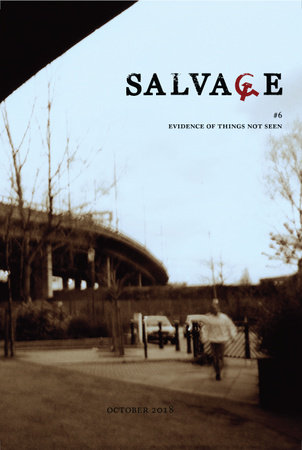
Salvage #6: Evidence of Things Not Seen
by
multiple authors
by
multiple authors
Salvage #6: Evidence of Things Not Seen
by
multiple authors
by
multiple authors
Salvage #6: Evidence of Things Not Seen
by
multiple authors
by
multiple authors
Writing, whatever else it is doing, is always getting at something that it never quite obtains. There is always something unsaid, something that clings to writing like a shadow.
Thus, from the perspective of many educated political people, writing is something that one despises: an onerous task, a sacrifice one makes for the greater good. It results in left-wing writers becomingly aggressively boring, in an unconscious attempt to punish the reader: I've suffered for my writing, now it's your turn. Any writer who seems to be having a good time, revelling in the jouissance of writing, enjoying with rococo swagger the ornate sensuousness of language, is self-indulgent, a source of resentment. [...]
I'm not sure exactly who he's talking about (??) but the idea that writing should be something we enjoy is good
The literature of the left, is literary. Marx, Aimé Césaire, Suzane Césaire, Louis Althusser, Audre Lorde, Simone Yoyotte, Pierre Yoyotte, J H Prynne, Jules Monnerot, Simone de Beauvoir, Christopher Caudwell, Claudia Jones, Theodore Adorno, Walter Benjamin, CLR James, Leon Trotsky, John Berger, the prelapsarian Christopher Hitchens and Rusa Luxemburg are all notable for being, not just theorists, journalists, historians, philosophers, poets and intellectuals who opened up new worlds to their readers but, precisely on that account, great stylists. Historical materialism, at its inception, stressed the artifice - the art - in living, and goes on doing so. We make history, even if not in circumstances or with materials of our own choosing. Nothing has to be taken as it is given, not even our written language.
These literary jouissances are, far from being incidental trappings often essential to the persuasive power of the 'ruthless criticism' of all that exists, and to the new concepts to which it gives birth. They are part of the meaning of the work, which is something that is done to you, not just said to you. One way of putting this is that radical writing is an attempt at, among other things, conversion. We don't write just to pass on information, as honest brokers, but to change people: to shake them up, to make them laugh, pray, blush, worry, cry and yearn. We aim to help make revolutionary subjects, people who are capable of waging the kinds of difficult, and often unrewarding struggles that are the lot of any radical. [...]
on Marx's writing

The summer evenings of my boyhood when I used to ride by her cottage speak to me in that voice of hers now. On a road among fields, where it met the desolate highway, I would dismount and prop my bicycle against a telegraph pole. A sunset, almost formidable in its splendor, would be lingering in the fully exposed sky. Among its imperceptibly changing amassments, one could pick out brightly stained structural details of celestial organisms, or glowing slits in dark banks, or flat, ethereal beaches that looked like mirages of desert islands. I did not know then (as I know perfectly well now) what to do with such things—how to get rid of them, how to transform them into something that can be turned over to the reader in printed characters to have him cope with the blessed shiver—and this inability enhanced my oppression. A colossal shadow would begin to invade the fields, and the telegraph poles hummed in the stillness, and the night-feeders ascended the stems of their plants. Nibble, nibble, nibble—went a handsome striped caterpillar, not figured in Spuler, as he clung to a campanula stalk, working down with his mandibles along the edge of the nearest leaf out of which he was eating a leisurely hemicircle, then again extending his neck, and again bending it gradually, as he deepened the neat concave. Automatically, I might slip him, with a bit of his plantlet, into a matchbox to take home with me and have him produce next year a Splendid Surprise, but my thoughts were elsewhere: Zina and Colette, my seaside playmates; Louise, the prancer; all the flushed, low-sashed, silky-haired little girls at festive parties; languorous Countess G., my cousin’s lady; Polenka smiling in the agony of my new dreams—all would merge to form somebody I did not know but was bound to know soon.
AAAAHHHH

This leaves me with the thought that the problem and possibilities of the contemporary social novel are not exclusively tied to genre—i.e., they are not the classical problems of the novel, per se. They aren’t exactly the problems and possibilities offered by the familiar challenge of maintaining a balance between action and description (famously described by György Lukács in his rants on the political efficacy of realist prose). There’s something challenging in this unfamiliar territory but also something hopeful, not just because we seem still to like novels, but because it’s clear that literature can contribute, in a significant way, to contemporary events. And where literature can help is in its combinatory and experimental capacities. Novelists can do things and try things that academics and critics cannot. So I am advocating for that now. Let’s have more social novels that explore the disruption and near-impossibility of our cherished narrative forms. Let’s have more social novels that look for narrative—and even fail to find it. In their spectacular and detailed failure, such novels may more closely resemble us.
And we can name the trash this system encourages for what it is. It isn’t that we lack writers who can write well—just like many trash novels written to fit market demands in the fifties hold up well today. Writers have always had to work with and against a marketplace designed by the rich and powerful. But I personally can’t help feeling alarmed and enraged by the ways writers are now driven by incentives to fill the needs of creative executives working in Amazon’s film studio. It feels wildly dispiriting to see how much my friends and I casually accept the idea that we should craft our work to fit a commercial imperative—the entire system of our writing and reporting now being market-tested and data-driven and robbed by financial forces of much of its lasting value. There is a part of me that wants to grab all the rewards that come from this system, but it’s the part of me good writing is meant to kill.

[...] once of the reasons I wrote the novel was that I felt there are blank spaces where novels ought to be, particularly in nineteenth-century literature. For instance, I would like to read novels that give the taste and flavour of the Chartists, and their personal lives, their discussions, their conflicts, and perhaps, the small revolutionary groups that flourished in London in the nineteenth century, most of them dedicated to fomenting revolution in Europe. I think The Golden Notebook is a useful testament to its time, particularly now that communism is dead or dying everywhere, or changing its nature. Nothing seems more improbable than what people believed when this belief has gone with the wind. Novels give you the matrix of emotions, give you the flavour of a time in a way formal history cannot.