
View all notes
Available query params: commented=1, untagged=1

For Verhagen, these works show that to simply affirm—as the ‘first line of resistance’—those aspects of life that most immediately appear under threat by the temporal and geographical reach of the global market, while lacking any clear analysis of how they are coeval with and thus shaped by that market, is to risk both naturalizing and also moralizing them. It is also to ignore, as Verhagen notes, that many global developments are today parasitic on this ideal of the local, and are in fact powered by a ‘keen and superficial’ preoccupation with it; yet the personal (or private) remains political. Critical art practice will seek to unearth the contradictions inherent within globalization’s processes, rather than resting content with the valorization of its surface-level, highly individualized positive aspects; it will refuse any attempt at escape or utopianization.
[...] Much of the recent discussion has been limited to arguments for re-distribution after the fact, through taxes and social spending, thereby ‘naturalizing’ the sources of inequality in the primary distribution between capital and labour, ultimately leading to an impasse.
The prevailing orthodoxy accounts for the stagnation or decline of working-class incomes in Western economies by reference to productivity. The majority of workers are said to be less productive, either because competition from lower-income countries has reduced the value of the goods and services they produce, or because new technologies have made their labour redundant. Askenazy’s new book, Tous rentiers!, challenges such views. He argues that social-democratic parties, in reproducing the ‘productivity’ story, have surrendered to fatalism. By accepting primary distribution as ‘natural’, they are limited to proposing redistributive measures only—themselves problematic in the global economy—or abandoning the pursuit of equality altogether for the mirage of ‘equal opportunity’. Meanwhile the devaluation of work performed by the mass of people is pushing capitalism into a deflationary spiral. He links this dysfunctional primary distribution to the ability of powerful actors to capture ‘rents’—incomes deriving from certain socio-economic or political advantages, rather than their contribution to production. Those advantages can be challenged, and the primary distribution to which they give rise is therefore malleable. A second theme of the book is the ideology of private property, which is used to buttress existing rents by linking them to property rights. The notion of a ‘property-owning democracy’, sustained in particular by owner-occupation in housing, serves to defend the predatory claims of the strongest. [...]
Rather than accept the ‘naturalist’ interpretation of inequality, Askenazy maintains, it is necessary to understand the upheavals that have given rise to new rents and allowed their seizure. He notes the role played by three ‘especially powerful’ factors in recent decades: the collapse of Communism and incorporation of China into global market circuits; the weakening of trade unions and destructuring of the working class (salariat); and new sources of rent linked to technological change and urban agglomeration. In principle, the growing importance of intangibles and agglomeration factors in economic development ought to devalue the claims of capital, as the giant enterprises of the digital age hardly need physical capital anymore. Instead, capital benefits from regimes that extend and reinforce property rights, the two most important being real estate and ‘intellectual’ property. The development of highly productive economies in major cities gives rise to rents of agglomeration, frequently appropriated by the owners of real estate: London, where Askenazy thinks feudal forms of land ownership still persist, is a key example. The financial sector, by providing mortgage credit, is also able to capture part of these rents. (Of course, it would be possible to limit this trend through political action by rent control and the provision of public transport.) A key aim of official policy has been to extend the range of private-property forms. Askenazy draws particular attention to intellectual property—exemplified by the exploitation of pharmaceutical patents, which drive up healthcare costs—and the privatization of data harvested from the internet.
Historical trade unionism, although it still has strongholds in some sectors such as urban transport, ‘struggles to conquer new territory because it is too tied to the specific characteristics of the work-places where it is entrenched’. However, Askenazy does identify some promising developments: the alliance between nurses and patients against healthcare corporations in some states of the US, for example. Movements against low wages for cleaners or in fast-food outlets are also part of this ‘trade unionism of opinion’ that seeks to build alliances with user groups and the general public: where low-paid workers depend on subsidies, it is in the interest of taxpayers for wages to rise. He refers to two other successful struggles. In the first, hotel-room cleaners in central Paris exploited their criticité during the season of high fashion shows to boost their wages, improve working conditions and challenge their casualized status. The rents arising from the fashion houses could thus be partly captured by workers rejecting their ‘outsider’ status and demanding to be treated as ‘insiders’. In the second, the Teamsters won big concessions for the drivers of coaches ferrying the employees of big tech companies to work in Silicon Valley.
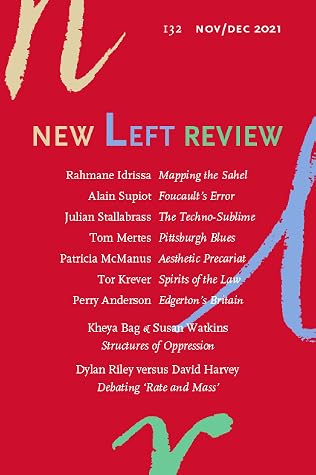
A feature of the Western ‘war on terror’ that seems to come out of fable rather than reality is an inability to see the enemy. In fact, it is an inability to define the enemy. In the Sahel, the French state has settled on ‘Islamist terrorists’, a sequence of adjectives that denote elusive subjects surging out of horizons of pure violence. The inability is compounded by the fact that terrorists must be picked out in terrains unknowable to the West, because the West has long considered them—still considers them—to be outside of history: Afghanistan, a redoubt against empires, those makers of history; the Sahel, a land somewhere in the continent that Hegel banished from history.
just thought this was pretty
From this perspective, a people may be assimilated, as were many western Jews, or absorbed, like German and Italian immigrants to America, or divided—typically by religion—like the Irish, intermingled like the Brazilians, semi-forged from subordinate nations, like Spaniards or British, or newly minted, like Australians and Israelis. ‘Classes’, entailing a division of labour and of property, are shaped by the development of both. They may mutate, like the English landed gentry, or be expropriated, like the Prussian Junkers, rendered redundant, like the Rustbelt industrial proletariat, or brought into being, like China’s Sunbelt working class. One great advantage of the ‘people-class’ concept over that of ‘caste’, then, is that its double lens can capture a historically developing social reality that is both dynamic and uneven; in which the making and unmaking of social identities and economic functions proceed at different speeds, varying within the turbulent, fast-changing political economy of the us as a whole.

[...] one may throw the term out the window, but others will continue to use and disseminate it. The alternative is precisely to regard its vagueness and self-contradictoriness as its defining characteristic. This was the route taken by Pierre-André Taguieff, for whom populism is a political style which ‘can shape diverse symbolic materials and be fixed in a multiplicity of ideological positions, assuming the political colour of its place of reception’. The same line is taken by Yves Surel who, in an essay on Berlusconi, argues that populism does not represent a coherent trend, but corresponds to ‘a dimension of the discursive and normative register adopted by political actors’. Populism, writes Ernesto Laclau, ‘is not a fixed constellation but a series of discursive resources which can be put to very different uses’, ‘floating signifiers’ that convey different meanings in different historical-political conjunctures. The idea that populism works when regarded as a certain kind of rhetoric, applied in different ways in different situations, is appealing—but in truth, merely registers its polysemy and returns it to sender. However, there is a third possible line of attack. It is this: populism is not a self-definition. No one defines themselves as populist; it is an epithet pinned on you by your political enemies. In its most brutal form, ‘populist’ is simply an insult; in a more cultivated form, a term of disparagement. But if no one defines themselves as populist, then the term populism defines those who use it rather than those who are branded with it. As such, it is above all a useful hermeneutic tool for identifying and characterizing those political parties that accuse their opponents of populism.
The central thesis of this study is that systematic use of the term populism is a post-war phenomenon which develops in exact proportion to the disuse of the term ‘the people’: the more peripheral the people in political discourse, the more central populism becomes.
kinda interesting. he does provide evidence for this, though i'm skeptical cus the underlying trend is (obviously) for more papers to be published every decade, and i'm not certain that he takes that into consideration
[...] Today, the choice offered the electorate is no longer that between right and left, but centre-right and centre-left. The distance between the two discourses emerged in the late 1990s when Arthur Schlesinger snapped back at Clinton’s increasing use of the coinage ‘the vital centre’, writing in Slate magazine:
When I wrote the book I named The Vital Centre in 1949, the ‘centre’ I referred to was liberal democracy, as against its mortal international enemies—fascism to the right, communism to the left. I used the phrase in a global context. President Clinton is using the phrase in a domestic context. What does he mean by it? His DLC fans probably hope that he means ‘middle of the road,’ which they would locate somewhere closer to Ronald Reagan than Franklin D. Roosevelt. In my view, as I have said elsewhere, that middle of the road is definitely not the vital centre. It is the dead centre.
Secondly, ‘negative power’—that is, powers of prevention, surveillance and evaluation—has vastly increased. Nadia Urbinati has cited the ‘pervasive power of the market’ as perhaps the most influential modern negative power, due to ‘its ability to claim the legitimacy to veto political decisions in the name of supposedly neutral and even natural rules’. In recent years, the ‘independent’ central banks and the international financial institutions have significantly extended their exercise of negative power: the IMF, World Bank, WTO and European Central Bank evaluate and interdict national economic policies according to their own ‘expert’ priorities. The assessments of the ratings agencies, which are private entities in law, have a decisive impact on the lives of individual citizens. No Greek, Spaniard or Italian has ever elected the board of directors of Moody’s; yet whether that citizen will receive treatment for a tumour, whether her daughter will be able to go to university, may be determined by their call.