
View all notes
Available query params: commented=1, untagged=1

We were walking down the bare brown slope of Baldwin Hill, a hill where we walked pretty often but whose name we could never remember, so we insisted upon calling it Bernal Heights (the name of another bare brown hill, this one in San Francisco), which made us laugh at our own dottiness. The hill overlooked the gray gutter of the Los Angeles River. I had been trying to write about being young and finding it painfully difficult. I was tormented by the question of identity in a way I never had been before. It confused me, the way reading coming-of-age memoirs often confused me. A problem of narration. Who was telling the story of young Claire? Asking this question made me feel like I was floating in space. I thought about Geoff Dyer’s writing, and the way he often situates himself in the present day before he engages in nostalgia or memory.
“It’s like he’s in a room, writing, and he tells you about the room, and once that’s established, then you go with him wherever he takes you into the past, and you’re willing to go there with him because you know where he’s writing from. It all makes sense because of that.”
The party was in a dozy subdivision. I went to be nice. The hostess was a woman I liked; we were hovering on the doorstep between acquaintanceship and friendship. The party was typical of my safe island: a lot of voluble, smart, still-beautiful women chatting and cackling away; a few softer-spoken bearded men interspersed. I sat quiet—unusual for me—and listened to someone talk about her divorce; there had been a crop of them that year, like rhubarb. My friend Melinda came in, looking glamorous, the way a fresh divorce takes some women. She looked thinner and somehow more big-boobed. She had that crazed gleam in her eye I had come to recognize. Maybe I had it too. She strode up to me and kissed me on the mouth. “Woman!” she said. “You look HOT.” And she kissed me on the mouth again. Avec tongue. She slipped me the sashimi.
cute
The beignet sat leaden in my stomach. I thought, perhaps not entirely illogically, of dinner parties I would not be invited to as a single woman. The expense of a setting up a second household. Changing the batteries in the smoke alarm. The empty bed. All that old business. At the same time, I felt lighter. When I was in Indonesia many years ago a parrot landed on my head. Everyone oohed and aahed and told me how lucky I was, but all I could feel was its weight, surprisingly heavy. Bruce’s words felt like the moment the parrot took off from my head.
“That guy has been writing you. It sort of hurts my feelings.” He paused, figuring out what to say. “People like you, you know, Claire,” he said. “They love you.”
“I know,” I said. Even though I didn’t really believe him.
“It’s okay to have secrets,” he said. “Just be careful.”
I cried a little, in a pro forma sort of way, wondering as the tears leaked out: Did he have secrets? We had been gone from each other so much, traveling alone. I knew it was dangerous, but I also intuited it was the only way for us to be married right now. We were each giving the other a long lead. I was so mired in my own despair it was hard for me to see that Bruce was undergoing something or other as well. We were sort of trundling along, in our separate orbs, next to each other. I didn’t know what to do about it, except hope we were headed in the same general direction. I often had an obscure feeling that I wanted to figure out a different way to be married; it had never before occurred to me that Bruce and I were in the midst of inventing it.
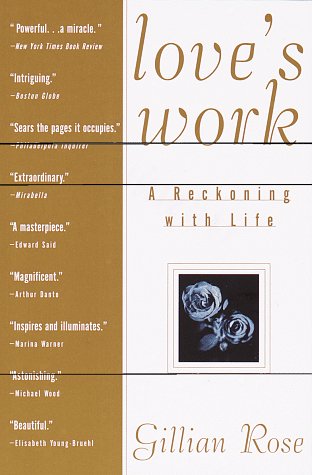
The person who emerges in this brief autobiography is fierce, difficult, vulnerable, and unrelenting in her will to hope and in her devotion to what she calls “the shared cares of the finite world.” When she writes, thinking of Proust (“les vrais paradis sont les paradis qu’on a perdus”), that “the only paradises cannot be those that are lost but those that are unlocked as a result of coercion, reluctance, cajolery and humiliation,” she is saying paradise is not a gift or an effect of grace but the end of a plan of work, and although no one works to get into an inferno, one might need to stay there for some time to perform various necessary labors.
Rose’s epigraph to Love’s Work—“Keep your mind in hell, and despair not”—is taken from the sayings of the Russian monk Staretz Silouan, and is glossed several times within the text. There is, for example, “the unhappiness of one who refuses to dwell in hell, and who lives, therefore, in the most static despair.” There is the moment when Rose describes herself as unhappy in love and refusing all consolation, including “the endlessly inventive love of my sisters.” “Keep your mind in hell and...” she says, without completing the sentence. Alternative healing, with what Rose regards as its fake spirituality, is said to offer a “counsel of despair which would keep the mind out of hell.”
However satisfying writing is—that mix of discipline and miracle, which leaves you in control, even when what appears on the page has emerged from regions beyond your control—it is a very poor substitute indeed for the joy and the agony of loving. Of there being someone who loves and desires you, and he glories in his love and desire, and you glory in his ever-strange being, which comes up against you, and disappears, again and again, surprising you with difficulties and with bounty. To lose this is the greatest loss, a loss for which there is no consolation. There can only be that twin passion—the passion of faith.
:)
[...] On this particular occasion, I was aware of an intense aura emanating from someone whom I had never seen before, an intense, sexual aura, aimed precisely and accurately at my vacant being. “A man,” I wondered, “could there be a man in this meeting?” He looked weather-beaten, his flat, lined faced suffused with a self-consciously alert intelligence and a knowledge of sensual power. I had no idea who he was, and did not pursue the matter.
One lunch hour, as I was hurrying purposelessly across campus, sine ira ac studio, without anger or enthusiasm, the perfect legal-rational bureaucrat according to Max Weber, oblivious to my surroundings, a student importuned me on behalf of someone who stood motionless a few feet away and who required my attention. As we shook hands, Father Dr Patrick Gorman and the man in the meeting merged alarmingly into the same person.
Does “love at first sight” mean that you fall in love the instant you meet someone, or does the first sight occur when you suddenly fall in love with someone you may have met or known for any amount of time?
this is amazing
Time and time again that evening, it was I who encountered the limits of my prejudices and inhibitions, not he. Champagne was the only drink, and the food was an initiation into sensual rites in which I had not until then participated—oysters, turbot, lemon soufflé. Patrick converted me before the evening was over to a serious interest in Latin American Liberation Theology, an amalgam of Marxism and the Bible, which proved a most uneven body of literature. More significantly, he introduced me to its philosophical roots in the earlier transcendental Thomism of Rahner and Lonergan. In return, I persuaded him to deepen his Marxism by reassessing its relation to the works of Hegel; and, predictably, I introduced him to Rilke’s Sonnets to Orpheus.
<3
Love-making is never simply pleasure. Sex manuals or feminist tracts which imply the infinite plasticity of position and pleasure, which counsel assertiveness, whether in bed or out, are dangerously destructive of imagination, of erotic and of spiritual ingenuity. The sexual exchange will be as complicated as the relationship in general—even more so. Kiss, caress and penetration are the relation of the relation, body and soul in touch, two times two adds up: three times three is the equation. The three I harbour within me—body, soul and paraclete—press against the same triplicity in you. What I want, my overcharged imagination, released inside your body, taken up into mine, with attack and with abandon, succumbs so readily and with more joy than I could claim, to your passion, pudency and climax.