
View all notes
Available query params: commented=1, untagged=1

[...] I kept on pushing at my own limitations and at the limits of science fiction. That is what the practice of an art is, you keep looking for the outside edge. When you find it you make a whole, solid, real, and beautiful thing; anything less is incomplete. [...]
We read books to find out who we are. What other people, real or imaginary, do and think and feel - or have done and thought and felt; or might do and think and feel - is an essential guide to our understanding of what we ourselves are and may become. A person who had never known another human being [...] could not know anything about himself, no matter how long he lived with himself. And a person who had never listened to nor read a tale or myth or parable or story, would remain ignorant of his own emotional and spiritual heights and depths, would not know fully what it is to be human. [...]
[...] the shadow stands on the threshold. We can let it bar the way to the creative depths of the unconscious, or we can let it lead us to them. For the shadow is not simply evil [...] without it, the person is nothing. What is a body that casts no shadow? Nothing, a formlessness, two-dimensional, a comic-strip character. The person who denies his own profound relationship with evil denies his own reality. He cannot do, or make; he can only undo, unmake.
[...] There is no right way to act when you're the hero or heroine of a fairy tale. There is no system of conduct, there are no standards of what a nice prince does and what a good little girl doesn't do. I mean, do good little girls usually push old ladies into baking ovens, and get rewarded for it? [...]
In the fairy tale, though there is no "right" and "wrong", there is a different standard, which is perhaps best called "appropriateness." [...] under the conditions of fairy tale, in the language of the archetypes, we can say with perfect conviction that it may be appropriate to do so. Because, in those terms, the witch is not an old lady, nor is Gretel a little girl. Both are psychic factors, elements of the complex soul. Gretel is the archaic child-soul, innocent, defenseless; the witch is the archaic crone, the possessor and destroyer, the mother who feeds you cookies and who must be destroyed before she eats you like a cookie, so that you can grow up and be a mother too. [...]
[...] Nothing is more personal, more unshareable, than pain; the worst thing about suffering is that you suffer alone. Yet those who have not suffered, or will not admit that they suffer, are those who are cut off in cold isolation from their fellow men. Pain, the loneliest experience, gives rise to sympathy, to love: the bridge between self and other, the means of communion. So with art. The artist who goes into himself most deeply - and it is a painful journey - is the artist who touches us most closely, speaks to us most clearly.
[...] It's one thing to sacrifice fulfilment in the service of an ideal; it's another to suppress clear thinking and honest feeling in the service of an ideology. An ideology is valuable only insofar as it is used to intensify clarity and honesty of thought and feeling.
[...] I am not predicting, or prescribing. I am describing. I am describing certain aspects of psychological reality in the novelist's way, which is by inventing elaborately circumstantial lies.
In reading a novel, any novel, we have to know perfectly well that the whole thing is nonsense, and then, while reading, believe every word of it. Finally, when we're done with it, we may find - if it's a good novel - that we're a bit different from what we were before we read it, that we have been changed a little, as if by having met a new face, crossed a street we never crossed before. But it's very hard to say just what we learned, how we were changed.
The artist deals with what cannot be said in words.
The artist whose medium is fiction does this in words. The novelist says in words what cannot be said in words.
[...] The future, in fiction, is a metaphor.
A metaphor for what?
If I could have said it nonmetaphorically, I would not have written all these words, this novel; [...]
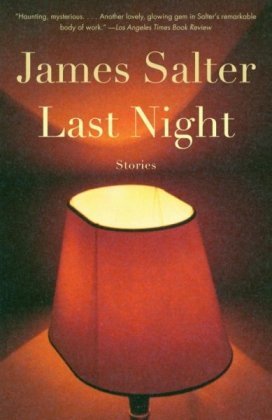
— To the end of privacy and the life of dignity, he said. He was with a dampened woman who had recently found out that her husband had been having an affair with a black woman in Cleveland, an affair that had somehow been going on for seven years. There may even have been a child.
— You can see why coming here is like a breath of fresh air for me, she said.
The women were sympathetic. They knew what she had to do—she had to rethink completely the past seven years.
— That’s right, her companion agreed.
— What is there to be rethought? Phil wanted to know. He was answered with impatience. The deception, they said, the deception—she had been deceived all that time. Adele meanwhile was pouring more wine for herself. Her napkin covered the place where she had already spilled a glass of it.
— But that time was spent in happiness, wasn’t it? Phil asked guilelessly. That’s been lived. It can’t be changed. It can’t be just turned into unhappiness.
— That woman stole my husband. She stole everything he had vowed.
— Forgive me, Phil said softly. That happens every day. There was an outcry as if from a chorus, heads thrust forward like the hissing, sacred geese. Only Adele sat silent.
— I didn’t leave them. Anyway it was over between us. It had been for more than a year. He said it evenly, almost as if it had happened to someone else. It was my son’s tutor, he explained. I fell in love with her.
— And you began something with her? Morrissey suggested.
— Oh, yes.
There is love when you lose the power to speak, when you cannot even breathe.
— Within two or three days, he confessed.
— There in the house?
Phil shook his head. He had a strange, helpless feeling. He was abandoning himself.
— I didn’t do anything in the house.
— He left his wife and children, Adele repeated.
— You knew that, Phil said.
— Just walked out on them. They’d been married fifteen years, since he was nineteen.
— We hadn’t been married fifteen years.
— They had three children, she said, one of them retarded.
Something had happened—he was becoming speechless, he could feel it in his chest like a kind of nausea. As if he were giving up portions of an intimate past.
— He wasn’t retarded, he managed to say. He was . . . having trouble learning to read, that’s all.
ooof
None of them could know, none of them could visualize Mexico City and the first unbelievable year, driving down to the coast for the weekend, through Cuernavaca, her bare legs with the sun lying on them, her arms, the dizziness and submission he felt with her as before a forbidden photograph, as if before an overwhelming work of art. Two years in Mexico City oblivious to the wreckage. It was the sense of godliness that empowered him. He could see her neck bent forward with its slender nape. He could see the faint trace of bones like pearls that ran down her smooth back. He could see himself, his former self.
— I talk to her, he admitted.
— And your first wife?
— I talk to her. We have three kids.
— He left her, Adele said. Casanova here.
— Some women have minds like cops, Phil said to no one in particular. This is right, that’s wrong. Well, anyway . . .
He stood up. He had done everything wrong, he realized, in the wrong order. He had scuttled his life.
— Anyway there’s one thing I can say truthfully. I’d do it all over again if I had the chance.