
by
n+1
(editor)
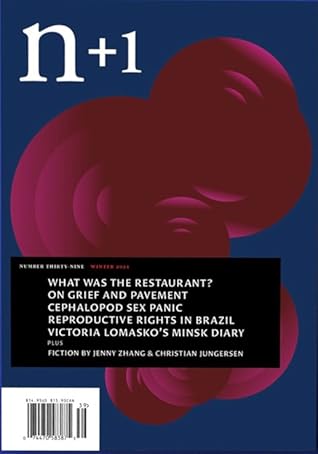
n+1 Issue 39: Take Care
n+1 Issue 39: Take Care
by
n+1
(editor)
by
n+1
(editor)
n+1 Issue 39: Take Care
by
n+1
(editor)
by
n+1
(editor)
All this in search of pleasure and escape! Instead of delivering shelter from the storm of too-late-stage capitalism, the anonymizing maw of the delivery apps brought the storm home. Rather than bringing us together—the restaurant’s nominal function—the delivery economy encouraged us to move further apart and eat in isolation, undisturbed by human contact, weakening whatever measly bonds of social solidarity had survived the post-Reagan apocalypse. Eating during these years became less an exercise in replenishment than erosion, a relentless food-lubricated bruxism mirroring the grinding deterioration of old social certainties. The “mechanics of movement has invaded a wide swathe of human experience,” Richard Sennett once wrote. “Ease, comfort, ‘user-friendliness’ in human relations come to appear as guarantees of individual freedom of action. However, resistance is a fundamental and necessary experience for the human body: through feeling resistance, the body is roused to take note of the world in which it lives.” Seamlessness, the freedom from resistance that was at the core of the new gastronomic escapism, was not the coping mechanism against the depredations of the economy that many of us—thumbing for the delivery app in end-of-day debility—may have imagined it to be. It was only ever a strategy of avoidance and delay. Hovering over all this was the elemental question: Who gets to eat? Or rather, whose eating deserves to be witnessed, chronicled, elevated, and celebrated? The answer: The eating of the famous and the rich. The pre-Covid restaurant gave us David Chang, who once filmed an entire documentary series whose sole premise was that celebrities eat. The rest of us were exactly where the masters of the competition economy wanted us: in their miserly employ, or if we were lucky, gorging on takeout at home, left to fend for ourselves, alone and unseen.