
by
n+1
(editor)
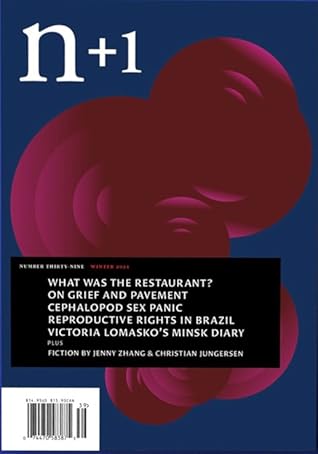
n+1 Issue 39: Take Care
n+1 Issue 39: Take Care
by
n+1
(editor)
by
n+1
(editor)
n+1 Issue 39: Take Care
by
n+1
(editor)
by
n+1
(editor)
199
REVIEWS:
On restaurants
by Aaron Timms
(missing author)
by Aaron Timms
(missing author)
0
terms
3
notes
202
When I eventually made it there a few years later, Carbone was exactly as advertised: an exercise in pure kitsch, a kind of theater restaurant offering the food, decor, and waiterly patter of an Italian American dining hall of the 1960s, only at many times the price and with none of the neighborly bonhomie. The restaurant existed as a riff on the Cockaignian theme of abundance: a long, leather-bound menu, carts carrying cocktails and condiments, shrimp and lobster and steak done “as you like it.” But it was all for show; transformed into culinary cabaret, these “moves” illustrated only the chasm between a true society of abundance and the reality of an American economy tailored to the whims of the rich. “What can I get for youse?” the waiter asked after my dining companion and I were seated, and for the two rote and underwhelming hours that followed it remained difficult to detect the line between reality and simulacrum. Was this guy really a crotchety Italian American wiseass, or just playing one? There was something joyless and cynical about Carbone’s evocation of the American restaurant’s—and by extension, America’s—bountiful history. Here stood a restaurant with the self-confidence to treat its patrons like idiots. Here was all the richness of the Land of Cockaigne, but only for those who could afford it. Here was America as a land of plenty, whose best and most generous days were firmly in the past.
When I eventually made it there a few years later, Carbone was exactly as advertised: an exercise in pure kitsch, a kind of theater restaurant offering the food, decor, and waiterly patter of an Italian American dining hall of the 1960s, only at many times the price and with none of the neighborly bonhomie. The restaurant existed as a riff on the Cockaignian theme of abundance: a long, leather-bound menu, carts carrying cocktails and condiments, shrimp and lobster and steak done “as you like it.” But it was all for show; transformed into culinary cabaret, these “moves” illustrated only the chasm between a true society of abundance and the reality of an American economy tailored to the whims of the rich. “What can I get for youse?” the waiter asked after my dining companion and I were seated, and for the two rote and underwhelming hours that followed it remained difficult to detect the line between reality and simulacrum. Was this guy really a crotchety Italian American wiseass, or just playing one? There was something joyless and cynical about Carbone’s evocation of the American restaurant’s—and by extension, America’s—bountiful history. Here stood a restaurant with the self-confidence to treat its patrons like idiots. Here was all the richness of the Land of Cockaigne, but only for those who could afford it. Here was America as a land of plenty, whose best and most generous days were firmly in the past.
209
All this in search of pleasure and escape! Instead of delivering shelter from the storm of too-late-stage capitalism, the anonymizing maw of the delivery apps brought the storm home. Rather than bringing us together—the restaurant’s nominal function—the delivery economy encouraged us to move further apart and eat in isolation, undisturbed by human contact, weakening whatever measly bonds of social solidarity had survived the post-Reagan apocalypse. Eating during these years became less an exercise in replenishment than erosion, a relentless food-lubricated bruxism mirroring the grinding deterioration of old social certainties. The “mechanics of movement has invaded a wide swathe of human experience,” Richard Sennett once wrote. “Ease, comfort, ‘user-friendliness’ in human relations come to appear as guarantees of individual freedom of action. However, resistance is a fundamental and necessary experience for the human body: through feeling resistance, the body is roused to take note of the world in which it lives.” Seamlessness, the freedom from resistance that was at the core of the new gastronomic escapism, was not the coping mechanism against the depredations of the economy that many of us—thumbing for the delivery app in end-of-day debility—may have imagined it to be. It was only ever a strategy of avoidance and delay. Hovering over all this was the elemental question: Who gets to eat? Or rather, whose eating deserves to be witnessed, chronicled, elevated, and celebrated? The answer: The eating of the famous and the rich. The pre-Covid restaurant gave us David Chang, who once filmed an entire documentary series whose sole premise was that celebrities eat. The rest of us were exactly where the masters of the competition economy wanted us: in their miserly employ, or if we were lucky, gorging on takeout at home, left to fend for ourselves, alone and unseen.
All this in search of pleasure and escape! Instead of delivering shelter from the storm of too-late-stage capitalism, the anonymizing maw of the delivery apps brought the storm home. Rather than bringing us together—the restaurant’s nominal function—the delivery economy encouraged us to move further apart and eat in isolation, undisturbed by human contact, weakening whatever measly bonds of social solidarity had survived the post-Reagan apocalypse. Eating during these years became less an exercise in replenishment than erosion, a relentless food-lubricated bruxism mirroring the grinding deterioration of old social certainties. The “mechanics of movement has invaded a wide swathe of human experience,” Richard Sennett once wrote. “Ease, comfort, ‘user-friendliness’ in human relations come to appear as guarantees of individual freedom of action. However, resistance is a fundamental and necessary experience for the human body: through feeling resistance, the body is roused to take note of the world in which it lives.” Seamlessness, the freedom from resistance that was at the core of the new gastronomic escapism, was not the coping mechanism against the depredations of the economy that many of us—thumbing for the delivery app in end-of-day debility—may have imagined it to be. It was only ever a strategy of avoidance and delay. Hovering over all this was the elemental question: Who gets to eat? Or rather, whose eating deserves to be witnessed, chronicled, elevated, and celebrated? The answer: The eating of the famous and the rich. The pre-Covid restaurant gave us David Chang, who once filmed an entire documentary series whose sole premise was that celebrities eat. The rest of us were exactly where the masters of the competition economy wanted us: in their miserly employ, or if we were lucky, gorging on takeout at home, left to fend for ourselves, alone and unseen.
211
Of course, people will still need to eat, they will not always want to cook for themselves, and the restaurant will survive. But in what form? As the pre-Covid restaurant became, like many other social institutions, a tool for economic dominion, resistance was gathering. The food-security and food-justice movements gained strength, amid a broader resurgence of the left, pointing the way to another path for the restaurant once the pandemic passes. During these long, strange months of the city’s somnambulism, one of the few joys, for me at least, has come from helping out as an occasional line cook at various pop-ups run out of semi-resuscitated bars and restaurants around Brooklyn, Manhattan, and Queens. What these exercises in culinary improvisation have taught me is that food still has the power to knit communities together, but only if the institutions delivering it have a stake in the local outcome—if the aid between restaurants and the people they host really is mutual, anchored in a hospitality whose highest calling is always the duty of reciprocity. As Rebecca L. Spang has shown, the earliest restaurants fulfilled something like this function: during the French Revolution, restaurants emerged as sites for the fraternal suppers and people’s banquets that helped establish, however briefly, the egalitarian ideals of the new republic. Restaurants became, during these years, venues at which the people could figure out how they wanted to rule themselves, the kind of society they wished to live in. Questions of collective subsistence and collective government were coterminous.
Today the opposite is true: the restaurant is a depoliticized realm of pure pleasure-seeking, a refuge rather than a front line. With the coronavirus raging uncontrolled across the country, the New York Times chose as the subject of its first pandemic-era restaurant review . . . a wildly popular New American bistro in gentrified brownstone Brooklyn serving food around the back-to-childhood theme of “summer camp.” The lure of infantilizing nostalgia remains strong. Plainly, repoliticizing the restaurant—restoring its place at the center of local public life, engaged with questions of common welfare and material redistribution—will not be easy, requiring courage, imagination, solidarity, and generosity at all levels of the hospitality industry, from chefs and owners to journalists and diners. But for many restaurants, recovering a lost political vocation—along with the exigencies of resistance, discovery, and human contact that are critical to the act of feeding people—might be the only hope for life after the virus. The future is seamful.
:)
Of course, people will still need to eat, they will not always want to cook for themselves, and the restaurant will survive. But in what form? As the pre-Covid restaurant became, like many other social institutions, a tool for economic dominion, resistance was gathering. The food-security and food-justice movements gained strength, amid a broader resurgence of the left, pointing the way to another path for the restaurant once the pandemic passes. During these long, strange months of the city’s somnambulism, one of the few joys, for me at least, has come from helping out as an occasional line cook at various pop-ups run out of semi-resuscitated bars and restaurants around Brooklyn, Manhattan, and Queens. What these exercises in culinary improvisation have taught me is that food still has the power to knit communities together, but only if the institutions delivering it have a stake in the local outcome—if the aid between restaurants and the people they host really is mutual, anchored in a hospitality whose highest calling is always the duty of reciprocity. As Rebecca L. Spang has shown, the earliest restaurants fulfilled something like this function: during the French Revolution, restaurants emerged as sites for the fraternal suppers and people’s banquets that helped establish, however briefly, the egalitarian ideals of the new republic. Restaurants became, during these years, venues at which the people could figure out how they wanted to rule themselves, the kind of society they wished to live in. Questions of collective subsistence and collective government were coterminous.
Today the opposite is true: the restaurant is a depoliticized realm of pure pleasure-seeking, a refuge rather than a front line. With the coronavirus raging uncontrolled across the country, the New York Times chose as the subject of its first pandemic-era restaurant review . . . a wildly popular New American bistro in gentrified brownstone Brooklyn serving food around the back-to-childhood theme of “summer camp.” The lure of infantilizing nostalgia remains strong. Plainly, repoliticizing the restaurant—restoring its place at the center of local public life, engaged with questions of common welfare and material redistribution—will not be easy, requiring courage, imagination, solidarity, and generosity at all levels of the hospitality industry, from chefs and owners to journalists and diners. But for many restaurants, recovering a lost political vocation—along with the exigencies of resistance, discovery, and human contact that are critical to the act of feeding people—might be the only hope for life after the virus. The future is seamful.
:)