
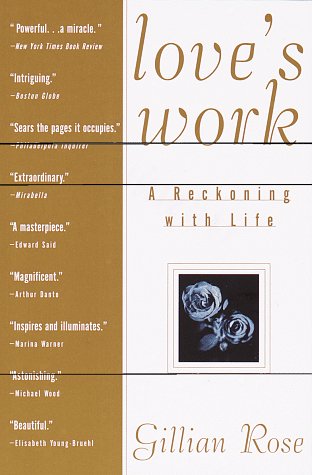
by
Gillian Rose
xii
The person who emerges in this brief autobiography is fierce, difficult, vulnerable, and unrelenting in her will to hope and in her devotion to what she calls “the shared cares of the finite world.” When she writes, thinking of Proust (“les vrais paradis sont les paradis qu’on a perdus”), that “the only paradises cannot be those that are lost but those that are unlocked as a result of coercion, reluctance, cajolery and humiliation,” she is saying paradise is not a gift or an effect of grace but the end of a plan of work, and although no one works to get into an inferno, one might need to stay there for some time to perform various necessary labors.
The person who emerges in this brief autobiography is fierce, difficult, vulnerable, and unrelenting in her will to hope and in her devotion to what she calls “the shared cares of the finite world.” When she writes, thinking of Proust (“les vrais paradis sont les paradis qu’on a perdus”), that “the only paradises cannot be those that are lost but those that are unlocked as a result of coercion, reluctance, cajolery and humiliation,” she is saying paradise is not a gift or an effect of grace but the end of a plan of work, and although no one works to get into an inferno, one might need to stay there for some time to perform various necessary labors.
xiii
Rose’s epigraph to Love’s Work—“Keep your mind in hell, and despair not”—is taken from the sayings of the Russian monk Staretz Silouan, and is glossed several times within the text. There is, for example, “the unhappiness of one who refuses to dwell in hell, and who lives, therefore, in the most static despair.” There is the moment when Rose describes herself as unhappy in love and refusing all consolation, including “the endlessly inventive love of my sisters.” “Keep your mind in hell and...” she says, without completing the sentence. Alternative healing, with what Rose regards as its fake spirituality, is said to offer a “counsel of despair which would keep the mind out of hell.”
Rose’s epigraph to Love’s Work—“Keep your mind in hell, and despair not”—is taken from the sayings of the Russian monk Staretz Silouan, and is glossed several times within the text. There is, for example, “the unhappiness of one who refuses to dwell in hell, and who lives, therefore, in the most static despair.” There is the moment when Rose describes herself as unhappy in love and refusing all consolation, including “the endlessly inventive love of my sisters.” “Keep your mind in hell and...” she says, without completing the sentence. Alternative healing, with what Rose regards as its fake spirituality, is said to offer a “counsel of despair which would keep the mind out of hell.”
59
However satisfying writing is—that mix of discipline and miracle, which leaves you in control, even when what appears on the page has emerged from regions beyond your control—it is a very poor substitute indeed for the joy and the agony of loving. Of there being someone who loves and desires you, and he glories in his love and desire, and you glory in his ever-strange being, which comes up against you, and disappears, again and again, surprising you with difficulties and with bounty. To lose this is the greatest loss, a loss for which there is no consolation. There can only be that twin passion—the passion of faith.
:)
However satisfying writing is—that mix of discipline and miracle, which leaves you in control, even when what appears on the page has emerged from regions beyond your control—it is a very poor substitute indeed for the joy and the agony of loving. Of there being someone who loves and desires you, and he glories in his love and desire, and you glory in his ever-strange being, which comes up against you, and disappears, again and again, surprising you with difficulties and with bounty. To lose this is the greatest loss, a loss for which there is no consolation. There can only be that twin passion—the passion of faith.
:)
65
[...] On this particular occasion, I was aware of an intense aura emanating from someone whom I had never seen before, an intense, sexual aura, aimed precisely and accurately at my vacant being. “A man,” I wondered, “could there be a man in this meeting?” He looked weather-beaten, his flat, lined faced suffused with a self-consciously alert intelligence and a knowledge of sensual power. I had no idea who he was, and did not pursue the matter.
One lunch hour, as I was hurrying purposelessly across campus, sine ira ac studio, without anger or enthusiasm, the perfect legal-rational bureaucrat according to Max Weber, oblivious to my surroundings, a student importuned me on behalf of someone who stood motionless a few feet away and who required my attention. As we shook hands, Father Dr Patrick Gorman and the man in the meeting merged alarmingly into the same person.
Does “love at first sight” mean that you fall in love the instant you meet someone, or does the first sight occur when you suddenly fall in love with someone you may have met or known for any amount of time?
this is amazing
[...] On this particular occasion, I was aware of an intense aura emanating from someone whom I had never seen before, an intense, sexual aura, aimed precisely and accurately at my vacant being. “A man,” I wondered, “could there be a man in this meeting?” He looked weather-beaten, his flat, lined faced suffused with a self-consciously alert intelligence and a knowledge of sensual power. I had no idea who he was, and did not pursue the matter.
One lunch hour, as I was hurrying purposelessly across campus, sine ira ac studio, without anger or enthusiasm, the perfect legal-rational bureaucrat according to Max Weber, oblivious to my surroundings, a student importuned me on behalf of someone who stood motionless a few feet away and who required my attention. As we shook hands, Father Dr Patrick Gorman and the man in the meeting merged alarmingly into the same person.
Does “love at first sight” mean that you fall in love the instant you meet someone, or does the first sight occur when you suddenly fall in love with someone you may have met or known for any amount of time?
this is amazing
66
Time and time again that evening, it was I who encountered the limits of my prejudices and inhibitions, not he. Champagne was the only drink, and the food was an initiation into sensual rites in which I had not until then participated—oysters, turbot, lemon soufflé. Patrick converted me before the evening was over to a serious interest in Latin American Liberation Theology, an amalgam of Marxism and the Bible, which proved a most uneven body of literature. More significantly, he introduced me to its philosophical roots in the earlier transcendental Thomism of Rahner and Lonergan. In return, I persuaded him to deepen his Marxism by reassessing its relation to the works of Hegel; and, predictably, I introduced him to Rilke’s Sonnets to Orpheus.
<3
Time and time again that evening, it was I who encountered the limits of my prejudices and inhibitions, not he. Champagne was the only drink, and the food was an initiation into sensual rites in which I had not until then participated—oysters, turbot, lemon soufflé. Patrick converted me before the evening was over to a serious interest in Latin American Liberation Theology, an amalgam of Marxism and the Bible, which proved a most uneven body of literature. More significantly, he introduced me to its philosophical roots in the earlier transcendental Thomism of Rahner and Lonergan. In return, I persuaded him to deepen his Marxism by reassessing its relation to the works of Hegel; and, predictably, I introduced him to Rilke’s Sonnets to Orpheus.
<3
69
Love-making is never simply pleasure. Sex manuals or feminist tracts which imply the infinite plasticity of position and pleasure, which counsel assertiveness, whether in bed or out, are dangerously destructive of imagination, of erotic and of spiritual ingenuity. The sexual exchange will be as complicated as the relationship in general—even more so. Kiss, caress and penetration are the relation of the relation, body and soul in touch, two times two adds up: three times three is the equation. The three I harbour within me—body, soul and paraclete—press against the same triplicity in you. What I want, my overcharged imagination, released inside your body, taken up into mine, with attack and with abandon, succumbs so readily and with more joy than I could claim, to your passion, pudency and climax.
Love-making is never simply pleasure. Sex manuals or feminist tracts which imply the infinite plasticity of position and pleasure, which counsel assertiveness, whether in bed or out, are dangerously destructive of imagination, of erotic and of spiritual ingenuity. The sexual exchange will be as complicated as the relationship in general—even more so. Kiss, caress and penetration are the relation of the relation, body and soul in touch, two times two adds up: three times three is the equation. The three I harbour within me—body, soul and paraclete—press against the same triplicity in you. What I want, my overcharged imagination, released inside your body, taken up into mine, with attack and with abandon, succumbs so readily and with more joy than I could claim, to your passion, pudency and climax.
100
Enter Mr Bates. Mr Bates is the bowel specialist who operates with Mr Wong in cases of ovarian cancer, the pattern of whose metastases typically involves the bowel. A former Rhodesian, Mr Bates is large, alternately bluff and jovial; he belongs to a Scottish malt whisky fraternity. I first met him when I found myself in intensive care after the first operation. An unknown man, dressed in brightly coloured sports clothes (it was a Sunday), was bouncing up and down beside my cot. He enquired breezily, “How are you, young lady?” Through the haze of pain, I replied with outrage, “How dare you call me ‘young lady,‘” and demanded that the intruder introduce himself. This act of gross impropriety on my part in the mode of address, or rather, return of address, to a very senior consultant surgeon, who, moreover, like Mr Wong and the anaesthetist, was treating me gratis in a private hospital, enhanced my kudos in Mr Wong’s eyes, and he took every opportunity to remind me of this picaresque solecism. Mr Bates and I became wary sparring partners. I always greeted him with the appellation “Young Man,” and I presented him with unwanted volumes of Marx so that he might correct the vulgarity of his right-wing misapprehensions of the socialist theory of politics and society.
cute
Enter Mr Bates. Mr Bates is the bowel specialist who operates with Mr Wong in cases of ovarian cancer, the pattern of whose metastases typically involves the bowel. A former Rhodesian, Mr Bates is large, alternately bluff and jovial; he belongs to a Scottish malt whisky fraternity. I first met him when I found myself in intensive care after the first operation. An unknown man, dressed in brightly coloured sports clothes (it was a Sunday), was bouncing up and down beside my cot. He enquired breezily, “How are you, young lady?” Through the haze of pain, I replied with outrage, “How dare you call me ‘young lady,‘” and demanded that the intruder introduce himself. This act of gross impropriety on my part in the mode of address, or rather, return of address, to a very senior consultant surgeon, who, moreover, like Mr Wong and the anaesthetist, was treating me gratis in a private hospital, enhanced my kudos in Mr Wong’s eyes, and he took every opportunity to remind me of this picaresque solecism. Mr Bates and I became wary sparring partners. I always greeted him with the appellation “Young Man,” and I presented him with unwanted volumes of Marx so that he might correct the vulgarity of his right-wing misapprehensions of the socialist theory of politics and society.
cute
105
This is the counsel of despair which would keep the mind out of hell. The tradition is far kinder in its understanding that to live, to love, is to be failed, to forgive, to have failed, to be forgiven, for ever and ever. Keep your mind in hell, and despair not.
A crisis of illness, bereavement, separation, natural disaster, could be the opportunity to make contact with deeper levels of the errors of the soul, to loose and to bind, to bind and to loose. A soul which is not bound is as mad as one with cemented boundaries. To grow in love-ability is to accept the boundaries of oneself and others, which remaining vulnerable, woundable, around the bounds. Acknowledgement of conditionality is the only unconditionality of human love.
Exceptional, edgeless love effaces the risk of relation: that mix of exposure and reserve, of revelation and reticence. It commands the complete unveiling of the eyes, the transparency of the body. It denies that there is no love without power; that we are at the mercy of others and that we have others in our mercy. Existence is robbed of its weight, its gravity, when it is deprived of its agon. Instead of insinuating that illness may better prepare you for the earthly impossibilities, these enchiridions on Faith, Hope and Love would condemn you to seek blissful, deathless, cosmic emptiness—the repose without the revel.
This is the counsel of despair which would keep the mind out of hell. The tradition is far kinder in its understanding that to live, to love, is to be failed, to forgive, to have failed, to be forgiven, for ever and ever. Keep your mind in hell, and despair not.
A crisis of illness, bereavement, separation, natural disaster, could be the opportunity to make contact with deeper levels of the errors of the soul, to loose and to bind, to bind and to loose. A soul which is not bound is as mad as one with cemented boundaries. To grow in love-ability is to accept the boundaries of oneself and others, which remaining vulnerable, woundable, around the bounds. Acknowledgement of conditionality is the only unconditionality of human love.
Exceptional, edgeless love effaces the risk of relation: that mix of exposure and reserve, of revelation and reticence. It commands the complete unveiling of the eyes, the transparency of the body. It denies that there is no love without power; that we are at the mercy of others and that we have others in our mercy. Existence is robbed of its weight, its gravity, when it is deprived of its agon. Instead of insinuating that illness may better prepare you for the earthly impossibilities, these enchiridions on Faith, Hope and Love would condemn you to seek blissful, deathless, cosmic emptiness—the repose without the revel.
109
I first met Jim in New York in August 1970. I had been in New York for three days. He invited me to go to a concert with him in Central Park to hear Alicia de Larrocha play Liszt and Ravel. It was a dramatic pause in my first few days of furious tourism.
The skyscrapers of the city rise in mammoth terraces all around the steaming, wide open ground. The tiny hand-span of the lady playing the grand piano in the park belies the immensity of the sound which, beyond nature and technē, soars into the empyrean. In the intervals, Jim tells me about his work on Nietzsche’s The Birth of Tragedy out of the Spirit of Music. I feel the stirrings again of my original passion for philosophy, which three years at Oxford have almost completely expunged. Instead of staying in New York for the three weeks planned, I decide to stay for a year.
It was my Lehrjahr, my real apprenticeship, after the borniert complacencies of my undergraduate education. What did I discover in that year? Jim, continental philosophy (Kant, Hegel, Nietzsche, Husserl, Heidegger), the Second Vienna School (Schoenberg, Webern, Berg), Abstract Expressionism (Clyfford Still, Mark Rothko, Barnett Newman, Morris Louis), cooking (out of Craig Claiborne and Alice B. Toklas), hashish, LSD, popular music (Grateful Dead, Bob Dylan, Rolling Stones—yes, in New York!), homosexuality, Jim, Häagen-Dazs ice-cream, the German language, Harlem (where I taught black teenage delinquents to read, two afternoons a week), Adorno, Jim.
ahhhh
I first met Jim in New York in August 1970. I had been in New York for three days. He invited me to go to a concert with him in Central Park to hear Alicia de Larrocha play Liszt and Ravel. It was a dramatic pause in my first few days of furious tourism.
The skyscrapers of the city rise in mammoth terraces all around the steaming, wide open ground. The tiny hand-span of the lady playing the grand piano in the park belies the immensity of the sound which, beyond nature and technē, soars into the empyrean. In the intervals, Jim tells me about his work on Nietzsche’s The Birth of Tragedy out of the Spirit of Music. I feel the stirrings again of my original passion for philosophy, which three years at Oxford have almost completely expunged. Instead of staying in New York for the three weeks planned, I decide to stay for a year.
It was my Lehrjahr, my real apprenticeship, after the borniert complacencies of my undergraduate education. What did I discover in that year? Jim, continental philosophy (Kant, Hegel, Nietzsche, Husserl, Heidegger), the Second Vienna School (Schoenberg, Webern, Berg), Abstract Expressionism (Clyfford Still, Mark Rothko, Barnett Newman, Morris Louis), cooking (out of Craig Claiborne and Alice B. Toklas), hashish, LSD, popular music (Grateful Dead, Bob Dylan, Rolling Stones—yes, in New York!), homosexuality, Jim, Häagen-Dazs ice-cream, the German language, Harlem (where I taught black teenage delinquents to read, two afternoons a week), Adorno, Jim.
ahhhh
111
Everything about Jim was in huge proportions: over six foot three, he was lean and lanky, with a luxuriant mantle of shining jet hair cast carelessly over his elongated back, and a leopard walk, his limbs curving forward like a giant, caged cat. Jim had the most majestic hands; to say they were the hands of a keyboard player would understate their magnitude and grace. They were hands from the workshop of Henry Moore, with immense, broad, flat fingers, languid under their intelligent weight. At the piano, these organs were possessed, animated by the contortions of Scriabin’s music, in the disciplined expression of an emotional range which no other medium afforded him.
Not philosophy, and this was Jim’s tragedy. He found no way—not even Nietzsche’s example—of bringing his inner emotional turmoil into his philosophy, his discipline, his art. Philosophy remained cleverness, a game, but not a stage on life’s way; it remained aesthetic without an oeuvre, as did everything and everyone else for him.
Everything about Jim was in huge proportions: over six foot three, he was lean and lanky, with a luxuriant mantle of shining jet hair cast carelessly over his elongated back, and a leopard walk, his limbs curving forward like a giant, caged cat. Jim had the most majestic hands; to say they were the hands of a keyboard player would understate their magnitude and grace. They were hands from the workshop of Henry Moore, with immense, broad, flat fingers, languid under their intelligent weight. At the piano, these organs were possessed, animated by the contortions of Scriabin’s music, in the disciplined expression of an emotional range which no other medium afforded him.
Not philosophy, and this was Jim’s tragedy. He found no way—not even Nietzsche’s example—of bringing his inner emotional turmoil into his philosophy, his discipline, his art. Philosophy remained cleverness, a game, but not a stage on life’s way; it remained aesthetic without an oeuvre, as did everything and everyone else for him.