
Bookmarker is a personal project by @dellsystem to help with retaining reading material. Source on GitHub.

Activity

You added a note
2 months, 3 weeks ago
the FBI did a much better job

Observers then and later have disagreed regarding the degree to which the CP succeeded in its ambition to be a tightly disciplined organization. Even membership could be ambiguous. Caroline Decker recalled, “I never carried a book, I never paid dues. . . . As far as I was concerned, I was a member;…

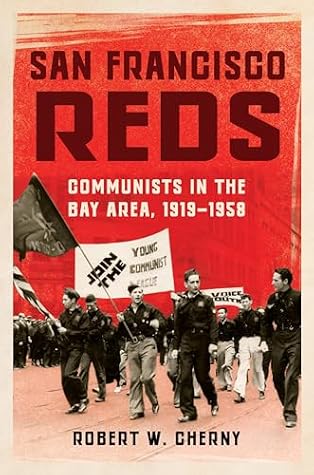
—p.114 San Francisco Reds: Communists in the Bay Area, 1919-1958 Life in the Party in the 1930s (89) by Robert W. Cherny
You added a note
2 months, 3 weeks ago

concluding that she should be a member of the working class

Arnstein graduated in 1935 and then continued for another three semesters, including some time in the law school. In 1936, while in law school, she became section organizer for the party’s professional section. She later recalled “everything was so secretive” that she didn’t even know who was in th…

—p.113 Life in the Party in the 1930s (89) by Robert W. Cherny
You edited a note
2 months, 3 weeks ago

Angela Gizzi’s experience

For Brown and Yoneda, party membership led them into union activity. Angela Gizzi’s experience provides a different pattern. Her interest in the left led her to union activism and then to the CP. She was born in San Francisco’s North Beach, an Italian neighborhood. Her parents were middle-class Ita…

—p.92 Life in the Party in the 1930s (89) by Robert W. Cherny
You added a note
2 months, 3 weeks ago

Angela Gizzi’s experience

For Brown and Yoneda, party membership led them into union activity. Angela Gizzi’s experience provides a different pattern. Her interest in the left led her to union activism and then to the CP. She was born in San Francisco’s North Beach, an Italian neighborhood. Her parents were middle-class Ita…

—p.92 Life in the Party in the 1930s (89) by Robert W. Cherny
You added a note
2 months, 3 weeks ago

party members formed “fractions”

In the early 1930s, party members formed “fractions” within union locals, which typically met before union meetings and formulated a position that CP members were to follow when the meeting started. However, as Dorothy Ray Healey later recalled, “Some of our closest allies were unhappy about it,” a…

—p.90 Life in the Party in the 1930s (89) by Robert W. Cherny