
topic/the-passage-of-time
Simone de Beauvoir,
Mark Doty,
Martin Amis,
Miranda July,
Jenny Erpenbeck,
Jennifer Egan,
Lorrie Moore,
James Salter,
Nicholas Dames
Paula came down the stairs with soft, silken steps. 'You uncorked all the bottles!' she exclaimed. 'That was sweet of you.'
'You're so positively dedicated to violet!' he said, smiling.
'But you adore violet!' she said.
He had been adoring violet for the past ten years; ten years was a long time.
'You don't like this dress?' Paula asked.
'Yes, of course,' he said hastily. 'It's very pretty. I just thought that there were some other colours which might become you. Green, for example,' he ventured, picking the first colour that came to mind.
She looked at herself in one of the mirrors. 'Green?' she said, and there was bewilderment in her voice. 'You really think I'd look well in green?'
It was all so useless, he told himself. In green or yellow he would never again see in her the woman who, that day ten years earlier, he had desired so much when she had nonchalantly held out her long violet gloves to him.
DEVASTATING

What kind of life must that be? Eight hours up and dowp on a train, into the Railway Arms to drink yourself silly, dinner from a frying pan, a terrible hangover and then begin again. Moving from job to job, shedding friends, gathering illnesses. Chester stopped chewing for a moment and let the possibility of desolate and dreary singleness sweep over him like a gust of secondhand smoke. He had always thought that life, his life at least, would end, whatever its meanderings and false starts, in an undefined but surely well-deserved, satisfaction. Now, as he pushed on towards forty, and in the sad half-light of this disheveled steward, it began to occur to him, slowly and embarrassingly late perhaps, that this was not necessarily so. Some mistakes once made were never rectified; some chances missed would never reappear. Looked at from this perspective, life struck Chester suddenly as harsh and inadequately explained, and happiness as a matter not of time but of desperate human effort.
The problem with marriage, we all know, is the endlessness of it. Plenty of things we do will have long-term repercussions, but in what other situation do you promise to do something for the rest of your life? Not when you choose a college. Not when you take a job. Not when you buy a house. During childhood, you pick up many habits that are probably going to be lifelong, like walking, talking, reading, and sleeping, but once you’ve got those down, you start to feel like you’re at greater liberty to decide what things you want to do and what things you want to stop doing. Especially when you’re a young adult the apparently infinite multiplicity of possible choices—possible jobs, possible friends, possible cities, possible girlfriends or boyfriends—can sometimes fool you into thinking you have an infinite amount of time to try out everything. But once you’re married, you’ve significantly cut down the options, and it suddenly makes your life feel shorter—like now there’s a direct line between you and your own death. You’ve just gotten on a train and you won’t get off until the very end of the track. In your final moments, if you stick to your promise, you’ll still be doing the same thing you’re doing now, dealing with the same person, possibly having the same arguments. And that commonality between now and then makes that far-off time, when you’re old and sick and about to die, a little more imaginable. Which is scary.

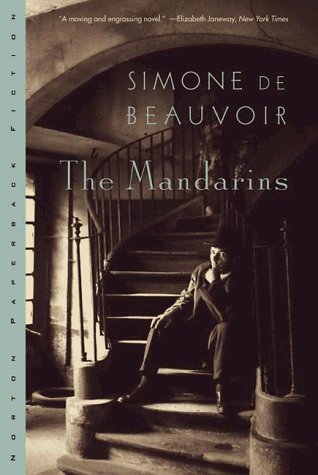
We stopped at the same little hotel we had stayed at twenty years ago, and we had—perhaps on another floor—the same room. I went to bed first, and I watched him, walking to and fro in his blue pajamas, barefooted on the worn carpet. He looked neither cheerful nor sad. And I was blinded by the mental image—an image called up hundreds of times, set, but not worn out, still shining with newness—of Maurice walking barefoot upon this carpet in his black pajamas: he had pulled up the collar and its points framed his face; he talked nonsense, childishly worked up. I realized that I had come here in the hope of once more finding that man so hopelessly in love: I had not seen him for years and years, although this memory lies like a transparency over all the visions I have of him. That evening, for the very reason that the surroundings were the same, the old image, coming into contact with a flesh and blood man smoking a cigarette, fell to dust and ashes. I had a shattering revelation: time goes by. I began to weep. He sat on the edge of the bed and took me tenderly in his arms. “Sweetheart, my sweetheart, don’t cry. What are you crying for?” He stroked my hair; he gave me little fluttering kisses on the side of my head.
I had an inspiration this morning: the whole thing is my fault. My worst mistake has been not grasping that time goes by. It was going by and there I was, set in the attitude of the ideal wife of an ideal husband. Instead of bringing our sexual relationship to life again I brooded happily over memories of our former nights together. I imagined I had kept my thirty-year-old face and body instead of taking care of myself, doing gymnastics and going to a beauty parlor. I let my intelligence wither away: I no longer cultivated my mind—later, I said, when the children have gone. (Perhaps my father’s death was not without bearing on this way of letting things slide. Something snapped. I stopped time from that moment on.) Yes: the young student Maurice married felt passionately about what was happening in the world, about books and ideas; she was very unlike the woman of today, whose world lies between the four walls of this apartment. It is true enough that I tended to shut Maurice in. I thought his home was enough for him: I thought I owned him entirely. Generally speaking I took everything for granted; and that must have irritated him intensely—Maurice who changes and who calls things in question. Being irritating—no one can ever get away with that. I should never have been obstinate about our promise of faithfulness, either. If I had given Maurice back his freedom—and made use of mine, too, perhaps—Noëllie would not have profited by the glamour of clandestinity. I should have coped with the situation at once. Is there still time? I told Marie Lambert that I was going to have it all out with Maurice and take steps to deal with the position. I have already taken to reading again a little and to listening to records: I must make a greater effort. Lose several pounds, dress better. Talk with Maurice more openly, refuse to have silences. She listened to me without enthusiasm. She wanted to know which of us was responsible for my first pregnancy, Maurice or I. Both of us. Or I was, if you like, in that I trusted in the calendar too much; but it was not my fault if it let me down. Had I insisted upon keeping the child? No. Upon not keeping it? No. The thing decided itself. She seemed skeptical. Her idea is that Maurice harbors a serious grudge against me. I countered that with Isabelle’s argument—the beginning of our marriage would not have been so happy if he had not wanted it. Her reply seems to me very far-fetched: so as not to admit his disappointment Maurice staked everything on love—he went all out for happiness, and once his enthusiasm faded he rediscovered the resentment that he had repressed. She herself feels that her argument is weak. His old grievances would not have sprung up again with such strength as to separate him from me if there had been no new ones. I asserted that he had none whatever.
Why? I batter my head against the walls of this blind alley. I have not loved a scoundrel all through these twenty years! I am not, unknown to myself, a fool or a shrew! This love between us was real: it was solid—as indestructible as truth. Only there was time going by and I—I did not know it. The river of time, the erosion caused by the river’s current: there you have it—there has been an erosion of his love by the flow of time. But why not of mine, too, in that case?

Government officials come to the narrator’s workplace to warn his students of various sects operating contrary to Marxist-Leninist doctrine, the most dangerous of which is the mysterious Picketists, whose secret sign is an extended hand with an insect in its palm. Through Caty, one of his fellow teachers and a Picketist convert, he learns of their nighttime meetings, where they dress in black and march on local hospitals, cemeteries, and morgues, carrying signs reading Down with Aging!, Down with Cancer, No to Eternal Disappearance! It is an ongoing, recurrent, futile protest against the realization that:
you are living in a slaughterhouse, that generations are butchered and swallowed by the earth, that billions are pushed down the throat of hell, that no one, absolutely no one escapes. That not one person you see coming out of the factory gates in a Méliès film is still alive. That absolutely everyone in an eighty-year-old sepia photograph is dead.
jesus