
topic/literary-theory
Terry Eagleton,
Jean-Paul Sartre,
James Wood,
Zadie Smith,
Annie Dillard,
George Saunders,
Ben Lerner,
Richard Seymour,
Jon Baskin

The future will be gorgeous and reckless, and words, those luminous charms, will set us free again. If only for a moment.
Does it make any difference whether literature survives? Maybe not, but only in the sense that to people alive right now, it may not make any difference whether the environment survives; they won't be around to choke on the water or to breathe in pure CO. Both literature and the environment have to do with the quality of life, as do music, ballet, museums. We can, of course, survive without ballet, but survive to do what?

[...] I, too, dislike it: That “too” in the Moore is important—poet and reader of poetry are united in a suspicion of the song of any “earthly poet,” and that suspicion is the ground for an intuition of the ideal. The hatred of poetry is internal to the art, because it is the task of the poet and poetry reader to use the heat of that hatred to burn the actual off the virtual like fog.
Great poets as different as Keats and Dickinson express their contempt for merely actual poems by developing techniques for virtualizing their own compositions—by dissolving the actual poem into an image of the Poem literary form cannot achieve. [...]

We speak of the complex network of meanings of a Shakespeare play without always supposing that Shakespeare was holding these meanings in his head at the exact moment of writing the words down. How could any poet of such prodigal imaginative fertility keep in mind all the possible connotations of his meanings? To say ‘This is a possible meaning of the work’ is sometimes to say that this is what the work can be plausibly interpreted to mean. What the author actually ‘had in mind’ may be completely beyond recovery, even for himself. Many writers have had the experience of being shown patterns of meaning in their work which they did not mean to put there. And what of unconscious meanings, which are by definition not deliberately intended? ‘I really do think with my pen’, Wittgenstein observes, ‘because my head often knows nothing about what my hand is writing.

[...] in his essay The Last Reader, Ricardo Piglia writes that "Borges's greatest lesson is perhaps the certainty that fiction doesn't only depend on the person who constructs it but also on the person who reads it." And he adds: "What is particular to Borges (if such a thing exists), is the capacity to read everything like a fiction and believe in its power. Fiction as a theory of reading."
<3

[...] For details represent those moments in a story where form is outlived, cancelled, evaded. I think of details as nothing less than bits of life sticking out of the frieze of form, imploring us to touch them. Details are not, of course, just bits of life: they represent that magical fusion, wherein the maximum amount of literary artifice (the writer's genius for selection and imaginative creation) produces a simulacrum of the maximum amount of non-literary or actual life, a process whereby artifice is then indeed converted into (fictional, which is to say, new) life. Details are not lifelike but irreducible: things-in-themselves, what I would call lifeness itself. [...]
[...] fiction's chief difference from poetry and painting and sculpture--from the other arts of noticing--is this internal psychological element. In fiction, we get to examine the self in all its performance and pretence, its fear and secret ambition, its pride and sadness. It is by noticing people seriously that you begin to understand them; by looking harder, more sensitively, at people's motives, you can look around and behind them, so to speak. [...]
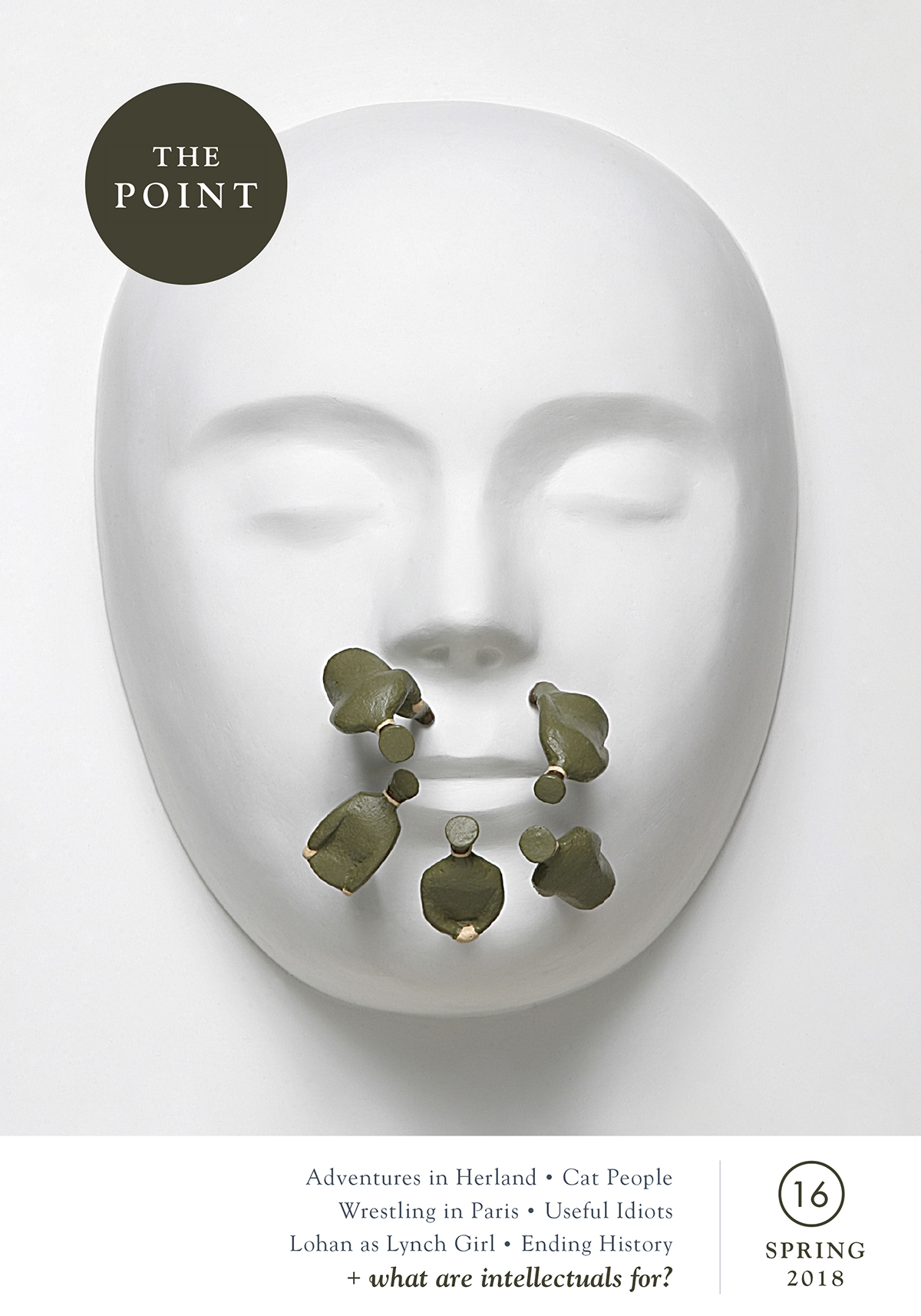
The Point 16: What are intellectuals for?
by
multiple authors
by
multiple authors
The Point 16: What are intellectuals for?
by
multiple authors
by
multiple authors
The Point 16: What are intellectuals for?
by
multiple authors
by
multiple authors
The end of history, Fukuyama wrote, was not the end of historical events, but the end of ideological conflict. But once the end of history has been revoked, a renewal of the possibilities of ideology to enhance narrative should not be far behind. Reality under the Trump administration truly is hysterical, and any meaningful literary response to it should probably take into account how we—that nebula of left-leaning literary types to which Batuman and I and everyone who reviewed or cares about reviews of The Idiot belong—put up with so many patently mediocre fictions for so long. This isn’t to suggest that novelists should dive headfirst into professions of socialist faith. Certain authors have already shown the limits of such an approach. It is not a question of advocating one belief or another, but of examining their implications through the vessel of dramatic narrative. It’s not to discount the existence of types of novels other than the ideological, nor to overlook the gifted fiction writers who already know how to fuel their narratives with zealous idiocy, self-centered or otherwise. Junot Díaz, Tao Lin, Adelle Waldman, Alexandra Kleeman and Paul Beatty have all demonstrated how foolish true believers can push novels forward onto territory that blatant author surrogates, burdened by intelligent inaction, could never reach.
These are unsettling times. Tensions and pressures formerly pacified by the prospect of endless growth now draw force from a state of permanent stagnation. Established institutions tremble with the resentful energies of dishonored promises; each crisis barely averted sows the seeds for more inevitable confrontation. Yet if literary history is any indication, an era of collapsing order offers fertile ground for novelists. Shaken by events out of inertia and conformity, they waken to a world teeming with open inquiries and untested solutions; whether facing the window, the mirror or the other, certainties dissolve. The pressing question is no longer how to fit in with the given, but how much must be changed. The temptation to wager one’s existence on an unrealized social ideal grows ever more alluring. So, too, grows the inclination to review one’s ideals and imagine their implications writ large. The unique quality of the novel catalyzed by ideology is its range, its capacity to simultaneously circumscribe the horizons of belief, exercise the full freedom to maneuver in society, and gauge its potential to foster individual maturity. It’s the best, if not the only, instrument left to us to understand what we are becoming.
wow. think about this

The key moment of any theoretical – and indeed ethical, political, and, as Badiou demonstrated, even aesthetic – struggle is the rise of universality out of the particular lifeworld. The commonplace according to which we are all thoroughly grounded in a particular, contingent lifeworld, so that all universality is irreducibly coloured by and embedded in that life-world, needs to be turned round. The authentic moment of discovery, the breakthrough, occurs when a properly universal dimension explodes from within a particular context and becomes ‘for-itself’, and is directly experienced as universal. This universality-for-itself is not simply external to or above its particular context: it is inscribed within it. It perturbs and affects it from within, so that the identity of the particular is split into its particular and its universal aspects. Surely Marx already pointed out how the true problem with Homer was not to explain the roots of his epics in early Greek society, but to account for the fact that, although clearly rooted in their historical context, they were able to transcend their historical origin and speak to all epochs. Perhaps the most elementary hermeneutic test of the greatness of a work of art is its ability to survive being torn from its original context. In the case of truly great art, each epoch reinvents and rediscovers it. There is a romantic Shakespeare and a realist Shakespeare.
[...]
The standard Marxist hermeneutics of unearthing the particular bias of abstract universality should thus be supplemented by its opposite: by the properly Hegelian procedure which uncovers the universality of what presents itself as a particular position. [...]
Isn’t this the very lesson of Hegel’s ‘Cunning of Reason’? Particularity can indeed mask universality. [...] ore generally, an individual capitalist thinks he is active for his own profit, ignoring how he is serving the expanded reproduction of universal capital. It is not only that every universality is haunted by a particular content that taints it; it is that every particular position is haunted by its implicit universality, which undermines it. Capitalism is not just universal in itself, it is universal for itself, as the tremendous actual corrosive power which undermines all particular lifeworlds, cultures and traditions, cutting across them, catching them in its vortex. It is meaningless to ask ‘Is this universality true or a mask of particular interests?’ This universality is directly actual as universality, as the negative force of mediating and destroying all particular content.
This is the moment of truth in liberalism’s claim to kulturlos universality: capitalism, whose ideology liberalism is, effectively is universal, no longer rooted in a particular culture or ‘world’. This is why Badiou recently claimed that our time is devoid of world: the universality of capitalism resides in the fact that capitalism is not a name for a ‘civilisation’, for a specific cultural-symbolic world, but the name for a truly neutral economic-symbolic machine which operates with Asian values as well as with others. In that sense, Europe’s worldwide triumph is its defeat, its self-obliteration. Capitalism’s umbilical link to Europe has been cut. The critics of Eurocentrism who endeavour to unearth the secret European bias of capitalism fall short here: the problem with capitalism is not its secret Eurocentric bias, but the fact that it really is universal, a neutral matrix of social relations.
The same logic holds for the emancipatory struggle: the particular culture which tries desperately to defend its identity has to repress the universal dimension which is active at its very heart, that is the gap between the particular (its identity) and the universal which destabilises it from within. [...] The formula of revolutionary solidarity is not ‘let us tolerate our differences’, it is not a pact of civilisations, but a pact of struggles which cut across civilisations, a pact between what, in each civilisation, undermines its identity from within, fights against its oppressive kernel. What unites us is the same struggle. A better formula would thus be: in spite of our differences, we can identify the basic antagonism or antagonistic struggle in which we are both caught; so let us share our intolerance, and join forces in the same struggle. In other words, in the emancipatory struggle, it is not the cultures in their identity which join hands, it is the repressed, the exploited and suffering, the ‘parts of no-part’ of every culture which come together in a shared struggle.
this ties in to some of my thoughts on literary theory actually, and how great literature isn't just inward-looking (as in: you're not just thinking about the characters and the plot) but rather outward-looking, universal, greater than its pages. you read it and end up understanding more about the world around you

[...] the modernist aesthetic: go in fear of general ideas, Pound had said, the natural object is always an adequate symbol of the idea or the inward state. There is much to be said for this view: it is a way of bringing the minimum of conceptual baggage to the fresh encounter with reality. What was death to Stevens? A flock of pigeons that made ambiguous undulations as they went downward to darkness on extended wings. What was the secret principle of order in things to Ezra Pound? A rose in the steel dust. What was the paradise, tucked in memory or hidden just behind misery, to T. S. Eliot? Sunlight and laughter in a garden. These images have immense and memorable evocative power, and they have the permanent sphinxlike and unparaphrasable quality of all powerful metaphors. One feels in them the imagination in the twentieth century pounding on the wall of what it cannot know. [...]