
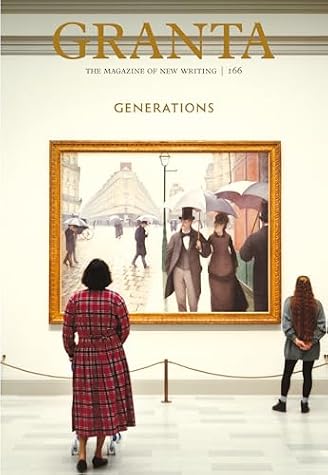
by
Granta
7
Time is meaningful – think of it that way. Generations define us, perhaps not as strongly as other identities – class, religion, gender, profession, politics, nation – but in ways that may be among the most fixed. ‘He tore me away from my generation, but I was not part of his,’ Annie Ernaux writes in Le jeune homme, in which the narrator has an affair with a man three decades her junior. They share working-class origins, the signs of which are remarkably durable across time. ‘His gestures and reflexes were dictated by a continual, inherited lack of money,’ she writes. She notices his ‘hickish’ mannerisms – wiping his mouth with a piece of bread, covering his wineglass to signal no more – tics ‘I knew I’d once had in me too.’ But their separate passages through time make for differences in the quality of their emotion. Much of the woman’s feeling is vicarious, much of the man’s is inaugural, and there’s no way around it.
cool
Time is meaningful – think of it that way. Generations define us, perhaps not as strongly as other identities – class, religion, gender, profession, politics, nation – but in ways that may be among the most fixed. ‘He tore me away from my generation, but I was not part of his,’ Annie Ernaux writes in Le jeune homme, in which the narrator has an affair with a man three decades her junior. They share working-class origins, the signs of which are remarkably durable across time. ‘His gestures and reflexes were dictated by a continual, inherited lack of money,’ she writes. She notices his ‘hickish’ mannerisms – wiping his mouth with a piece of bread, covering his wineglass to signal no more – tics ‘I knew I’d once had in me too.’ But their separate passages through time make for differences in the quality of their emotion. Much of the woman’s feeling is vicarious, much of the man’s is inaugural, and there’s no way around it.
cool
9
Materially, the Silents were on much closer terms with agricultural realities, as well as manufacturing ones. Silents often know how things are made. As children, they were left to wander through the wastes and scrapheaps of the post-war moment. To this day, they inspect food and mechanical objects differently. Many of the most celebrated Boomer pop figures are in fact Silents – Bob Dylan, the Beatles, Patti Smith, Leonard Cohen, Joan Baez – as if the consumption craze of the later generation had to be supplied by a cohort of indefatigable harvesters. Tonally, the Silents are distinguished by their assurance and will toward objectivity, as well as their talent for hammering at fundamentals. It is difficult to imagine an author of a different generation writing about photography like Susan Sontag, who takes to the task like Aristotle, first taking care to tell how it differs from painting, etc. The Silents at their best are simultaneously vernacular and oracular, with a weakness for loftiness. You can feel the decisiveness of the typewriter in their prose, the balm of the cigarette.
(1930-1945)
Materially, the Silents were on much closer terms with agricultural realities, as well as manufacturing ones. Silents often know how things are made. As children, they were left to wander through the wastes and scrapheaps of the post-war moment. To this day, they inspect food and mechanical objects differently. Many of the most celebrated Boomer pop figures are in fact Silents – Bob Dylan, the Beatles, Patti Smith, Leonard Cohen, Joan Baez – as if the consumption craze of the later generation had to be supplied by a cohort of indefatigable harvesters. Tonally, the Silents are distinguished by their assurance and will toward objectivity, as well as their talent for hammering at fundamentals. It is difficult to imagine an author of a different generation writing about photography like Susan Sontag, who takes to the task like Aristotle, first taking care to tell how it differs from painting, etc. The Silents at their best are simultaneously vernacular and oracular, with a weakness for loftiness. You can feel the decisiveness of the typewriter in their prose, the balm of the cigarette.
(1930-1945)
10
The trajectory of some Boomers from would-be establishment wreckers into effusive caressers of farmer’s market vegetables was bound to feed the cynicism of the generation below them. The first thing Gen X learned in school was not to talk to strangers. Christian Lorentzen has described his levy – with his Gen X smirk and tossing of the hands – as the generation that will never have to suffer one of its own members as the American President. Zadie Smith has done some quick moral accounting for her cohort: right about trying to get men to do childcare; wrong about the internet. If the Boomers flattered themselves as the chief protagonists of post-war culture and history, Gen X marveled at the hypocrisies of the generation above them – the way the Boomers had cast off their most signature accomplishments, from anti-war coalitions to independent cinema. Gen X was the last generation for whom Selling Out meant something (an attitude which Millennials like to suggest is luxury masquerading as principle). Gen X’s signature lit mags were the anti-establishment Baffler, McSweeney’s, which was a way of selling out by other means (inviting New Yorker writers into your upstart magazine, sometimes under pseudonyms), and the early n+1, when it prioritized author’s voices over mappings of social movements. It was a generation for whom ‘Victory for the forces of democratic freedom’ was less a credo solemnly scrawled on placards than something David Foster Wallace’s ‘hideous men’ compulsively spurted out during orgasms.
The trajectory of some Boomers from would-be establishment wreckers into effusive caressers of farmer’s market vegetables was bound to feed the cynicism of the generation below them. The first thing Gen X learned in school was not to talk to strangers. Christian Lorentzen has described his levy – with his Gen X smirk and tossing of the hands – as the generation that will never have to suffer one of its own members as the American President. Zadie Smith has done some quick moral accounting for her cohort: right about trying to get men to do childcare; wrong about the internet. If the Boomers flattered themselves as the chief protagonists of post-war culture and history, Gen X marveled at the hypocrisies of the generation above them – the way the Boomers had cast off their most signature accomplishments, from anti-war coalitions to independent cinema. Gen X was the last generation for whom Selling Out meant something (an attitude which Millennials like to suggest is luxury masquerading as principle). Gen X’s signature lit mags were the anti-establishment Baffler, McSweeney’s, which was a way of selling out by other means (inviting New Yorker writers into your upstart magazine, sometimes under pseudonyms), and the early n+1, when it prioritized author’s voices over mappings of social movements. It was a generation for whom ‘Victory for the forces of democratic freedom’ was less a credo solemnly scrawled on placards than something David Foster Wallace’s ‘hideous men’ compulsively spurted out during orgasms.
11
Galvanized in their youth by a financial crisis, the Millennials entered a world of short horizons, with political ambitions that had not been seen since the 1960s, but far fewer organizational vehicles at their disposal. Having come of age on social media, many mark themselves through the articulation of their opinions and identities. They are criticized for unwittingly serving the interests of their societies’ elites through their appeals to institutional authority, but their plight, as a generation twice removed from the spoils of the Trente glorieuses (until a small fraction of them inherit from their parents), may simply be an instance of a cohort making do with the weapons of the weak. Their mobilization of morality hits their Boomer bosses in a particularly sensitive spot; it threatens to withdraw the very affirmation that Boomers most crave: that they are on the correct side of history. As Anton Jäger writes in this issue: Millennials move in ‘a public sphere in which politics has clearly reclaimed its urgency, and collective notions of class have acquired a newfound plausibility. But the resultant posture is still fundamentally one of self-expression: a [Sally Rooney] character may serenade her cleaner’s proletarian credentials, another may declare she is a Marxist, but it’s not clear what Marxist organization she’s a member of.’
heh
Galvanized in their youth by a financial crisis, the Millennials entered a world of short horizons, with political ambitions that had not been seen since the 1960s, but far fewer organizational vehicles at their disposal. Having come of age on social media, many mark themselves through the articulation of their opinions and identities. They are criticized for unwittingly serving the interests of their societies’ elites through their appeals to institutional authority, but their plight, as a generation twice removed from the spoils of the Trente glorieuses (until a small fraction of them inherit from their parents), may simply be an instance of a cohort making do with the weapons of the weak. Their mobilization of morality hits their Boomer bosses in a particularly sensitive spot; it threatens to withdraw the very affirmation that Boomers most crave: that they are on the correct side of history. As Anton Jäger writes in this issue: Millennials move in ‘a public sphere in which politics has clearly reclaimed its urgency, and collective notions of class have acquired a newfound plausibility. But the resultant posture is still fundamentally one of self-expression: a [Sally Rooney] character may serenade her cleaner’s proletarian credentials, another may declare she is a Marxist, but it’s not clear what Marxist organization she’s a member of.’
heh