
by
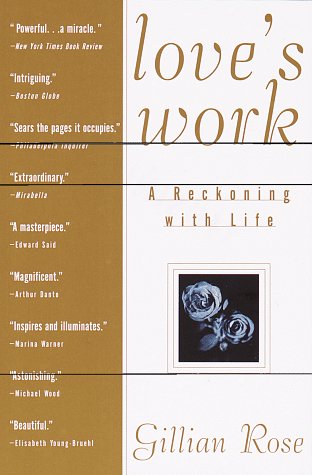
Gillian Rose
View all notes
Available query params: commented=1, untagged=1
Everything about Jim was in huge proportions: over six foot three, he was lean and lanky, with a luxuriant mantle of shining jet hair cast carelessly over his elongated back, and a leopard walk, his limbs curving forward like a giant, caged cat. Jim had the most majestic hands; to say they were the hands of a keyboard player would understate their magnitude and grace. They were hands from the workshop of Henry Moore, with immense, broad, flat fingers, languid under their intelligent weight. At the piano, these organs were possessed, animated by the contortions of Scriabin’s music, in the disciplined expression of an emotional range which no other medium afforded him.
Not philosophy, and this was Jim’s tragedy. He found no way—not even Nietzsche’s example—of bringing his inner emotional turmoil into his philosophy, his discipline, his art. Philosophy remained cleverness, a game, but not a stage on life’s way; it remained aesthetic without an oeuvre, as did everything and everyone else for him.
Jim included the following passage from The Wicked Pavilion (1954) by Dawn Powell in one of his letters to me:
Sloane, so it seemed to him now, had never had to make a decision before in his life. There were always two paths, and if you stood long enough at the crossroads, one of them proved impassable. There were always two women, but one of them wouldn’t have you or one of them kidnapped you. There were always two careers, but at the crucial moment one of them dropped out, something happened, somebody made an appointment, and there you were. For Dalzell Sloane, destiny had shaped itself only through his hesitation…There were people, and Dalzell was one of them, who were born café people, claustrophobes unable to endure a definite place or plan. The café was a sort of union station where they might loiter, missing trains and boats as they liked, postponing the final decision to go any place or do anything until there was no longer any need for decision. One came here because one couldn’t decide where to dine, whom to telephone, what to do…One might be lonely, frustrated, or heartbroken, but at least one wasn’t sewed up.
Jim was a passionate fan of Isaiah Berlin and of Michel Foucault, both of whom he had met personally on visits which they had made at various times to New York. He asked me to obtain a copy of Alexander Herzen’s My Past and Thoughts for him, because Isaiah Berlin claims somewhere that it is one of the great works of Russian literature. I found an edition without difficulty in a New York bookstore. Jim devoured it eagerly. However, it was the opening passage which he said eased what he called his “problem of self-representation”:
Who is entitled to write his reminiscences?
Everyone
Because no one is obliged to read them. In order to write one’s reminiscences it is not at all necessary to be a great man, nor a notorious criminal, nor a celebrated artist, nor a statesman—it is quite enough to be simply a human being, to have something to tell, and not merely the desire to tell it but at least have some little ability to do so.
Every life is interesting; if not the personality, then the environment, the country are interesting, the life itself is interesting. Man likes to enter into another existence, he likes to touch the subtlest fibres of another’s heart, and to listen to its beating…he compares, he checks it by his own, he seeks for himself confirmation, sympathy, justification…
Dante’s poem is called The Divine Comedy. Sacrilegious poet! He usurped the impassible sceptre of Godhead to assign his friend and foe to the eternal terraces of the paradiso and the inferno. Does not all writing, even if it aims at Gelassenheit—to let things be—arrogate such illegitimate authority?
Philosophy provides a humbler definition of comedy, which eludes the hubris of the medieval poet: “The comical as such implies an infinite light-heartedness and confidence felt by someone raised altogether above his own inner contradiction and not bitter or miserable in it at all; this is the bliss and ease of a man who, being sure of himself, can bear the frustrations of his aims and achievements.” This is Hegel’s version of the divine comedy. No human being possesses sureness of self: this can only mean being bounded and unbounded, selved and unselved, “sure” only of this untiring exercise. Then, this sureness of self, which is ready to be unsure, makes the laughter at the mismatch between aim and achievement comic, not cynical; holy, not demonic. This is not love of suffering, but the work, the power of love, which may curse, but abides. It is power to be able to attend, powerful or powerless; it is love to laugh bitterly, purgatively, purgatorially, and then to be quiet.

Knowing what love is certainly helps us learn to walk in love, but we are also wise to understand what love is not. Many people become confused about love because people tell them they love them and then act in ways totally inconsistent with real love. Love is not talk or theory, and it is not merely a sermon. It may produce feelings, but it is much more than a feeling, because we can love by choice even when the feeling of love is absent.
[...]
We don’t have to feel like doing the right thing in order to do it. This is what it means to love people who are hard to love. It means to treat them as Jesus would treat them, no matter how they have treated us.
Loving people means doing what is for their good, not necessarily yours. Love is the greatest thing in the world. It has the power to change lives, and it defeats the devil in his works on the earth. Nothing gives people more joy than feeling loved. We can tell someone we love them, and it is meaningful, but when they feel loved, it is much, much better. People will always remember how you made them feel when they were with you, even if they forget what you said or did. Make people feel good about themselves and you will have many friends.
I think few men would have done what Dave did, because most people are too addicted to their own comfort to be willing to suffer in order to give God time to heal another person. But Dave is a godly man, and an unusually patient one, and he learned early in our relationship to enjoy the parts of me that were enjoyable and turn the ones that weren’t over to God. He knew he couldn’t change me, so he prayed for me and went about enjoying his life.
When you find yourself faced with someone who is hard to love, thinking about how God loved you when you were hard to love will help. The first step toward loving people who are hard to love is to pray for ourselves to have a godly attitude and to remember that God loved us when we were hard to love.
Having a desire to please God doesn’t mean we will enjoy loving people who are hard to love. Remember, love is much more than a feeling. It is how we treat people. God isn’t asking us to let people abuse us, but He is asking us not to give up on them simply because they are difficult to deal with. There are times when we cannot be with certain people because they are abusive, but we can still pray for them and love them in ways that won’t put us in harm’s way. These are rare cases, and most of what we are talking about in this book pertains to ordinary people who for a variety of reasons are just hard to love.
We are never truly free until we feel no need to impress anyone. If and when we reach that point, then we can rest internally and live without concern about what people think of us. We know that what they think is between them and God, and that what they think cannot hurt us. It is what we think of ourselves that really matters.
Like many people, I was insecure for years, but as I received God’s unconditional love and acceptance, I found security in Christ. The better we feel about ourselves, the less we feel the need to argue over opinions and fight to be right, and we can find a way to disagree agreeably if the other person is willing to do so. Some people won’t be at peace no matter what we do, but we can all be peaceful in and through Jesus.