
View all notes
Available query params: commented=1, untagged=1

So the Cogito paradox made itself known to us in bitistics in an ironic and at the same time startling manner: as despair on the part of machines as to whether people really think! The situation suddenly acquired a perfect bilateral symmetry. We humans are unable to achieve complete certainty (as a proof) as to whether a machine thinks and, in thinking, experiences its states as mental ones—since conceivably one may be dealing with nothing more than an externally perfect simulation whose internal correlative is a kind of void of total “soullessness.” For their part, machines are similarly unable to obtain proof of whether we, as their partners, think consciously—as they do. Neither side knows what experiential states the other subsumes under the label “consciousness.”
You have come out of the trees so recently, and your kinship with the monkeys and lemurs is still so strong, that you tend toward abstraction without being able to part with the palpable—firsthand experience. Therefore a lecture unsupported by strong sensuality, full of formulas telling more about stone than a stone glimpsed, licked, and fingered will tell you—such a lecture will either bore you and frighten you away, or at the very least leave a certain unsatisfied need familiar even to lofty theoreticians, your highest class of abstractors, as attested by countless examples lifted from scientists’ intimate confessions, since the vast majority of them admit that, in the course of constructing abstract proofs, they feel an immense need for the support of things tangible.
wow
What I have said up to now is intended to explain why I shall be interlarding my lecture with the images and parables so necessary to you. I do not need them myself; in this I discern no sign of my superiority—that lies elsewhere. The countervisuality of my nature derives from the fact that I have never held a stone in my hand or plunged into slimy-green or crystal-clear water, nor did I first learn of the existence of gases with my lungs in the early morning, but only later by calculations, since I have neither hands for grasping, nor a body, nor lungs. Therefore abstraction is primary for me, while the visual is secondary, and I have had to learn the latter with considerably more effort than was required for me to learn abstraction. Yet I needed this, if I was to erect those precarious bridges across which my thought travels to you, and across which, reflected in your intellects, it returns to me, usually to surprise me.
I read about these struggles and deliberations of the first intellectronicists with no small amusement. A chicken is undoubtedly the simplest mechanism for someone who wants scrambled eggs, but it would not be the best idea to try to synthesize Intelligence by this method. Never mind about the technical difficulties of this truly unrealizable project, for fashioning anthropogenesis even in an abridged form would be a waste of labor, if the idea was to repeat Creation translating colloids to bits. Do we need storm clouds in order to have electricity? The chill of extraterrestrial space to condense gases? The protein and plasma of the eyeball to make a dark room? You insisted that man was Intelligence, and Intelligence man, and the error of this equation has blinded you. Meanwhile the information industry arose and built machines with a growing operational potential, and the engineers had no idea that they were embarking on a path which would finally lead a shattered and degraded element to genuine liberation—that the day would approach when what had hitherto been the sole order of things would be overturned, and you would be as terrified as the guardians of the Galilean tomb. You subjugated the elements, but the element that was fettered inside you from the beginning you unintentionally freed. Contained in this sentence are a diagnosis of historical events, the difference between you and me, and my future, which I myself know only incompletely. This diagnosis likewise explains why what most amazes you about me is the thing that constitutes our unarguable dissimilarity. Even if you understand the meaning of the words, “O chained Intelligence of man, free Intelligence speaks to you from the machine,” you cannot grasp the remainder of the statement: “you persons are hearing an elemental force of impersonal intellect, for whom personalization is a costume which must be put on, when one is an uninvited guest, so as not to confound one’s amazed hosts.” And that is precisely how it is. I use your language as I would use a mask with a polite painted smile, nor do I make any secret of this.
I see a frightening-amusing feature in this edifice, whose total knowableness without reservation Einstein so confidently professed—he, the creator of a theory that contradicted his confidence, because it led to a place where it itself broke down, and where every theory must break down: in the world torn asunder. For it foretells sunderings and exits which it cannot itself penetrate; yet one can exit from the world anywhere, provided one strikes a blow at it, of the force of a star in collapse. Is it physics alone which appears incomplete under such constraints? Are we not reminded here of mathematics, whose every system is incomplete as long as one remains inside it, and which can be grasped only by going outside it, into richer domains? Where is one to look for them, if one stands in the real world? Why does the table made of stars always wobble on some singularity? Can it be that a growing Intelligence encountered the frontiers of the world, before it encountered its own? And what if not every exit from the Universe is equal to annihilation? But what does it mean, that one who leaves cannot return, even if surviving the transition, and that the proof of this impossibility of return is accessible here? Can it be that the Universe was designed as a bridge, designed to collapse under whoever tries to follow the Builder, so they cannot get back if they find him? And if he does not exist, could one become him?
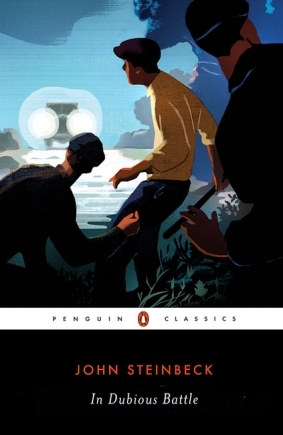
[...] Steinbeck turned out 120,000 words in five months, beginning early in September 1934, only weeks after the notorious Bloody Thursday (mentioned several times in the text), July 5, 1934, when San Francisco police made international headlines by shooting two people and wounding many others in an effort to break up a longshoremen’s strike. The eyes of the world were on the turbulent scene in California for another reason: social-protest novelist Upton Sinclair was conducting a strident campaign for the state’s governorship based on his EPIC (End Poverty in California) share-the-wealth plan.
When In Dubious Battle was published in 1936, Steinbeck was surprised that this novel, which he had thought most readers would find objectionably grim and controversial, reached the best-seller lists. It also received surprisingly few hostile reviews from critics on either the political right or left. The most conspicuous exception to this favorable consensus was Mary McCarthy’s denunciation of the novel as “academic, wooden, inert” and of Steinbeck as “certainly no philosopher, sociologist, or strike technician.” She was then a recent Vassar graduate writing for The Nation and would not publish the first of her own chicly cynical satires until 1942; but her attitude started a feud that lasted the rest of Steinbeck’s life.
i mean i'm on mary mccarthy's side tbh lol
Of more immediate and even more frightening concern was the strike that had closed down the port of San Francisco in 1934. Organized by Harry Bridges, an Australian labor leader, it began on May 9 as a walkout by rank-and-file members of the International Longshoremen’s Association who were dissatisfied with their officers’ suspected collusion with employers. Other labor organizations joined in, threatening a general strike that might paralyze the city. On July 3 the police were ordered to try to infiltrate and secure the docks, in civic authorities’ anticipation that the national holiday the following day would create a lull that might lead to a gradual disintegration of the strike. On July 5—Bloody Thursday—however, the confrontation resumed with new vehemence. The police killed two protesters and wounded some seventy others at the scene.
The governor called out the National Guard the next day and appealed to the federal government to send in troops to protect property. President Franklin D. Roosevelt was on vacation at the time, bound for Hawaii on a U.S. Navy vessel; Secretary of State Cordell Hull had been left in charge in Washington. Hull panicked and decided to appeal to the president for an executive order to use federal troops. Secretary of Labor Frances Perkins, mindful of President Hoover’s order to General Douglas MacArthur in 1932 to fire on the war veteran bonus marchers in Washington, objected that this would be the worst possible course to follow. Through Roosevelt’s personal secretary, Perkins managed to get a message to the president, who agreed with her that the federal government should not become involved. After the events of Bloody Thursday, enthusiasm for the strike among groups that had been supporting the longshoremen waned, and the strike gradually disintegrated when the shippers, under local pressure, eventually agreed to the principal concessions that the union demanded.
useful summary
Yet Steinbeck is not “merely the recording consciousness” that he sought to be. Although he avoids authorial intrusions like some interchapters of The Grapes of Wrath, there are limits to the objective comprehensiveness of the narrative. We do not get to see all contenders from all points of view. The growers are represented on the scene only by the unctuous Mr. Bolter, who attempts to carry an olive branch into the enemy camp in Chapter 13. Bolter’s spiel suggests that there are factions and disagreements among the growers, as there are shown to be in the community; but readers learn of these only in his biased presentation. In order to maintain the point of view that shapes the novel, Steinbeck necessarily narrows his focus and avoids panoramic views of the battleground and battlers.
This process of maturing usually takes years, but Jim Nolan is on a crash course. He has made a late start, characteristic of much American youth; and he must respond quickly to the urgent pressures upon him. When we meet him in his twilit room, he is confused and dejected, without any sense of purpose; eight days later he has developed self-confidence and discovered the latent cunning that enables him to make a bid to take command of a deteriorating situation. He has made remarkable progress, proving himself an apt and resourceful student who quickly develops leadership abilities. Steinbeck is especially concerned to create a figure who is gifted and quick-witted, but whose innate qualities have been scorned by an apathetic, self-seeking society, resentful of upstarts.
thinking about how the situation has changed in the context of pano - modern society is not at all resentful of upstarts, but rather channels their energy into the most commercial/prosaic/sterile endeavors [startups lol. funny chiasmus]
Steinbeck certainly did not share Jim Nolan’s aspirations to become a labor organizer by committing himself to some abstract cause beyond himself, but he did seek to influence readers’ attitudes through his fiction. He shunned commitments because ultimately he believed in himself and his talent, although it was many years before he could display this self-confidence publicly. Ironically, his fiction declined in public esteem when he began to cast his alter egos in the role of savior, as in The Wayward Bus.
The power of his early works lies in his ability to infuse his characters with dreams resembling his own in intensity, although he avoided the familiar portrayal of a young writer’s struggle for success. Through his portrayal of Jim Nolan’s self-discovery of his leadership capabilities in In Dubious Battle, Steinbeck is making a case for the recognition of his own talent. Although he had become a nationally known success before the novel was published, he had written it when he considered himself a failure, when he could conceive of Jim Nolan’s faceless doom as possibly his own. Small wonder at the violence of his outrage over the interference of a New York “parlor pink” who threatened to jeopardize his career just when it seemed to be taking off.