
by
Jodi Dean
View all notes
Available query params: commented=1, untagged=1

Today, in a setting that is ever more nationalist and authoritarian, intensely competitive, unequal, and immiserated, in a world of anthropocenic exhaustion, it’s hard to recapture the hope, futurity, and sense of shared struggle that were part of an earlier revolutionary tradition. What, then, is comradeship for us? My wager throughout this book is that a speculative-compositive account of comradeship, one that distills common elements from multiple uses of comrade as a mode of address, figure of belonging, and container for shared expectations, can provide us with a view of political relation necessary for the present. Comrades are more than survivors and more than allies. They are those on the same side of a struggle for an emancipated egalitarian world.
The comrade is also not the same as the neighbor understood in an ethical sense. “Love thy comrade as thyself” makes no sense: Comrades don’t love themselves as uniquely special individuals. They subordinate their individual preferences and proclivities to their political goals. Comrades’ relation to each other is outward-facing, oriented toward the project they want to realize, the future they want to bring into being. They cherish one another as shared instruments in common struggle; comrades are a necessity. [...]
Expulsions are a way that comradeship ends. It’s easy to see this in the case of the expelled individual. Haywood’s recollection of a time when expulsions ran amok, when the party entered into a self-destructive frenzy, lets us see the broader impact of expulsion. Paranoia undermines the trust necessary for comradely criticism and self-criticism. Turning in upon itself, the party turned away from mass struggle; away from the campaigns, organizations, and popular work through which it had actively fought for black liberation. No longer an instrument of struggle, the party disintegrates into a field of struggle. Comrades become combatants, then casualties, cut off from their previous world.
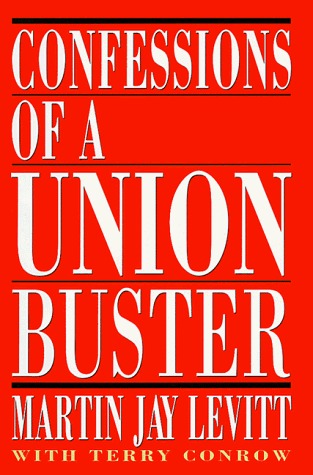
There are many forms of union busting. Some labor consultants, and attorneys take on unions that already represent a work force, squeezing negotiators at the bargaining table, forcing workers out on strike, harassing union officers. My career took another path. I refined the Sheridan specialty called "counter-organizing drives," battling non-union employees as they struggled to win union representation. The enemy was the collective spirit. I got hold of that spirit while it was still a seedling; I poisoned it, choked it, bludgeoned it if I had to, anything to be sure it would never blossom into a united work force, the dreaded foe of any corporate tyrant.
For my campaigns I identified two key targets: the rank-and-file workers and their immediate supervisors. The supervisors served as my front line. I took them hostage on the first day and sent them to anti-union boot camp. I knew that people who didn't feel threatened wouldn't fight. So through hours of seminars, rallies, and one-on-one encounters, I taught the supervisors to despise and fear the union. I persuaded them that a union-organizing drive was a personal attack on them, a referendum on their leadership skills, and an attempt to humiliate them. I was friendly, even jovial at times, but always unforgiving as I compelled each supervisor to feel he was somehow to blame for the union push and consequently obliged to defeat it. Like any hostages, most supervisors could not resist for long. They soon came to see the fight through the eyes of their captor and went to work wringing union sympathies out of their workers.
To stop a union proponent - a "pusher," in the anti-union lexicon - the buster will go anywhere, not just to the lunch room, but into the bedroom if necessary .The buster not only is a terrorist; he is also a spy. My team and I routinely pried into workers' police records, personnel files, credit histories, medical records, and family lives in search of a weakness that we could use to discredit union activists.
Once in a while, a worker is impeccable. So some consultants resort to lies. To fell the sturdiest union supporters in the 1970s, I frequently launched rumors that the targeted worker was gay or was cheating on his wife. It was a very effective technique, particularly in blue-collar towns. If even the nasty stories failed to muzzle an effective union proponent, the busters might get the worker fired.
In 1975 I left the employ of consulting firms and set out on my own. Over the next eight years I ran a series of one-man union-busting enterprises I called by such disingenuous names as Employee Synthesis Program and Human Resources Institute, and I struck it rich. But by 1983 I had become hopelessly alcoholic; the addiction had badly complicated my life, and solo work was taking its toll on me. I landed a counter-organizing job at an Ohio coal company five hundred workers strong, and I decided I needed backup. I called on some former colleagues from a Sheridan spin off called Modern Management Methods and invited them to join me as I feasted off the carcass of the United Mine Workers. They did, gleefully, and my reaffiliation with MMM continued until the death of my shameful career.
lmao
Many consultants have given up union busting and quietly gone about building more honorable careers for themselves, sort of like former Nazis moving to America and setting up flower shops. Not I. At the time I made my conversion, I was struggling to overcome alcoholism. In my pursuit of recovery I also sought redemption, so I came to believe it was my moral duty to confront what I had done and somehow to make amends to my tens of thousands of victims. At that moment I vowed I would do whatever I could to stop the others in my trade from carrying out their hateful mission. I would not run and hide.
lol
I first met Cravat Coal on paper. One hot August day in 1983, I sent the paralegal student who worked as my assistant to the National Labor Relations Board office in downtown Cleveland to poke through the filings. That was the method I had developed to generate work during slow times. It turned out to be a brilliant tactic, for of ten I discovered a union-organizing drive before company executives had any suspicions. The timeliness of my call made it impossible to ignore, and the chief executives' panic allowed me to suggest that, having caught the trouble early, we could launch our offensive while the union was still struggling to develop a strategy. That, in fact, was the case with Cravat. My student-assistant had discovered a union representation petition that had been filed just a day before by the United Mine Workers District 6, based in Wheeling, in neighboring West Virginia. The UMWA aimed to organize the 485 miners at what was then the nation's largest independent coal-mining company.
damn
I moved in closer. "You love your wife?" "Yes, sir."
"You sleep with your wife?"
The man blushed. "Uh, yes, sir."
"Well," I continued, "how would you like it if your mother-in-law slept between you and your wife every night?"
The crowd broke out in laughter, and a voice from the back of the room hooted, "Not bad. You should see his mother-in-law." Well, maybe you're lucky, I told the boy, but most of us wouldn't want our mother-in-law in bed with us. That's what it will be like for you if we let the union in; everything you do or say to your employees will have to be cleared through the mother-in-law, the union steward.
lol
So what could the foremen do about the union threat? It was time for a lesson in law. I walked to the back of the basement room and picked up the legal pad on which the miners had signed their names. I handed the tablet to the miner sitting nearest me and announced that everyone should make sure he had signed the paper. While the tablet was being passed up and down the aisles, I distributed copies of a federal government guide to the National Labor Relations Act. The fact that the booklet was a government publication was not serendipitous. It is crucial for the union buster to establish that what he is doing is sanctioned, even promoted to a certain extent, by the U.S. government. The labor law guide spelled out what an employer could and could not legally do to thwart a union-organizing attempt. The booklet would teach the miners the limits of the law, and I would tell them how to bend and even break those limits.