
View all notes
Available query params: commented=1, untagged=1

The industrial reserve army, during the periods of stagnation and average prosperity, weighs down the active labour-army; during the periods of overproduction and paroxysm it holds its pretensions in check. Relative surplus population is therefore the pivot upon which the law of demand and supply of labour works. It confines the field of action of this law within the limits absolutely convenient to the activity of exploitation and to the domination of capital. [...]
The immediate producer, the labourer, could only dispose of his own person after he had ceased to be attached to the soil and ceased to be the slave, serf, or bondman of another. To become a free seller of labour power, who carries his commodity wherever he finds a market, he must further have escaped from the regime of the guilds, their rules for apprentices and journeymen, and the impediments of their labour regulations. Hence, the historical movement which changes the producers into wage-workers, appears, on the one hand, as their emancipation from serfdom and from the fetters of the guilds, and this side alone exists for our bourgeois historians. But, on the other hand, these new freedmen became sellers of themselves only after they had been robbed of all their own means of production, and of all the guarantees of existence afforded by the old feudal arrangements. And the history of this, their expropriation, is written in the annals of mankind in letters of blood and fire.
At any rate, it is but a requirement of the capitalist mode of production that the number of wage-workers should increase absolutely, in spite of its relative decrease. Labour power becomes redundant for it as soon as it is no longer necessary to employ it for twelve to fifteen hours daily. A development of productive forces which would diminish the absolute number of labourers, i.e. enable the entire nation to accomplish its total production in a shorter time span, would cause a revolution, because it would put the bulk of the population out of the running. This is another manifestation of the specific barrier of capitalist production, showing also that capitalist production is by no means an absolute form for the development of the productive forces and for the creation of wealth, but rather that at a certain point it comes into collision with this development. This collision appears partly in periodical crises, which arise from the circumstance that now this and now that portion of the labouring population becomes redundant under its old mode of employment. The limit of capitalist production is the excess time of the labourers. The absolute spare time gained by society does not concern it. The development of productivity concerns it only in so far as it increases the surplus labour time of the workingclass, not because it decreases the labour time for material production in general. It moves thus in contradiction.
The domination of the capitalist over the worker is thus the domination of the thing over man, of dead labour over living labour, of the product over the producer; for the commodities which become the means of domination (in fact only over the worker) are themselves merely the results of the productive process, its products.
The supreme ideal of capitalist production is—at the same time as it increases net produce in a relative way—to reduce as much as possible the number of those who live on wages, and to increase as much as possible the number of those who live on net produce.

Capital is concentrated social force, while the workman has only to dispose of his working force. The contract between capital and labour can therefore never be struck on equitable terms, equitable even in the sense of a society which places the ownership of the material means of life and labour on one side and the vital productive energies on the opposite side. The only social power of the workmen is their number. The force of numbers, however is broken by disunion. The disunion of the workmen is created and perpetuated by their unavoidable competition among themselves.

The credit system ... accelerates the material development of the productive forces and the creation of the world market ... At the same time, credit accelerates the violent outbreaks of this contradiction, crises, and with these elements the dissolution of the old mode of production.
The credit system has a dual character immanent in it: on the one hand it develops the driving force of capitalist production, enrichment through the exploitation of others’ labor, into the purest and most colossal system of gambling and swindling, and restricts ever more the already small number of the exploiters of social wealth; but on the other hand, it establishes the form of transition to a new mode of production.
citation: Karl Marx, Capital, Volume 3, trans. David Fernbach (New York: Vintage
Books, 1981), p. 572.
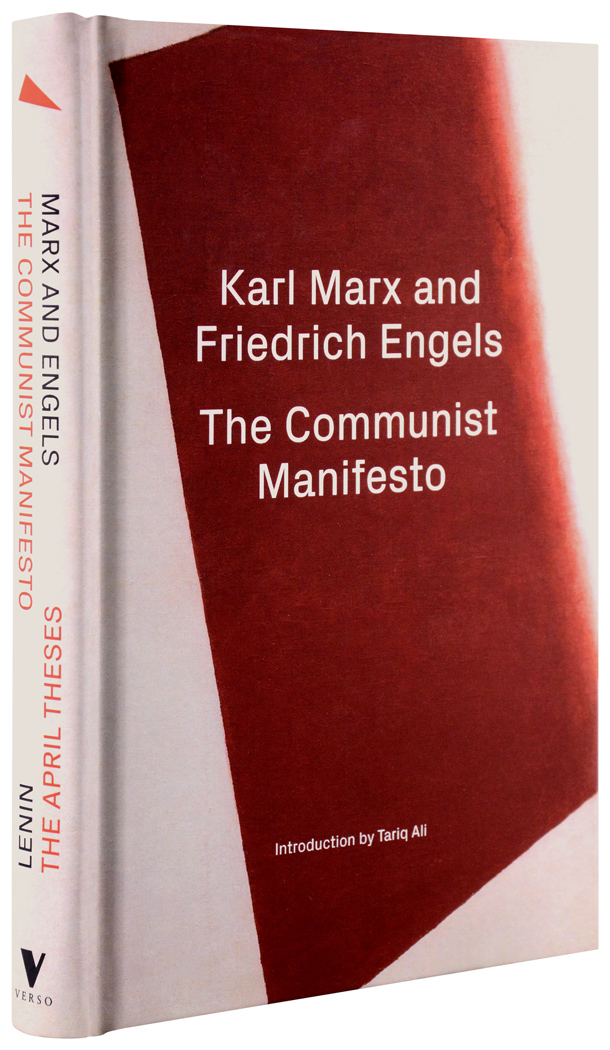
The Communist Manifesto
by
multiple authors
by
multiple authors
The Communist Manifesto
by
multiple authors
by
multiple authors
The Communist Manifesto
by
multiple authors
by
multiple authors
The bourgeoisie cannot exist without constantly revolutionizing the instruments of production, and thereby the relations of production, and with them the whole relations of society. Conservation of the old modes of production in unaltered form, was, on the contrary, the first condition of existence for all earlier industrial classes. Constant revolutionizing of production, uninterrupted disturbance of all social conditions, everlasting uncertainty and agitation distinguish the bourgeois epoch from all earlier ones. All fixed, fast-frozen relations, with their train of ancient and venerable prejudices and opinions, are swept away, all new-formed ones become antiquated before they can ossify. All that is solid melts into air, all that is holy is profaned, and man is at last compelled to face with sober senses, his real conditions of life, and his relations with his kind.
the famous quote
- Abolition of property in land and application of all rents of land to public purposes.
- A heavy progressive or graduated income tax.
- Abolition of all right of inheritance.
- Confiscation of the property of all emigrants and rebels.
- Centralization of credit in the hands of the state, by means of a national bank with state capital and an exclusive monopoly.
- Centralization of the means of communication and transport in the hands of the state.
- Extension of factories and instruments of production owned by the state; the bringing into cultivation of waste lands, and the improvement of the soil generally in accordance with a common plan.
- Equal liability of all to labour. Establishment of industrial armies, especially for agriculture.
- Combination of agriculture with manufacturing industries; gradual abolition of the distinction between town and country, by a more equable distribution of the population over the country.
- Free education for all children in public schools. Abolition of children’s factory labour in its present form. Combination of education with industrial production, etc.
Bourgeois socialism attains adequate expression when, and only when, it becomes a mere figure of speech.
Free trade: for the benefit of the working class. Protective duties: for the benefit of the working class. Prison reform: for the benefit of the working class. This is the last word and the only seriously meant word of bourgeois socialism.
It is summed up in the phrase: the bourgeois is a bourgeois—for the benefit of the working class.