
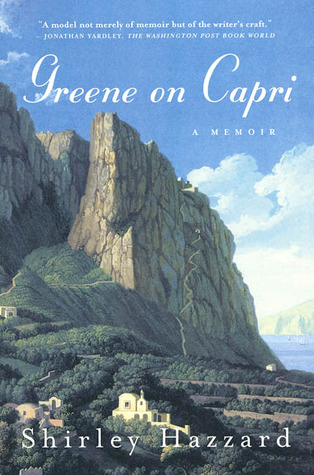
Two tall figures under umbrellas appeared in the empty square and loped across to the café: a pair of Englishmen wearing raincoats, and one—the elder—with a black beret. The man with the beret was Graham Greene. I recognised him—as one would; and also because I had seen him in the past on Capri, at the restaurant Gemma near the piazza, where he dined at a corner table with his companion, and great love of the postwar decade, Catherine Walston. That was in the late 1950s, when I used to visit Naples and Capri from Siena, where I then spent part of the year. One knew that Greene had a house in the town of Anacapri, in the upper portion of the island, which he had visited faithfully if sporadically for many years.
On that damp December morning, Greene and his dark-haired friend came into the Gran Caffè, hung their coats, and sat down at the next tiny table to mine. I went on with my puzzle; but it was impossible not to overhear the conversation of my neighbours—or, at any rate, not to hear one side of it. Graham Greene certainly did not have a loud voice, but his speech was incisive, with distinctive inflections, and his voice was lowered only in asides or to make confidences. It was an individual voice, developed before the great British flattening, when one’s manner of speaking might, beyond any affectation of class, become personal speech: one’s own expressive instrument casting its spell in conversation. I would in any case have noticed what he was saying, because he began to quote from a poem by Robert Browning called “The Lost Mistress.” The poem opens:
[...]
And then he could not remember the very end. He recurred to this several times, trying to draw it up from his memory, but did not manage it.
When I had finished my coffee and my puzzle, and had paid, and had taken my raincoat and umbrella from the dank stand, I said, “The line is
“Or so very little longer.”
<3 <3