
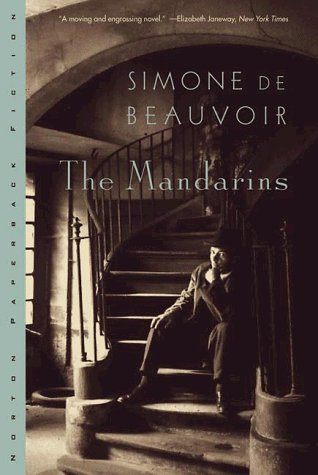
[...] The world was wavering between war and peace, the future depended perhaps on an imponderable; it would be a crime not to try anything and everything to sway the balance in favour of peace. Henri looked at his desk, his chair, the walls; he listened to the purrings of the presses; and suddenly it seemed to him as if he had just awakened from a long, futile dream. Up to now he had considered L'Espoir a sort of toy, a complete set of equipment for the little junior editor — life-size. A magnificent plaything! But it was in fact an instrument, a weapon; people had the right to hold him to account for the way he used it. He walked over to the window. Oh, he was exaggerating a little, of course; it hadn't been as futile as all that. The September euphoria had long since been dissipated. He had been quite emotional about this paper, but nevertheless he had always believed there was no one to account to but himself. He couldn't have been more wrong. 'It's funny,' he said to himself, 'but whenever you do the decent thing, instead of it giving you certain rights it only creates more obligations.' He had founded L'Espoir, and now that act was forcing him to throw himself body and soul into the political arena. Even now he could imagine Samazelle's intrusions, his harangues, Dubreuilh's telephone calls, the conversations, the conferences, the arguments, the deals. I won't let myself be eaten up, he had promised himself. Well, the die was cast; he was going to be eaten up. He left his office and went down the stairs. Wrapped in fog and darkness, the city seemed to him like a huge station. There was a time when he had liked fogs, stations, but now he liked nothing; already he had let himself be eaten up. Yes, that was why he found so little to say when he tried to write about himself. There are things you value; tell us which. Which? He loved neither Paula nor Nadine, and travelling hardly tempted him; he never listened to music any more, took walks, never read for pleasure. He no longer did anything at all for pleasure alone, no longer stopped on street corners to look about idly, no longer took time to savour an old memory. People to see, things to do; he was living like an engineer in a mechanical world. No wonder he had become as dry as a stone. He quickened his pace. It terrified him, that dryness. At Christmas Eve he had promised himself so firmly that he would find himself again. And he had found nothing. In the bargain he felt constantly uneasy, constantly on the defensive, tense, irritable, irritated. He knew only too well he was acquitting himself poorly of all those drudgeries he inflicted upon himself; they brought him nothing but remorse. 'I don't know enough, don't see things clearly, take sides too lightly; I haven't enough time, I'll never have enough time.' It was unbearable, that refrain. And now it would grow even louder, he would never stop hearing it; everything was going to be worse than before, infinitely worse. Eaten up, devoured, picked clean to his very bones. Writing would be out of the question, for writing is way of life and he was about to choose another; he would longer have anything to communicate to anyone. 'That's not what I want; I don't want it,' he said to himself with revulsion. No, his repugnance wasn't frivolous; on the contrary, with only a little pathos, he could have told himself that the thing was matter of life or death, his life or death as a writer. He had assert himself. 'After all, the SRL doesn't hold the fate humanity in its hands,' he thought. 'Nor do I hold the fate of the SRL in mine.' [...]
jesus