
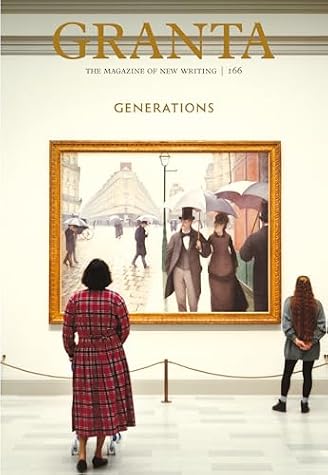
by
Granta
131
Per did not read the books that were popular in the store where he worked because those books were books, not literature. They had very little to do with life and would not be read in five years. The books most popular in the store were popular precisely because of the hyper-localized nature of their idiom and the narrowness of their concerns. The books described a mode of life that would be utterly unrecognizable in a year or two. Or worse, they were about a generalized, abstracted version of the past that had been mostly cobbled out of quickly digested research articles and hazy family memories from across the diaspora. The contemporary novel as Per understood it was mostly about the self, but also about things that had happened to a family across many generations but also about Nazis but also about slavery but also about some obscure local historical atrocity that reverberated through to the present day and had shocking consequences for all involved but also about a painter on a train going to Prague and thinking about a bad man she had slept with once or thought about sleeping with anyway.
ok fine this isn't inaccurate
Per did not read the books that were popular in the store where he worked because those books were books, not literature. They had very little to do with life and would not be read in five years. The books most popular in the store were popular precisely because of the hyper-localized nature of their idiom and the narrowness of their concerns. The books described a mode of life that would be utterly unrecognizable in a year or two. Or worse, they were about a generalized, abstracted version of the past that had been mostly cobbled out of quickly digested research articles and hazy family memories from across the diaspora. The contemporary novel as Per understood it was mostly about the self, but also about things that had happened to a family across many generations but also about Nazis but also about slavery but also about some obscure local historical atrocity that reverberated through to the present day and had shocking consequences for all involved but also about a painter on a train going to Prague and thinking about a bad man she had slept with once or thought about sleeping with anyway.
ok fine this isn't inaccurate
171
The children of the revolutionaries were happy dwellers in the land of happy childhood. They respected their seniors, loved their country, and looked forward to improving themselves for the sake of socialism and to building socialism as a means of self-improvement. They were children of the revolution because they were their fathers’ children, because they were born after the revolution, and because they were proud of their paternity and determined to carry on what was at once their father’s ‘profession’, their country’s mission, and History’s secret purpose. Born in the 1920s, they came of age along with socialist realism, and the heart of socialist realism, according to Bukharin’s speech at the First Writers’ Congress in 1934, was romanticism. ‘The soul’ of ‘most of the young people of that time’, wrote one of them many years later, was ‘romantic’ – romantic in the sense of being exalted, vibrant, hopeful, and vulnerable, and Romantic in the sense of seeking transcendence in the here and now. The fathers’ generation had been shaped by the expectation of the apocalypse; the children’s generation was ‘religious’ about the heavenly city they inhabited. The fathers’ friends and lovers were fellow sectarians who shared their faith; the children’s friends and lovers were unique individuals whom they loved for reasons they never tired of discussing but were never supposed to exhaust. The fathers’ ‘classical’ reading was tempered by Symbolism and disciplined by the study of Marx, Lenin, and economics. The children were bored by modernism, entirely innocent of economics, and only indirectly acquainted with Marxism-Leninism through speeches, quotations, and history-book summaries. No one ever read Das Kapital, everyone was in love with Pushkin.
heh
The children of the revolutionaries were happy dwellers in the land of happy childhood. They respected their seniors, loved their country, and looked forward to improving themselves for the sake of socialism and to building socialism as a means of self-improvement. They were children of the revolution because they were their fathers’ children, because they were born after the revolution, and because they were proud of their paternity and determined to carry on what was at once their father’s ‘profession’, their country’s mission, and History’s secret purpose. Born in the 1920s, they came of age along with socialist realism, and the heart of socialist realism, according to Bukharin’s speech at the First Writers’ Congress in 1934, was romanticism. ‘The soul’ of ‘most of the young people of that time’, wrote one of them many years later, was ‘romantic’ – romantic in the sense of being exalted, vibrant, hopeful, and vulnerable, and Romantic in the sense of seeking transcendence in the here and now. The fathers’ generation had been shaped by the expectation of the apocalypse; the children’s generation was ‘religious’ about the heavenly city they inhabited. The fathers’ friends and lovers were fellow sectarians who shared their faith; the children’s friends and lovers were unique individuals whom they loved for reasons they never tired of discussing but were never supposed to exhaust. The fathers’ ‘classical’ reading was tempered by Symbolism and disciplined by the study of Marx, Lenin, and economics. The children were bored by modernism, entirely innocent of economics, and only indirectly acquainted with Marxism-Leninism through speeches, quotations, and history-book summaries. No one ever read Das Kapital, everyone was in love with Pushkin.
heh
242
The first political slogan I learned was probably the alliterative, Le PAS ne passera pas (‘SAP [Structural Adjustment Program] shall not pass’) – supplemented by Pas moins d’État, mieux d’État (‘Not less state, a better state’). In a world where globalization would have been political, protesters in those demonstrations would have marched on Washington’s 19th Street NW, not on a thoroughfare in Niamey where all they did was to disturb the street hawkers. But they did not march in Washington, and the SAP passed. What then followed was a kind of psychological dry spell, which all the Conjunctures in the world could not quench. The fall of ‘progress’ scrambled the map we had relied on since independence, and many felt lost. But even that did not last.
lol cool
The first political slogan I learned was probably the alliterative, Le PAS ne passera pas (‘SAP [Structural Adjustment Program] shall not pass’) – supplemented by Pas moins d’État, mieux d’État (‘Not less state, a better state’). In a world where globalization would have been political, protesters in those demonstrations would have marched on Washington’s 19th Street NW, not on a thoroughfare in Niamey where all they did was to disturb the street hawkers. But they did not march in Washington, and the SAP passed. What then followed was a kind of psychological dry spell, which all the Conjunctures in the world could not quench. The fall of ‘progress’ scrambled the map we had relied on since independence, and many felt lost. But even that did not last.
lol cool
244
The screen generation is not as easy to read. The fact that they do not read – at least not the way we read – means that they are inscrutable in a way that cannot be chalked up only to a proverbial generational divide. They are in some sense inscrutable to each other. Our text culture created a generational space that made debates possible, clashes inevitable and even sought after. The youth seem to fold themselves into their virtual and networked worlds. They lack a generational public space, or perhaps have no need for it, because the maps have become a maze and the absence of fixed references come with a kind of freedom from expectation which previous generations could not imagine. Much of this must be true for the screen generation the world over. The difference, in the Sahel, is the conditions in which they operate. In Niger, there was in the early sixties a radical progressist movement, Sawaba, that was crushed by its more moderately progressivist rivals of the Nigerien Progressive Party (everyone was progressive back then!) and became decades later the subject of a 900-page book by the Dutch historian Klaas van Walraven, The Yearning for Relief. Relief, not progress, was really what it was all about – relief from drudgery and power, relief to be oneself, and, to quote a Songhay text from Boubou Hama – a nemesis of Sawaba – relief to be able to be bere nda ni wono, ‘great with one’s own’. The younger generation of Sahelians still yearn for that relief, and they perhaps have a better chance to find it in the open maze, outside the doctrinaire maps of their elders.
The screen generation is not as easy to read. The fact that they do not read – at least not the way we read – means that they are inscrutable in a way that cannot be chalked up only to a proverbial generational divide. They are in some sense inscrutable to each other. Our text culture created a generational space that made debates possible, clashes inevitable and even sought after. The youth seem to fold themselves into their virtual and networked worlds. They lack a generational public space, or perhaps have no need for it, because the maps have become a maze and the absence of fixed references come with a kind of freedom from expectation which previous generations could not imagine. Much of this must be true for the screen generation the world over. The difference, in the Sahel, is the conditions in which they operate. In Niger, there was in the early sixties a radical progressist movement, Sawaba, that was crushed by its more moderately progressivist rivals of the Nigerien Progressive Party (everyone was progressive back then!) and became decades later the subject of a 900-page book by the Dutch historian Klaas van Walraven, The Yearning for Relief. Relief, not progress, was really what it was all about – relief from drudgery and power, relief to be oneself, and, to quote a Songhay text from Boubou Hama – a nemesis of Sawaba – relief to be able to be bere nda ni wono, ‘great with one’s own’. The younger generation of Sahelians still yearn for that relief, and they perhaps have a better chance to find it in the open maze, outside the doctrinaire maps of their elders.
256
[...] Due to some sort of gender divide, my father only said a sentence or two about it to me. My mother took on the task of expressing their shared anger. ‘We don’t pay for you to go to school so you can sing the International in the lycée courtyard,’ she shouted at me that evening, adding numerous curses and threats: ‘You’re going to quit school and get a job.’ They couldn’t understand it: here I was with the good fortune to pursue a secondary education, a chance they had never had, and instead of being serious about my studies I was spending my time on all these other things. It left them altogether indignant.
lol
[...] Due to some sort of gender divide, my father only said a sentence or two about it to me. My mother took on the task of expressing their shared anger. ‘We don’t pay for you to go to school so you can sing the International in the lycée courtyard,’ she shouted at me that evening, adding numerous curses and threats: ‘You’re going to quit school and get a job.’ They couldn’t understand it: here I was with the good fortune to pursue a secondary education, a chance they had never had, and instead of being serious about my studies I was spending my time on all these other things. It left them altogether indignant.
lol
283
It’s discovering that almost everyone you truly liked has died, that you are now engaged in a dire, depressing contest with all those still living, and that winning would be the most inconsolable, loneliest victory anyone could achieve. Alive after all that, and in many areas of life, already dead.
Of any two people, someone always goes first.
It’s discovering that almost everyone you truly liked has died, that you are now engaged in a dire, depressing contest with all those still living, and that winning would be the most inconsolable, loneliest victory anyone could achieve. Alive after all that, and in many areas of life, already dead.
Of any two people, someone always goes first.