
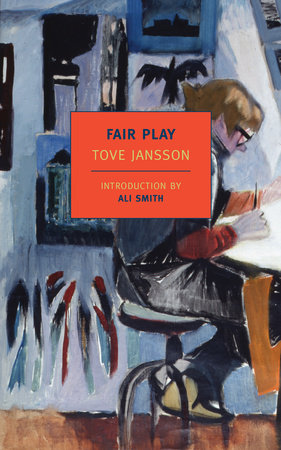
by
Tove Jansson
xii
But it is, too, a piece of writing about time running out, about the end of living space, about inevitable ends. The chapter called “Cemeteries,” for instance, examines how we helplessly think we can order things and control our fates; Fair Play never ignores real bleakness. Part of its analysis of art knows that art makes a killing in the same way as a pin will through a butterfly. Part of its radicalism comes from the repeated admittance that its main characters are simply getting older. Yet the form of the book suggests there’ll be no stopping. There’s only the journey, the open traveling companionship, the long-running aesthetic argument and agreement between Jonna and Mari, “doing all right,” from the start of the book to its finish.
But it is, too, a piece of writing about time running out, about the end of living space, about inevitable ends. The chapter called “Cemeteries,” for instance, examines how we helplessly think we can order things and control our fates; Fair Play never ignores real bleakness. Part of its analysis of art knows that art makes a killing in the same way as a pin will through a butterfly. Part of its radicalism comes from the repeated admittance that its main characters are simply getting older. Yet the form of the book suggests there’ll be no stopping. There’s only the journey, the open traveling companionship, the long-running aesthetic argument and agreement between Jonna and Mari, “doing all right,” from the start of the book to its finish.
4
Pursuing her work in blessed seclusion, free from interference; molding and playing with all sorts of materials, a game that all at once, capriciously, could become irresistible and crowd out all other activity. Enjoying a sudden burst of practical energy and repairing everything broken in the house and in the apartments of her completely impractical friends—mending things or making them beautiful, or simply, to everyone’s relief, discarding them. Periods of nothing but intense reading, night and day. Periods of listening to music to the exclusion of all else. To name just a few.
And each and every one of these periods was sharply defined by a day or two of extreme unease and boredom, irresolute days in search of a new course. It was always the same; there was no other way. To encroach on those empty days with suggestions or advice was utterly unthinkable.
Pursuing her work in blessed seclusion, free from interference; molding and playing with all sorts of materials, a game that all at once, capriciously, could become irresistible and crowd out all other activity. Enjoying a sudden burst of practical energy and repairing everything broken in the house and in the apartments of her completely impractical friends—mending things or making them beautiful, or simply, to everyone’s relief, discarding them. Periods of nothing but intense reading, night and day. Periods of listening to music to the exclusion of all else. To name just a few.
And each and every one of these periods was sharply defined by a day or two of extreme unease and boredom, irresolute days in search of a new course. It was always the same; there was no other way. To encroach on those empty days with suggestions or advice was utterly unthinkable.
7
They never asked, “Were you able to work today?” Maybe they had, twenty or thirty years earlier, but they’d gradually learned not to. There are empty spaces that must be respected—those often long periods when a person can’t see the pictures or find the words and needs to be left alone.
They never asked, “Were you able to work today?” Maybe they had, twenty or thirty years earlier, but they’d gradually learned not to. There are empty spaces that must be respected—those often long periods when a person can’t see the pictures or find the words and needs to be left alone.
68
“Yes, Wladyslaw, yes,” Mari said. She was very tired. From the depths of her exhaustion, where she no longer had the strength to follow what he was saying, she remarked that he had undoubtedly been very beautiful.
He answered gravely. “Very. I was so beautiful that people stopped on the street and turned around to look at me and I heard them say, ‘It’s not possible!’”
“That must have made you very happy.”
“Yes. I liked it. I couldn’t help it. But of course all of that took time from my work. I allowed feeling to dominate at the expense of observation. Much too often.” Wladyslaw was silent for quite a while. Then he said, “Now perhaps we might have a meal to complete the day. You said something about beef?”
At four o’clock, the morning paper came through the letter slot.
“Are you tired?” Wladyslaw asked.
“Yes.”
“Then I won’t say much more. Just one thing—and now, my friend, you must give me your complete attention. It is simply this: do not tire, never lose interest, never grow indifferent—lose your invaluable curiosity and you let yourself die. It’s as simple as that. No?”
“Yes, Wladyslaw, yes,” Mari said. She was very tired. From the depths of her exhaustion, where she no longer had the strength to follow what he was saying, she remarked that he had undoubtedly been very beautiful.
He answered gravely. “Very. I was so beautiful that people stopped on the street and turned around to look at me and I heard them say, ‘It’s not possible!’”
“That must have made you very happy.”
“Yes. I liked it. I couldn’t help it. But of course all of that took time from my work. I allowed feeling to dominate at the expense of observation. Much too often.” Wladyslaw was silent for quite a while. Then he said, “Now perhaps we might have a meal to complete the day. You said something about beef?”
At four o’clock, the morning paper came through the letter slot.
“Are you tired?” Wladyslaw asked.
“Yes.”
“Then I won’t say much more. Just one thing—and now, my friend, you must give me your complete attention. It is simply this: do not tire, never lose interest, never grow indifferent—lose your invaluable curiosity and you let yourself die. It’s as simple as that. No?”