
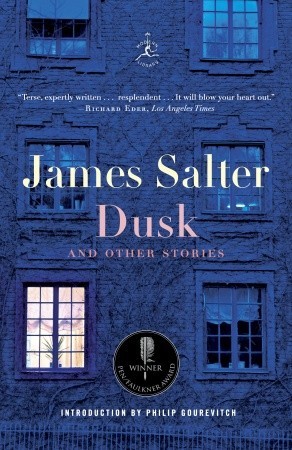
by
James Salter
ix
The pilot was called, as he had been from birth, James Horowitz. The writer called himself James Salter. He was handsome, and he had style. He lived in Europe. His prose announced itself with a high modernist elegance. He made language spare and lush all at once—strong feelings made stronger by abbreviation, intense physicality haunted by a whiff of metaphysics: for everything that is described, even more is evoked.
it's why i love him
x
The problem, Salter has said, was that the flying life was lived entirely in the present, and he chose the writing life instead because he wanted to make something continuous and permanent out of “this rubble of days.”
The problem, Salter has said, was that the flying life was lived entirely in the present, and he chose the writing life instead because he wanted to make something continuous and permanent out of “this rubble of days.”
x
In the sixties and into the seventies, he wrote screenplays. For Sidney Lumet he wrote The Appointment, and he saw his script made flesh by Omar Sharif, Anouk Aimée, and Lotte Lenya. For Robert Redford, he wrote Downhill Racer. He wrote two more movies that were made, and a dozen that were not, before the waste of spirit on work that never saw light took its toll and he gave it up. At the same time, he had written his most original and enduring novels, A Sport and a Pastime and Light Years, as well as the masterly stories in this collection, Dusk. These books all have the flickering hyper-vividness of cinema, the atmospherics, the jump-cut acuity, and that swift, skimming telegraphic emotion that gives a sense of immense depth to surfaces. Of course Salter achieves his effects without using anything more than any other writer—just words on paper—and so he makes other writers take notice and wonder how he does it.
<3
xi
“Because all this is going to vanish,” Salter told the poet Edward Hirsch in a 1993 interview for The Paris Review, the magazine where Salter had published his first stories. “The only thing left will be the prose and poems, the books, what is written down. Man was very fortunate to have invented the book. Without it the past would completely vanish, and we would be left with nothing, we would be naked on earth.”
One feels this reading him: that Salter is always bearing down on his own prose to make it yield his observations and perceptions with special precision. In his interview, he said that a short story must be compelling, it must be memorable, and it must be “somehow complete.” By way of example, Salter cited Isaac Babel, one of his heroes. He said: “He has the three essentials of greatness: style, structure, and authority.” These are the qualities of Salter’s work too; and for all the interiority, for all that is inventive and fanciful in these stories, they are drawn from deep in the well of life.
xi
“The notion that anything can be invented wholly and these invented things are classified as fiction and that other writing, presumably not made up, is called nonfiction strikes me as a very arbitrary separation of things,” Salter told Ed Hirsch. “We know that most great novels and stories come not from things that are entirely invented, but from perfect knowledge and close observation. To say they are made up is an injustice in describing them. I sometimes say that I don’t make up anything—obviously, that’s not true. But I am usually uninterested in writers who say that everything comes out of the imagination. I would rather be in a room with someone who is telling me the story of his life, which may be exaggerated and even have lies in it, but I want to hear the true story, essentially.”
“The notion that anything can be invented wholly and these invented things are classified as fiction and that other writing, presumably not made up, is called nonfiction strikes me as a very arbitrary separation of things,” Salter told Ed Hirsch. “We know that most great novels and stories come not from things that are entirely invented, but from perfect knowledge and close observation. To say they are made up is an injustice in describing them. I sometimes say that I don’t make up anything—obviously, that’s not true. But I am usually uninterested in writers who say that everything comes out of the imagination. I would rather be in a room with someone who is telling me the story of his life, which may be exaggerated and even have lies in it, but I want to hear the true story, essentially.”
xiii
“I believe there’s a right way to live and to die,” Salter said in his Paris Review interview.
“Do you mean to be discovered by each of us?” Hirsch asked him.
“No,” Salter said. “I don’t think it can be invented by everyone; that would be too chaotic. I’m referring to the classical, to the ancient, the cultural agreement that there are certain virtues and that these virtues are untarnishable.” Of course, his characters and the worlds they live in are frequently tarnished. Yet he is a writer who still believes in heroism, and he makes one feel that writing, when it is done well and truly, is as right a way to live and die as there is.
<3
19
She lay remembering that. The day had ended. Lights were appearing in parts of distant houses. The six o’clock news was on. Far below she could see the hayfield of Piñones and much closer, a hundred yards off, a truck. It belonged to someone trying to build a house down there. It was up on blocks, it didn’t run. There were other houses within a mile or so. On the other side of the ridge the metal roof, hidden in trees, of old man Vaughn who had once owned all of this and now could hardly walk. Further west the beautiful tan adobe Bill Millinger built before he went broke or whatever it was. He had wonderful taste. The house had the peeled log ceilings of the Southwest, Navajo rugs, and fireplaces in every room. Wide views of the mountains through windows of tinted glass. Anyone who knew enough to build a house like that knew everything.
She lay remembering that. The day had ended. Lights were appearing in parts of distant houses. The six o’clock news was on. Far below she could see the hayfield of Piñones and much closer, a hundred yards off, a truck. It belonged to someone trying to build a house down there. It was up on blocks, it didn’t run. There were other houses within a mile or so. On the other side of the ridge the metal roof, hidden in trees, of old man Vaughn who had once owned all of this and now could hardly walk. Further west the beautiful tan adobe Bill Millinger built before he went broke or whatever it was. He had wonderful taste. The house had the peeled log ceilings of the Southwest, Navajo rugs, and fireplaces in every room. Wide views of the mountains through windows of tinted glass. Anyone who knew enough to build a house like that knew everything.
27
It was her voice he liked, the city voice, scornful and warm. They were two of a kind, she liked to say, and in a way it was true. They drank in her favorite places where the owner played the piano and everyone seemed to know her. Still, she counted on him. The city has its incomparable moments—rolling along the wall of the apartment, kissing, bumping like stones. Five in the afternoon, the vanishing light. “No,” she was commanding. “No, no, no.”
small but pretty
31
His father had been wrong, which was something you could not hope for. They weren’t sued either. That was settled, too. In place of ruin there were new offices overlooking Bryant Park which from above seemed like a garden behind a dark château, young clients, opera tickets, dinners in apartments with divorced hostesses, surrendered apartments with books and big, tiled kitchens.
The city was divided, as he had said, into those going up and those coming down, those in crowded restaurants and those on the street, those who waited and those who did not, those with three locks on the door and those rising in an elevator from a lobby with silver mirrors and walnut paneling.
46
In the bathroom he lingered at the window. He was thinking of the first day they had come to work at Weyland, Braun—he and Frank. They would become inseparable. Autumn in the gardens of the Veneto. It was barely dawn. He would always remember meeting Frank. He couldn’t have done these things himself. A young man in a cap suddenly came out of a doorway below. He crossed the driveway and jumped onto a motorbike. The engine started, a faint blur. The headlight appeared and off he went, delivery basket in back. He was going to get the rolls for breakfast. His life was simple. The air was pure and cool. He was part of that great, unchanging order of those who live by wages, whose world is unlit and who do not realize what is above.
In the bathroom he lingered at the window. He was thinking of the first day they had come to work at Weyland, Braun—he and Frank. They would become inseparable. Autumn in the gardens of the Veneto. It was barely dawn. He would always remember meeting Frank. He couldn’t have done these things himself. A young man in a cap suddenly came out of a doorway below. He crossed the driveway and jumped onto a motorbike. The engine started, a faint blur. The headlight appeared and off he went, delivery basket in back. He was going to get the rolls for breakfast. His life was simple. The air was pure and cool. He was part of that great, unchanging order of those who live by wages, whose world is unlit and who do not realize what is above.