
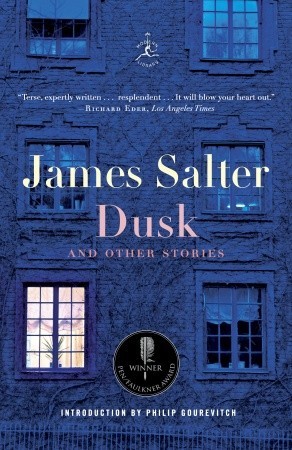
by
James Salter
ix
Introduction by Philip Gourevitch
0
terms
6
notes
ix
The pilot was called, as he had been from birth, James Horowitz. The writer called himself James Salter. He was handsome, and he had style. He lived in Europe. His prose announced itself with a high modernist elegance. He made language spare and lush all at once—strong feelings made stronger by abbreviation, intense physicality haunted by a whiff of metaphysics: for everything that is described, even more is evoked.
it's why i love him
x
The problem, Salter has said, was that the flying life was lived entirely in the present, and he chose the writing life instead because he wanted to make something continuous and permanent out of “this rubble of days.”
The problem, Salter has said, was that the flying life was lived entirely in the present, and he chose the writing life instead because he wanted to make something continuous and permanent out of “this rubble of days.”
x
In the sixties and into the seventies, he wrote screenplays. For Sidney Lumet he wrote The Appointment, and he saw his script made flesh by Omar Sharif, Anouk Aimée, and Lotte Lenya. For Robert Redford, he wrote Downhill Racer. He wrote two more movies that were made, and a dozen that were not, before the waste of spirit on work that never saw light took its toll and he gave it up. At the same time, he had written his most original and enduring novels, A Sport and a Pastime and Light Years, as well as the masterly stories in this collection, Dusk. These books all have the flickering hyper-vividness of cinema, the atmospherics, the jump-cut acuity, and that swift, skimming telegraphic emotion that gives a sense of immense depth to surfaces. Of course Salter achieves his effects without using anything more than any other writer—just words on paper—and so he makes other writers take notice and wonder how he does it.
<3
xi
“Because all this is going to vanish,” Salter told the poet Edward Hirsch in a 1993 interview for The Paris Review, the magazine where Salter had published his first stories. “The only thing left will be the prose and poems, the books, what is written down. Man was very fortunate to have invented the book. Without it the past would completely vanish, and we would be left with nothing, we would be naked on earth.”
One feels this reading him: that Salter is always bearing down on his own prose to make it yield his observations and perceptions with special precision. In his interview, he said that a short story must be compelling, it must be memorable, and it must be “somehow complete.” By way of example, Salter cited Isaac Babel, one of his heroes. He said: “He has the three essentials of greatness: style, structure, and authority.” These are the qualities of Salter’s work too; and for all the interiority, for all that is inventive and fanciful in these stories, they are drawn from deep in the well of life.
xi
“The notion that anything can be invented wholly and these invented things are classified as fiction and that other writing, presumably not made up, is called nonfiction strikes me as a very arbitrary separation of things,” Salter told Ed Hirsch. “We know that most great novels and stories come not from things that are entirely invented, but from perfect knowledge and close observation. To say they are made up is an injustice in describing them. I sometimes say that I don’t make up anything—obviously, that’s not true. But I am usually uninterested in writers who say that everything comes out of the imagination. I would rather be in a room with someone who is telling me the story of his life, which may be exaggerated and even have lies in it, but I want to hear the true story, essentially.”
“The notion that anything can be invented wholly and these invented things are classified as fiction and that other writing, presumably not made up, is called nonfiction strikes me as a very arbitrary separation of things,” Salter told Ed Hirsch. “We know that most great novels and stories come not from things that are entirely invented, but from perfect knowledge and close observation. To say they are made up is an injustice in describing them. I sometimes say that I don’t make up anything—obviously, that’s not true. But I am usually uninterested in writers who say that everything comes out of the imagination. I would rather be in a room with someone who is telling me the story of his life, which may be exaggerated and even have lies in it, but I want to hear the true story, essentially.”
xiii
“I believe there’s a right way to live and to die,” Salter said in his Paris Review interview.
“Do you mean to be discovered by each of us?” Hirsch asked him.
“No,” Salter said. “I don’t think it can be invented by everyone; that would be too chaotic. I’m referring to the classical, to the ancient, the cultural agreement that there are certain virtues and that these virtues are untarnishable.” Of course, his characters and the worlds they live in are frequently tarnished. Yet he is a writer who still believes in heroism, and he makes one feel that writing, when it is done well and truly, is as right a way to live and die as there is.
<3