
by
BOMB Magazine
(editor)
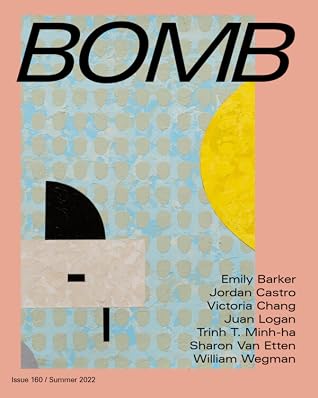
BOMB Magazine Summer 2022 (#160)
BOMB Magazine Summer 2022 (#160)
by
BOMB Magazine
(editor)
by
BOMB Magazine
(editor)
BOMB Magazine Summer 2022 (#160)
by
BOMB Magazine
(editor)
by
BOMB Magazine
(editor)
77
I’ll start my story again, this time with family. Call it filial piety. I am the daughter of a capitalist; that is to say, my mother needed money to feel safe. I don’t hold this against her. She was raised Chinese in the San Joaquin Valley in the 1950s. I don’t intend to explain this further; if you know, you know. Okay, so money keeps you safe. The problem with that paradigm is that there is never enough and never too much. Oh, the fragrant promise of capital! And all the immigrants buy in. Buy into what? The idea that we can own something that isn’t even ours to begin with.
After all, this is America, where every November is a pilgrim play, a feast, a holiday for the supermarkets to make their fortunes off of canned pumpkin. America, where not even Google can answer the only question about real estate worth asking: Who does this land belong to?
I’ll start my story again, this time with family. Call it filial piety. I am the daughter of a capitalist; that is to say, my mother needed money to feel safe. I don’t hold this against her. She was raised Chinese in the San Joaquin Valley in the 1950s. I don’t intend to explain this further; if you know, you know. Okay, so money keeps you safe. The problem with that paradigm is that there is never enough and never too much. Oh, the fragrant promise of capital! And all the immigrants buy in. Buy into what? The idea that we can own something that isn’t even ours to begin with.
After all, this is America, where every November is a pilgrim play, a feast, a holiday for the supermarkets to make their fortunes off of canned pumpkin. America, where not even Google can answer the only question about real estate worth asking: Who does this land belong to?
106
“My guests!” said the host, now standing once more. There was another empty chair to his right. Who had been there? A man with a mustache or a woman with a braid. Someone with a gleaming emerald ring. I drank more wine. “You are far too polite!” the host said. “We have hundreds and hundreds of songbirds for you, and hundreds more waiting in the kitchen! Try the goldcrest. Try the warbler. Don’t leave until you’ve tasted the regent bowerbird. The Gouldian finches are purple, turquoise, black, and blue. How can you argue with that?” he said. “Enjoy them while you can because they’ll be gone before you know it.”
What the host meant is that we were running out of the birds not on the table but rather: on the Earth. True, just that morning we had lost the yellow-bellied gecko, the North American mountain lion, the Tunisian hunting rat, the African nutria, and the Japanese water rhinoceros. The week before went the spotted dolphin, the reddish arctic leopard, and the subterranean crow. It was a tragedy, but we were growing used to it every day. I sighed to think that I had never tasted any of them.
the first paragraph is pretty funny but the second kind of ruins it. spoils the punchline essentially
“My guests!” said the host, now standing once more. There was another empty chair to his right. Who had been there? A man with a mustache or a woman with a braid. Someone with a gleaming emerald ring. I drank more wine. “You are far too polite!” the host said. “We have hundreds and hundreds of songbirds for you, and hundreds more waiting in the kitchen! Try the goldcrest. Try the warbler. Don’t leave until you’ve tasted the regent bowerbird. The Gouldian finches are purple, turquoise, black, and blue. How can you argue with that?” he said. “Enjoy them while you can because they’ll be gone before you know it.”
What the host meant is that we were running out of the birds not on the table but rather: on the Earth. True, just that morning we had lost the yellow-bellied gecko, the North American mountain lion, the Tunisian hunting rat, the African nutria, and the Japanese water rhinoceros. The week before went the spotted dolphin, the reddish arctic leopard, and the subterranean crow. It was a tragedy, but we were growing used to it every day. I sighed to think that I had never tasted any of them.
the first paragraph is pretty funny but the second kind of ruins it. spoils the punchline essentially
117
I’m sorry you’ve been falling into it. Nihilism is one of these words that has seeped into our everyday language, but people forget that Nietzsche’s nihilism diagnosis was a claim about the loss of transcendent values. It’s related to what we were just talking about. One of the ways Nietzsche defined nihilism is that it is what happens “when there is no Truth.” Modern secular people say they don’t believe in absolute Truth, but “there is no truth” is a truth claim. Instead, we have “my truth,” which doesn’t mean anything. It actually just means power—eventually “my truth” will come up against “your truth”—since there isn’t The Truth, all that is left is power. It’s the same with all of our other values. Now, we are subordinate to the market, which has infected every aspect of our lives: we are becoming timeless, placeless, history-less individuals, seeking the immediate fulfillment of our most base desires, scrambling for scraps of validation… We are nihilists. The Novelist is largely about trying to emerge from nihilism.
Earlier today Nicolette reminded me of an HTMLGIANT piece, where I kept saying how nothing is inherently good or bad… This is almost always just cope for living a shitty life. But tbh, I don’t know how much philosophy has helped me. I think “coming up against myself” enough to get humbled and then focusing on actions outside of my comfort zone—like prayer, nourishing friendships, lifting weights, trying to continually, incrementally change—helps more than anything. There are things we can only understand through the act; trying to understand everything beforehand doesn’t work. The Truth is not something you can just think or say. Truth does not belong to the Smarty-pants; it belongs to the fully alive human being, who increasingly conforms himself to Love.
the rest of the interview is a little disappointing cus it feels like a crude dismissal of politics but this is interesting
I’m sorry you’ve been falling into it. Nihilism is one of these words that has seeped into our everyday language, but people forget that Nietzsche’s nihilism diagnosis was a claim about the loss of transcendent values. It’s related to what we were just talking about. One of the ways Nietzsche defined nihilism is that it is what happens “when there is no Truth.” Modern secular people say they don’t believe in absolute Truth, but “there is no truth” is a truth claim. Instead, we have “my truth,” which doesn’t mean anything. It actually just means power—eventually “my truth” will come up against “your truth”—since there isn’t The Truth, all that is left is power. It’s the same with all of our other values. Now, we are subordinate to the market, which has infected every aspect of our lives: we are becoming timeless, placeless, history-less individuals, seeking the immediate fulfillment of our most base desires, scrambling for scraps of validation… We are nihilists. The Novelist is largely about trying to emerge from nihilism.
Earlier today Nicolette reminded me of an HTMLGIANT piece, where I kept saying how nothing is inherently good or bad… This is almost always just cope for living a shitty life. But tbh, I don’t know how much philosophy has helped me. I think “coming up against myself” enough to get humbled and then focusing on actions outside of my comfort zone—like prayer, nourishing friendships, lifting weights, trying to continually, incrementally change—helps more than anything. There are things we can only understand through the act; trying to understand everything beforehand doesn’t work. The Truth is not something you can just think or say. Truth does not belong to the Smarty-pants; it belongs to the fully alive human being, who increasingly conforms himself to Love.
the rest of the interview is a little disappointing cus it feels like a crude dismissal of politics but this is interesting
118
JE: I’ve had similar major shifts in my worldview, which I attribute to multiple causes, but mostly to sobriety and doing the things that it takes to be sober (“outside my comfort zone” things). I’m grateful for that. While I still slip into negative thinking, mostly I am able to find joy and wonder in small things, like a positive interaction with one of my students or even the seasons changing. Sometimes I think how funny it is that my life is so wholesome now, and how much better it is to seek a wholesome life, rather than the life of chaos that I avoided personal responsibility for because I thought of myself as having an “artistic temperament” or whatever. (Which I guess is still true, given my emotional volatility, but at least now I attempt to regulate it.) Sometimes I think I’m ridiculous because I’ve gotten into sober clichés like meditation and exercise. I think it’s cute/funny that you’ve turned to weightlifting and Jesus for similar reasons. How do you feel about being a sober cliché?
JE: I’ve had similar major shifts in my worldview, which I attribute to multiple causes, but mostly to sobriety and doing the things that it takes to be sober (“outside my comfort zone” things). I’m grateful for that. While I still slip into negative thinking, mostly I am able to find joy and wonder in small things, like a positive interaction with one of my students or even the seasons changing. Sometimes I think how funny it is that my life is so wholesome now, and how much better it is to seek a wholesome life, rather than the life of chaos that I avoided personal responsibility for because I thought of myself as having an “artistic temperament” or whatever. (Which I guess is still true, given my emotional volatility, but at least now I attempt to regulate it.) Sometimes I think I’m ridiculous because I’ve gotten into sober clichés like meditation and exercise. I think it’s cute/funny that you’ve turned to weightlifting and Jesus for similar reasons. How do you feel about being a sober cliché?
139
My mind returns to Mitch and my sister. He and Ashley got together so long ago I don’t remember introducing them but they both swear I did. I gave a sloppy, immemorable speech at the wedding that referenced their shared passion for itineraries. Now they’re getting divorced. Ignoring it until you can’t is the only reasonable human response. The clichést of clichés: Mitch got caught banging his paralegal. He swore he’d ended it, then got caught again. Ashley kicked him out of their Capitol Hill apartment and served him with papers. It splattered public two weeks into the season. Another group chat was formed, sans Mitch. Unfair to boot him for his personal life, went one argument. More unfair to Thrope to not boot him, went the counter. The latter won out because Ali argued it, and she’s both our alpha and our lawyer. So we’d play out the rest of the year, and find a replacement in the offseason. Could I have quit the league? Made a quiet act of loud solidarity with my sister? Yes. But I didn’t. Mitch put us in this position. Not me.
My mind returns to Mitch and my sister. He and Ashley got together so long ago I don’t remember introducing them but they both swear I did. I gave a sloppy, immemorable speech at the wedding that referenced their shared passion for itineraries. Now they’re getting divorced. Ignoring it until you can’t is the only reasonable human response. The clichést of clichés: Mitch got caught banging his paralegal. He swore he’d ended it, then got caught again. Ashley kicked him out of their Capitol Hill apartment and served him with papers. It splattered public two weeks into the season. Another group chat was formed, sans Mitch. Unfair to boot him for his personal life, went one argument. More unfair to Thrope to not boot him, went the counter. The latter won out because Ali argued it, and she’s both our alpha and our lawyer. So we’d play out the rest of the year, and find a replacement in the offseason. Could I have quit the league? Made a quiet act of loud solidarity with my sister? Yes. But I didn’t. Mitch put us in this position. Not me.
144
He pulls a piece of paper from his jacket. It’s folded down the middle with crisp exactness; Mitch has always been an attentive person. He begins to read in a low whisper, his voice shaky but rehearsed. His letter includes words like unhappiness and change and finding our true selves. It does not include words like abortion. When he starts talking about the past, and the importance of old friendships, I tune out and study his face. Its worn, pallid, large, raccoon eyes may not signify sleeplessness but sure as hell suggest it. There’s gray in his stubble, too, and not just here or there. He’s miserable. Of course he is.
My eyes slide over to the game on the television, and not only because Mitch’s kicker is lining up for a field goal. When I look back, he’s stopped reading from his letter.
“You ever cheat?” he asks.
It’s a sudden question. It’s also one he possesses the answer to.
“Julie,” I say. “You remember all that.” I pause and narrow my eyes to shards. “We were 17.”
I hate Mitch, I know now that I always will. But deep down? Deep down, I understand him. That hurts more than turning against a friend from the past ever could.
“Just her?” he asks. “That’s it?”
“Yes,” I lie.
Once. A couple times. On girlfriends, sure, but that doesn’t change the hurt, only its scale. I have to forgive myself, I think, watching Mitch fold up his paper speech and ask for another round. But I don’t have to forgive you.
oooooo
He pulls a piece of paper from his jacket. It’s folded down the middle with crisp exactness; Mitch has always been an attentive person. He begins to read in a low whisper, his voice shaky but rehearsed. His letter includes words like unhappiness and change and finding our true selves. It does not include words like abortion. When he starts talking about the past, and the importance of old friendships, I tune out and study his face. Its worn, pallid, large, raccoon eyes may not signify sleeplessness but sure as hell suggest it. There’s gray in his stubble, too, and not just here or there. He’s miserable. Of course he is.
My eyes slide over to the game on the television, and not only because Mitch’s kicker is lining up for a field goal. When I look back, he’s stopped reading from his letter.
“You ever cheat?” he asks.
It’s a sudden question. It’s also one he possesses the answer to.
“Julie,” I say. “You remember all that.” I pause and narrow my eyes to shards. “We were 17.”
I hate Mitch, I know now that I always will. But deep down? Deep down, I understand him. That hurts more than turning against a friend from the past ever could.
“Just her?” he asks. “That’s it?”
“Yes,” I lie.
Once. A couple times. On girlfriends, sure, but that doesn’t change the hurt, only its scale. I have to forgive myself, I think, watching Mitch fold up his paper speech and ask for another round. But I don’t have to forgive you.
oooooo