
View all notes
Available query params: commented=1, untagged=1
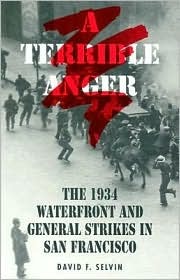
The year 1934 was marked across the country with protest against the suffering, the degradation, and the oppression of the Great Depression. Millions of workers clutched at hopes raised by Franklin Delano Roosevelt's New Deal. Some million and a half workers gave up nineteen million days of work in the nationwide industrial battle. Almost half of the disputes were fought mainly over the simple right to organize and bargain collectively. For two months, in San Francisco and along the entire Pacific Coast, the longshoremen and the seamen had been locked in one struggle in this nationwide battle.
And now, this somber procession bore the coffins of two men killed in a battle with police on July 5-the day imprinted as Bloody Thursday in the legends of San Francisco's storied waterfront. The first truck, escorted by a veterans' honor guard, carried the flagdraped casket of Howard S. Sperry, a longshoreman; the second, decorated by a simple spray of flowers, the casket of Nick Counderakis, a cook, known in the Communist Party as Nick Bordoise. They were followed by trucks banked high with flowers, a string of funeral cars carrying the mourning families, the lone band droning a death march, and a dozen men carrying a giant American flag.
On they came, a dark surge of humanity, under a cloudless blue sky. Their dark clothes and grim silence were in stark contrast to the bright flags and pennants under which the brass bands and black uniforms, shining swords and white plumes of the Knights of Pythias had paraded the day before. On they came, in an unending stream, rank after roughly formed rank: strikers, sympathizers, supporters, the Women's Auxiliary of the ILA, and wives and children.
No one agreed on the number. Ten thousand, fifteen thousand, were frequently used counts. "At least 15,000," said the San Francisco Chronicle, but still "uncountable." "Fifty thousand is more like the correct figure," remembered Henry Schmidt, a longshoreman and a strike leader. 2 Whatever the number, more thousands rounded the Steuart Street corner, making their way between silent ranks of onlookers lining the sidewalks on Market Street for blocks. No talk. No strike signs. No banners. No police.
The police report called it a "general riot." Two inspectors, the police report said, found themselves surrounded by a mob, shouting "kill them!" Strikers showered the officers with rocks and bricks and threatened to overturn their car. "Feeling that their lives were in danger, the officers fired two shots from a shotgun and several shots from their revolvers at the men who were attempting to overturn the car," the report said. "The two men who were struck with the bullets from the inspectors' guns later died." Strike leader Harry Bridges told the coroner's inquest that, emerging from the strike kitchen a block away, he had seen no bricks being thrown until after the shots were fired. A second witness saw no bricks thrown, either. He testified that, in response to threats to overturn the car, the officer had shouted, "If any of you sons-of-bitches want to start something, come on."
Paul Eliel was at the time a top-ranking staff member of the Industrial Association, the employers' premier anti-union force and, at that moment, the shipowners' strikebreaking agency. In his detailed account of that summer's strikes, he called the funeral "the most theatrically ominous and significant event in the history of the entire longshore and general strike." He insisted-with only partial accuracy-that it was largely the creation of the strike leaders-"a brilliant and theatric piece of propaganda." It was not the first time, or the last, that the employers (whose views were effectively mirrored in Eliel's account) refused to credit the simpler, and less calculated, more basic responses of the strikers. His appraisal, too, ignored the enormous content of sheer emotion-anger, protest, sympathy-that welled up in that march, in its numbers and its awesome silence. Nevertheless, he grasped the stunning impact of what he called "one of the strangest and most dramatic spectacles that had ever moved along Market Street."
Its dramatic qualities moved the entire community without regard to individual points of view as to the justice and righteousness of the strikers' cause. It created a temporary but tremendous wave of sympathy for the workers. . . . It provided the impetus that made events which followed as inevitable as though the human beings involved in the subsequent drama had been moved by vast physical forces over which they had no control. As the last marcher broke ranks, the certainty of a general strike, which up to this time had appeared to many to be the visionary dream of a small group of the most radical workers, became for the first time a practical and realizable objective.
A week later, the general strike was a reality. By that astonishing day, the strike was no longer a surprise but its dimensions as well as its substance, especially in the light of the newspapers' doomsday predictions, amazed the watching Western world. Workers by the thousands, in San Francisco and the East Bay, union and nonunion, left their jobs. Hundreds of businesses, factories, and ware- houses closed, many when their employees failed to show up, some out of sympathy, some from uncertainty and fear. Public services halted, then slowly, piecemeal, resumed. The newspapers had warned of hunger and riot but there was neither. By the end of the fourth day, it was over.
But the general strike opened the way, finally, after eighty-two bitter days, to end the longshoremen's and the maritime workers' strikes. They ended under an agreement to arbitrate the issues in dispute; the resulting changes encompassed more than the revised wage scales and changed working conditions handed down by the arbiters. The real settlement, as it turned out, produced radical, fundamental, and permanent changes in the economic relations between employer and employee in the then-massive and powerful Pacific Coast maritime industry. The settlement raised the curtain on a vigorous and aggressive drive by longshoremen and seamen to take charge of their jobs. The movement went beyond the blackand-white of new contracts to exert decisive control over the distri- bution of jobs, the pace of the work, the conditions on the job, safety-the very job control that employers had exercised unilaterally, without consultation or conscience. The settlement also pro- duced a long-desired but short-lived coastwide federation of maritime workers.
At 6:00 A.M., June 1, 1916, some 10,000 longshoremen up and down the Pacific Coast struck to enforce the new wage scale and working conditions established by the recently concluded convention of the ILA's Pacific Coast District. If employers resisted the demands, put up a fight, or sought a local settlement or local negotiations, the port unions were instructed to refer them to the district executive board. It alone was empowered to settle the strike.
This, the first coastwide strike of longshoremen, had been building almost from the turn of the century. Unionism had come early to the other Pacific Coast ports: Longshoremen in Portland formed a "Protective Union" in 1868. In the 1880s, Tacoma longshoremen organized a cooperative in an effort to restrict the labor force and limit the competition for jobs. In the last years of the old century, San Pedro began developing a spacious inner harbor and, soon after, longshoremen in San Pedro organized a union. In 1901 Seattle longshoremen joined the ILA. Local unions in the dozen or more ports in Oregon and Washington in 1908 formed the Longshoremen's Union of the Pacific in an unsuccessful effort to rescue a desperate strike. In 1909, recuperating from its disastrous loss, the coastwide union became District 38 of the ILA, with a sweeping grant of autonomy that played a key role in the strike twenty-five years later. Of the twenty-six unions on the coast, only the Riggers' and Stevedores' in San Francisco held out. Finally, in 1914, it, too, affiliated.
Alex Walthers, an old-time longshoreman who spoke at the funeral services for the victims of Bloody Thursday in 1934, recalled the 1919 longshoremen's strike. "I took part in the 1919 strike, and we were holding out very well, and then our strike committee prevailed upon the membership to make an additional demand. That is to demand that the union be given representation on the employer board. Trying to get union men on their board. That helped to break us up," 9 he said. Twenty-one years later, Thomas Plant remembered, horror underlying his words, two of the demands made in 1919: "25 percent stock ownership in each of the steamship companies, together with a number of seats on the boards of directors."
These startling demands emerged from a background of turbulence that marked the end of both World War I and the wartime truce between workers and their employers. Talk of nationalization flourished, with the railroads and coal mines prime candidates. Attacks on radicals, real and imagined, spread. Prices climbed, unrest mounted, strikes broke out. Union-open shop feuds stilled by wartime conditions were revived.
lol
In mid-December, a group of foremen organized the Harmony Club, sometimes called the "Bosses' Club," ostensibly to encourage a brotherly feeling and end rivalry among themselves. From it, came a new union, shorn of its "radical element" and called the Longshoremen's Association of San Francisco and the Bay District. The Waterfront Employers Union promptly entered into a fiveyear closed-shop contract. No man, the shipowners announced, could work without the blue dues book of the new union. For fourteen years, the Blue Book union dominated the San Francisco docks and the lives of the longshoremen. Paul Eliel, the Industrial Association's industrial relations director, thought it was "probably in- spired by the employers," but was neither "company-dominated" nor "completely independent." 13 To Plant twenty years later, "It so happened that a large number of the longshoremen had gotten sick and tired of their radical leadership and it was overthrown." He added, "I think we can refer to the fourteen years that followed as fourteen years of peace." 14
this is in 1916
To most longshoremen, however, the Blue Book union was an
unqualified company union, employer-dominated, employer-
controlled. The Harmony Club had been formed under the em-
ployers' prodding, they said. Its president had "collaborated with
the employers to set up a company union." The employers had
provided headquarters for the new organization, the Wateifront
Worker reported later. In the end, two unarguable results emerged:
The Riggers' and Stevedores' of the ILA were smashed; the Blue
Book union dominated the waterfront.
The voluble Captain Dollar told the National Association of
Manufacturers: "Up to the time of the strike San Francisco had
been known as the tightest 'closed shop' city in the world. When
the last rumble of the dock strike had died away, the labor aspects
in San Francisco had undergone a complete change. It became
known as the most wide 'open shop' community in America. How
shipping men brought this about has lots of thrills." 16
In 1921, shipowners served demands on their ship crews for a 15 to 25 percent cut in pay, the elimination of overtime, and a return to the two-watch system (an increase in weekly hours from 56 to 84). The wartime Shipping Board, still operating a major portion of the nation's merchant marine, backed their demands. When the board and the operators unilaterally imposed a wage cut, six unions of licensed and unlicensed seamen struck. The operators retaliated by declaring an open shop on their ships. War-trained sailors, jobless workers, and strikers drifting back to their jobs broke the strike and it was called off in mid-summer. Andy Furuseth, the Sailors' Union chief who had seen his union membership crumble from 115,000 in 1919 to 16,000 in 1923, commented: "We have lost many battles before and this is only one more battle lost. . . . We can and shall win again, if you can see the way and have the courage to walk it."
Thus, in the half-decade following the war, the shipowners and waterfront employers swept the docks and ships clear of unions, taking total, unilateral control of employee relations and job conditions. In the decade or more ahead, they exercised that dominance through employment systems stripped of employee input, pressed by unending mechanization, and driven by an insatiable demand for production and profit. From these years, the employers reaped the "terrible anger" that honed the issues, the tactics, and the goals that would surface explosively in the summer of 1934.