
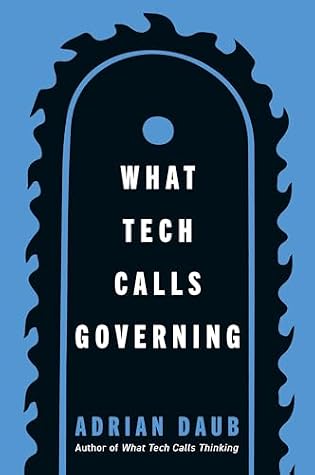
by
Adrian Daub
104
The Long Term
0
terms
1
notes
106
[...] One reason why we simply ignore the failures of the Boring Company, like those of the Metaverse or self-driving Teslas, and then eventually collectively forget them, is because we generally tend to talk and complain about government projects in this way. Think what you will about the California High Speed Rail, but the new system will definitely be more useful once built than the Las Vegas Loop. Even when Silicon Valley's efforts become monuments to hubris, failure, and incompetence, they are indicators of power.
Because, as is almost always the case when Silicon Valley talks about itself these days, they are based on the unspoken distinction of who is allowed what. In a September 2025 interview, Mark Zuckerberg said that Meta's investments in Al might not pay off. "If we end up having wasted a few hundred billion dollars, that would, of course, be very unfortunate," Zuckerberg said!" But it was important to be involved. He considered AI "the most important technology enabling the most new products, innovations, and value creation in history." A potential $600 billion of wasted investment, he argued, was the lesser of two evils. This was six months before the company quietly sunsetted the metaverse, another 8o billion dollar investment that failed to pay off.
Skepticism toward government power can be a very good thing. But those who criticize the capacity of government have simply redirected their childlike belief in the creative potential of the central state toward private industry. They now naively believe that the future is identical with whatever the Silicon Valley tinkerers will present at the next developers' conference. More importantly, they believe that the founders' mistakes, ruins, and failures are merely minor hitches along the path to a future dominated by them. Everything the state touches gives them cause for skepticism, a sign that the nation-state and its specific form of sovereignty are on the wane. Nothing-no Vegas Loop, no metaverse, no AI nonsense clogging every communication channel—can shake their belief that the tech giant and its specific form of sovereignty represent the future
[...] One reason why we simply ignore the failures of the Boring Company, like those of the Metaverse or self-driving Teslas, and then eventually collectively forget them, is because we generally tend to talk and complain about government projects in this way. Think what you will about the California High Speed Rail, but the new system will definitely be more useful once built than the Las Vegas Loop. Even when Silicon Valley's efforts become monuments to hubris, failure, and incompetence, they are indicators of power.
Because, as is almost always the case when Silicon Valley talks about itself these days, they are based on the unspoken distinction of who is allowed what. In a September 2025 interview, Mark Zuckerberg said that Meta's investments in Al might not pay off. "If we end up having wasted a few hundred billion dollars, that would, of course, be very unfortunate," Zuckerberg said!" But it was important to be involved. He considered AI "the most important technology enabling the most new products, innovations, and value creation in history." A potential $600 billion of wasted investment, he argued, was the lesser of two evils. This was six months before the company quietly sunsetted the metaverse, another 8o billion dollar investment that failed to pay off.
Skepticism toward government power can be a very good thing. But those who criticize the capacity of government have simply redirected their childlike belief in the creative potential of the central state toward private industry. They now naively believe that the future is identical with whatever the Silicon Valley tinkerers will present at the next developers' conference. More importantly, they believe that the founders' mistakes, ruins, and failures are merely minor hitches along the path to a future dominated by them. Everything the state touches gives them cause for skepticism, a sign that the nation-state and its specific form of sovereignty are on the wane. Nothing-no Vegas Loop, no metaverse, no AI nonsense clogging every communication channel—can shake their belief that the tech giant and its specific form of sovereignty represent the future