
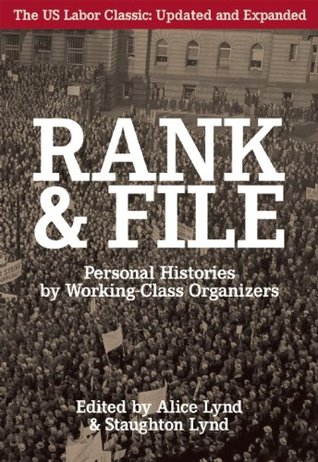
by
Alice Lynd,
Staughton Lynd
(editors)
149
I Appeal the Ruling of the Chair
by Burr McCloskey
(missing author)
by Burr McCloskey
(missing author)
0
terms
3
notes
153
My father, who was crippled and alcoholic, wouldn't go on WPA. He was too proud to go on WPA. He didn't believe in taking help. He had been a salesman; he sold tires. He was a good salesman but he was pushed into the sales mold because he had a club foot. Alcoholics Anonymous started in Akron, and my father was one of the early recruits-prominent in AA until he died. He always regarded the Depression as his own personal fault, and refused to lump himself into an abstract statistic.
lol
My father, who was crippled and alcoholic, wouldn't go on WPA. He was too proud to go on WPA. He didn't believe in taking help. He had been a salesman; he sold tires. He was a good salesman but he was pushed into the sales mold because he had a club foot. Alcoholics Anonymous started in Akron, and my father was one of the early recruits-prominent in AA until he died. He always regarded the Depression as his own personal fault, and refused to lump himself into an abstract statistic.
lol
160
[...] there was no smoking in the shop. I worked in the fifth floor tire room, and you had to go all the way down the stairs and walk about two city blocks to a railroad siding, where you could smoke. And we were all on piecework. The only way you could afford time for a smoke was if you had rates good enough to allow you to take the time off. You had to pay for your own sins. They sent around chow wagons, packaged foods. We never touched them. We'd shut our machines down, wash our hands and faces, go out of the plant and across the street and have a meal like a human being. We were allowed twenty minutes, but we took fifty and paid for it.
[...] there was no smoking in the shop. I worked in the fifth floor tire room, and you had to go all the way down the stairs and walk about two city blocks to a railroad siding, where you could smoke. And we were all on piecework. The only way you could afford time for a smoke was if you had rates good enough to allow you to take the time off. You had to pay for your own sins. They sent around chow wagons, packaged foods. We never touched them. We'd shut our machines down, wash our hands and faces, go out of the plant and across the street and have a meal like a human being. We were allowed twenty minutes, but we took fifty and paid for it.
162
I always knew in a fight - a picket line, or a union meeting, or a political faction struggle - whether somebody was on my side or not. You learn to recognize the cohorts who will be there when the chips are down. The chips were down about all the time. I'm proud to say that my closest friends today are men and women who were with me in these struggle situations thirty-five years ago.
They always said that anybody from the radical movement in Akron had a certain look around their eyes. We were mavericks in the radical labor movement. We were intellectualized activists. We fought every battle there was to fight. Student fights. Unemployed fights. Anti-ROTC fights. Anti-conscription fights. Anti-Legion fights. Anti-management fights. Anti-Union-boss fights. Anti-CP fights. Anti-Jim Crow fights. You name it. We were there.
<3
I always knew in a fight - a picket line, or a union meeting, or a political faction struggle - whether somebody was on my side or not. You learn to recognize the cohorts who will be there when the chips are down. The chips were down about all the time. I'm proud to say that my closest friends today are men and women who were with me in these struggle situations thirty-five years ago.
They always said that anybody from the radical movement in Akron had a certain look around their eyes. We were mavericks in the radical labor movement. We were intellectualized activists. We fought every battle there was to fight. Student fights. Unemployed fights. Anti-ROTC fights. Anti-conscription fights. Anti-Legion fights. Anti-management fights. Anti-Union-boss fights. Anti-CP fights. Anti-Jim Crow fights. You name it. We were there.
<3