
View all notes
Available query params: commented=1, untagged=1

There is so much to say about a system that increasingly treats housing as a means to accumulate capital, never as a home. A creeping worldview that only understands the value of housing as a commodity, as something to be bought and sold, speculated in, land banked. To them, where you live is only a piece of property subject to global markets, real estate whose value is tied to location and status rather than its conditions, the wellbeing or stability of its tenants, its impact on the neighbourhood. By this system, boarded up and empty houses with front yards full of weeds are somehow worth more than deeply-loved homes that have witnessed the joy and pain of generations and yield harvests, or seasons of flowers.
pretty
their deaths happened long
Before. It happened in the minds of people who never saw
Them. It happened in the profit margins. It happened
In the laws. They died because money could be saved and made.
poem by Ben Okri on Grenfell
What will happen now if our growing resistance does not create change? The housing policies of the Tory government will inflict ever-deeper violence of both kinds on the most vulnerable, shored up by moralising around cheap ideas of self-help and responsibility. On 24 June a Guardian headline said it all in quoting a new report from Shelter: ‘Housing Crisis Threatens a Million Families with Eviction by 2020’. There is little that is ‘new’ in this new housing crisis, just new depths to the cuts to benefits already cut to the bone, new breadth to their reach to tear away basic necessities from more and more people. We are watching a car crash in slow motion. [...]
The mass building of council houses, the removal of restrictions on councils building, regulating the private rented sector to secure tenancies, restrain rent raises and ensure adequate conditions, housing-first provision for rough sleepers, reversing benefit sanctions and caps, changing a planning framework that guarantees obscene profits to developers and so much more … the holistic nature of the proposed changes is inspiring. It undercuts the idea of housing as something to generate profits, housing as commodity.
This is the first thing that must be done. Stop the worst of the violence, clear the way to what matters.
We must start there, though, only that we aim higher, do better. That we think about how to make of housing not a commodity nor just a shelter, but a home. That we think of how that process happens, how we are able to take space and make it our own as households, and more collectively in our buildings or estates or neighbourhoods. That we take seriously how home nurtures our selves and futures. That housing associations and councils rip up the petty rules and regulations that treat their tenants as the enemy. That we look at sweat equity, self-build, cooperatives and land trusts. That we transform our unused and unloved spaces to permanent benefit to the community. That we think about how sustainability connects to the wealth of local and natural materials that could be used to retrofit and build or the integration with green space and gardens or the green jobs that could be created. That we think about how we each connect to our home and through it to a vibrant hybrid culture and to a broad and welcoming community where we can grow old gracefully while space remains for our children and their children. Ownership is not necessary for this; rather, secure tenancies and management structures granting the ability to shape our spaces according to needs and desires, to try new things, fail and try again, to build and paint and transform. It sounds utopian until you remember we are conditioned to think of housing as an asset to be managed, not a space that to support our passions and our dreams. Knitted into communities, houses should redefine sustainability and living well upon the earth. [...]
i like her style
[...] These are only a handful of inspiring spatial movements I am aware of. There are so many more. All this is possible.
But we live under logic that justifies buildings boarded up, left to fall apart, investment flats built to sit empty, while crisis rages and people must choose between housing they cannot afford, housing that could kill them, and no housing at all.
again, i like her style
The slogan of the ZAD is ‘ZAD partout,’ (‘ZAD everywhere’), a goal which, however desirable, is ultimately impossible. The ZAD’s emphasis on self-sufficiency obscures the visitors who bring money and alcohol, the supermarket that doesn’t lock its bins, the factories which made the tyres for the barricades, which are all absolutely indispensable elements of the ZAD. The ZAD is self-reflexive but it is not self-sufficient. There’s no doubt that the 200 inhabitants are capable of looking after themselves. They are doing a superb job of growing their own food and organising a complex and peaceful community in a relatively small area of land. But their pride in this achievement ignores that their relations with the outside world, however fragile and minute, maintain the ZAD to an extent beyond that which they would like to be the case. The ZAD, which sets itself against the outside world and simultaneously relies on the outside world to exist, is in contradiction with itself.
kinda cool
In the conventional, thetic, paranoid form of reading imposed on children, every text is a kind of a puzzle. You can read it simply, enjoying the shape of the words in your mouth, their indistinct resonances, their minute associations which seem to hold a special meaning for you and you alone, or the ones which float in the clear vastness of possibility and never need to settle down and become fixed; you can take joy in the act of reading, and understand it as a perpetual collaboration between yourself and an author you've never met. [...]
i do like his writing style tbh
The liberal technocrats who complain that truth is being devalued and the determined believers who gibber that it still needs to be uncovered both have their legs broken in the same trap. They're stuck in a world built by bad literary criticism and the grammtological magicians of the CIA. They're stuck in the abyss under words, the land of secret incomprehension.
Our era is not post-truth. It's nowhere near there yet. We're pre-meaning, and we've been there for a very long time.
not sure i fully subscribe to what he's saying at the end but i like the confidence lol
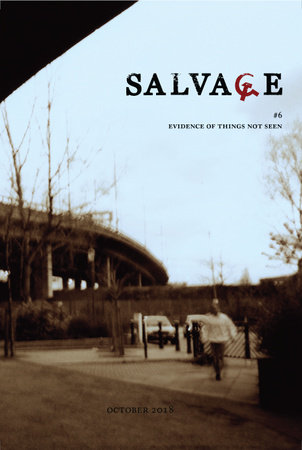
Salvage #6: Evidence of Things Not Seen
by
multiple authors
by
multiple authors
Salvage #6: Evidence of Things Not Seen
by
multiple authors
by
multiple authors
Salvage #6: Evidence of Things Not Seen
by
multiple authors
by
multiple authors
Poetry arises from the desire to get beyond the finite and the historical - the human world of violence and difference - and to reach the transcendent or divine. You're moved to write a poem, you feel called upon to sing, because of that transcendent impulse. But as soon as you move from that impulse to the actual poem, the song of the infinite is compromised by the finitude of its terms. In a dream your verses can defeat time, your words can shake off the history of their usage, you can represent what can't be represented [....] but when you wake [...] you're back in the human world with its inflexible laws and logic. Thus the poet is a tragic figure. The poem is always a record of failure.
from The Hatred of Poetry
[...] If we could separate meaning from sound, he adds, 'we'd read plot summaries rather than novels.' Or, in the domain of politics, listicles rather than the Communist Manifesto. But the fact that the common sense is what it is, indicates how much of the history of writing has been repressed: the idea of peering through a series of coloured knots onto reality would seem to be a profound misunderstanding of what the knots were for. Knots might illuminate, but they can't get out of the way of their own meaning. Yet we think we can use language as though it could be, and should aspire to be, as transparent as a windowpane. We expect language to get out of the way. We demand clarity.
The demand for clarity in its modern sense is ideologically suspect, rooted in an idealistic metaphysic of meaning, but it is seductive because it appears to be inclusive and democratic in its approach to communication. Its apparent obverse, say, 'obscurity', is regarded as an elitist practice, akin to obfuscation. [...]