
by
Tom Wolfe
View all notes
Available query params: commented=1, untagged=1
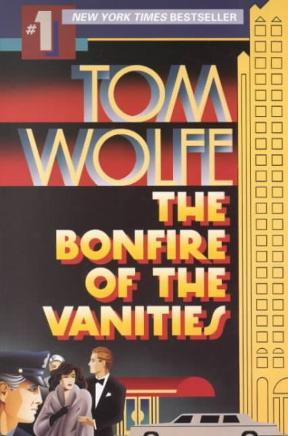
Having less than forty dollars to get him through the next three days, he had done the usual. He had called up a Yank. He had called up Gil Archer, the literary agent, who was married to a woman whose name Fallow could never remember. He had suggested that they meet for dinner at Leicester's, leaving the impression he would be bringing a girl along himself. Archer arrived with his wife, whereas he arrived alone. Naturally, under the circumstances, Archer, ever the bland polite Yank, picked up the bill. Such a quiet evening; such an early evening; such a routine evening for an Englishman in New York, a dull dinner paid for by a Yank; he really was thinking about getting up and going home. [...]
The Regent's Park was the sort of New York restaurant favored by married men having affairs with young women. It was grand, glossy, and solemn, with a great deal of marble inside and out, a colossal stiff neck whose hauteur appealed mainly to people staying at the nearby Ritz-Carlton, Park Lane, St. Moritz, and Plaza Hotels. In the history of New York no conversation had ever begun with: "I was having lunch at the Regent's Park the other day and ..."
True to his word, Albert Vogel had secured a table beside the great window. This was not a hard ticket at the Regent's Park. Nevertheless, there it was, the park, in its springtime glory. And there was the statue of Jose Marti, which Vogel had also promised. Marti" s horse was rearing up, and the great Cuban revolutionary was leaning perilously to the right in his saddle. Fallow averted his eyes. An unsteady park statue was too much to contend with.
"These goddamned girls." Vogel shook his head and stared off distractedly for a moment, as if stunned by the very thought. "I swear to God, Pete, you have to hold yourself back. Otherwise, you'd feel so fucking guilty. These girlstodaywell, when I was growing up, the big deal was that when you went to college, you could drink when you felt like it. Okay? These girls, they go to college so they can get laid when they feel like it. And who do they want? This is the part that's really pathetic. Do they want nice-looking healthy boys their own age? No. You wanna know who? They want . . . Authority . . . Power . . . Fame . . . Prestige . . . They wanna get laid by the teachers! The teachers go crazy at these places now. You know, when the Movement was going strong, one of the things we tried to do on the campuses was to break down that wall of formality between the faculty and the students, because it was nothing but an instrument of control. But now, Jesus Christ, I wonder. I guess they all want to get laid by their fathers, if you believe Freud, which I don't. You know, this is one thing the women's movement has made no headway with. When a woman reaches forty, her problems are just as big now as they ever were -- and a guy like me has never had it so good. I'm not so old, but, f'r Chrissake, I've got gray hair"
"Well, basically, it's just some kid in the South Bronx who gets hit by a car, as far as they're concerned. They can't be bothered. But what they're saying is, there were no witnesses, except for the victim himself, and he's in a terminal coma, and so they wouldn't have a case even if they found the car and the driver. Now, suppose this were your son. He's provided the information, but they're not going to use it because technically it's hearsay."
The whole thing made Fallow's head hurt. He couldn't imagine having a son, and certainly not in some council flats in the Bronx section of New York City in America.
Fallow tried to conceive of transferring the mercury egg and his bilious innards to the Bronx. He could scarcely imagine surviving the trip. From his viewpoint the Bronx was like the Arctic. It was somewhere to the north, and people didn't go there.
Maybe the whole thing was one of God's warnings. Why didn't he and Judy and Campbell get out of the madness of New York . . . and the megalomania of Wall Street? Who but an arrogant fool would want to be a Master of the Universeand take the insane chances he had been taking? A close call! . . . Dear God, I swear to you that from now on ... Why didn't they sell the apartment and move out here to Southampton year roundor to Tennessee . . . Tennessee ... His grandfather William Sherman McCoy had come to New York from Knox-ville when he was thirty-one ... a hick in the eyes of the Brownings . . . Well, what was so wrong with good American hicks! . . . Sherman's father had taken him to Knoxville. He had seen the perfectly adequate house where his grandfather had grown up ... A lovely little city, a sober, reasonable little city, Knoxville . . . Why didn't he go there and get a job in a brokerage house, a regular job, a sane, responsible job, not trying to spin the world on its head, a nine-to-five job, or whenever it is they work in places like Knoxville; $90,000 or $100,000 a year, a tenth or less of what he so foolishly thought he needed now, and it would be plenty ... a Georgian house with a screen porch at one end ... an acre or two of good green lawn, a Snapper lawn mower that he might operate himself occasionally, a garage with a door that opens with a Genie that you keep clipped onto the visor of your car, a kitchen with a magnetic bulletin board where you leave messages for each other, a cozy life, a loving life, Our Town . .
Judy launched into a description of his Giscard scheme. Then she said to his father, "Pierce & Pierce doesn't issue them for the French government and doesn't buy them from the French government but from whoever's already bought them from the French government. So Pierce & Pierce's transactions have nothing to do with anything France hopes to build or develop or ... achieve. It's all been done long before Pierce & Pierce enters the picture. So they're just sort of ... slices of cake. Golden cake. And Pierce & Pierce collects millions of marvelous" -- she shrugged -- ''golden crumbs."
"You can call them crumbs if you want," said Sherman, trying not to sound testy, and failing.
"Well, that's the best I can do," Judy said brightly. Then to his father and mother: "Investment banking is an unusual field. I don't know if there is any way you can explain it to anyone under twenty. Or perhaps under thirty."
Sherman now noticed that Campbell was standing by with a distressed look on her face. "Campbell," he said, "you know what? I think Mommy wants me to change professions." He grinned, as if this were one of the funniest discussions in years.
"Not at all," said Judy, laughing. "I'm not complaining about your golden crumbs!"
Crumbs -- enough! He could feel his anger rising. But he kept on smiling. "Perhaps I ought to try decorating. Excuse me, interior designing."
Greg was off on a disquisition on all the bourgeois elements who were now attracted to the artists' quarter. Why didn't he start with himself? Look at him. A wavy red beard as big as the King of Hearts's hiding his receding chin ... a blackish-green tweed jacket with enormous shoulders and lapels with notches down around his ribs ... a black T-shirt with the logo of the Pus Casserole, the band, across the chest . . . black pegged pants ... the Greasy Black look that was so ... so Post-Punk, so Downtown, so ... of the moment . . . And in fact he was a nice little Jewish boy from Riverdale, which was the Short Hills of the New York City limits, and his parents had a nice big Colonial house, or Tudor, or whatever it was ... A middle-class twerp ... a writer for The Village Voice, a know-it-all, possessor of Mary Lou Downy Shanks . . . Greg had started living with Mary Lou when she enrolled in the Investigative Journalism seminar he was teaching at N.Y.U. two years ago. She had a fantastic body, outstanding breasts, and classic Wasp looks. She stood out on the N.Y.U. campus like somebody from another planet. Kramer called her Mary Lou Love-Greg, which was a way of saying she had given up her actual identity to live with Greg. She bothered them. She bothered Kramer most of all. He found her dense, distant -- intensely desirable. She reminded him of the girl with brown lipstick. And for this he envied Greg most of all. He had taken this gorgeous creature and possessed her, without assuming any obligations, without getting stuck in an ant colony on the West Side, without having an English nanny sitting on his neck, without having a wife he had to watch turning into her shtetl mama . . . Kramer cut a look at Rhoda and her beaming puffy face and immediately felt guilty. He loved his new son, he was bound to Rhoda, forever, in a sacred way . . . and yet . . . This is New York! And I'm young!
"You talk like that's out of the question. I bet IBM has plenty of programs for minorities, but Herbert wouldn't want one a their jobs if they gave it to him. Herbert is a player. He's a hustler who tries to cover himself with this religious mantle, and he just goes on being childish, egocentric, irresponsible, shiftless"
Suddenly it dawned on Kramer that they were all looking at him in a funny way, all of them. Rhoda . . . Mary Lou . . . They were giving him the look you give someone who turns out to be a covert reactionary. He was too far gone in this criminal-justice scam ... He was humming with the System's reactionary overtones . . . This was like one of the bull sessions the gang used to have when they were all back at N.Y.U., except that now they were in their early thirties and they were looking at him as if he had become something awful. And he knew in an instant there was no way he could explain to them what he had seen over the past six years. They wouldn't understand, least of all Greg, who was taking his triumph over Herbert 92X and stuffing it down his throat.
Kramer looked up at the ceiling of the Haiphong Harbor. It had been painted matte black, along with all sorts of ducts, pipes, and lighting fixtures. Looked like intestines. His own wife. Her idea of coming to his defense was to say, "Larry's got so many colored people to put away, he hasn't got time to treat them as individuals. So you mustn't be hard on him." He had broken his hump on the Herbert 92X case, handled it brilliantly, looked Herbert himself right in the eye, avenged the father of five, Nestor Cabrillo -- and what did he get for it? Now he had to defend himself against a bunch of intellectual trendies in a trendy bistro in trendy fucking SoHo.
He scanned the table. Even Mary Lou was giving him the fishy look. The big beautiful whitebread airhead had become as trendy as the rest of them.
Well, there was one person who understood the Herbert 92X case, who understood how brilliant he had been, who understood the righteousness of the justice he had wrought, and she made Mary Lou Jugs look like . . . like . . . nothing.
For a moment he caught Mary Lou's eyes again, but the light had gone out.