
View all notes
Available query params: commented=1, untagged=1

He had wanted to know her when she was old. At lunches she would argue her ideas against him, holding up her glass, “To impatience! To the evolving human!” while he was intent on her shoulder, romantic towards the dazzle of her hair. Her grin was always there when he spoke of growing old with her – as if she had made some other pact, as if there was another arrow of alliance. He couldn’t wait to know her when, in years to come, they would be solvent, sexually calmer, less like wildlife. There was always, he thought, this pleasure ahead of him, an ace of joy up his sleeve so he could say you can do anything to me, take everything away, put me in prison, but I will know Alice Gull when we are old. Even if we cannot be lovers I will come each afternoon, come as if courting, and over lunch we will share our thoughts, laughing, so this talk will be love.
– Your goddamn herringbone tiles in the toilets cost more than half our salaries put together.
– Yes, that’s true.
– Aren’t you ashamed of that?
– You watch, in fifty years they’re going to come here and gape at the herringbone and the copper roofs. We need excess, something to live up to. I fought tooth and nail for that herringbone.
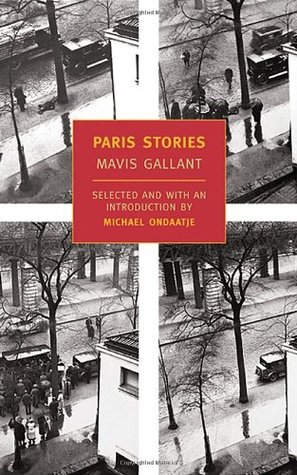
[...] Gallant, one suspects, similarly sees and meets people and then invents what becomes a precise landscape of their world. There is no vanity or self-aggrandizement in her process and the portraits are always tough as well as generous. For instance her satire is sharp in “The Ice Wagon Going Down the Street,” and yet she will take us beyond that satire to feel compassion for a character we would never have believed could be sympathetic. The tenderness does not replace or override the earlier portrait, Peter is still pathetic, but now there is that one moment where something happened, where the man's awareness of human nature was suddenly profound.
“I had a great, great fear that I was bent on doing something for which I have no ability, and that took years and years to get rid of... that I was dedicating my life to something I was not fit for,” Gallant once told an interviewer. With some writers greatness emerges out of their very tentativeness, their own uncertainty about how they make stories, or if it is even possible to make them. It results perhaps in every word and line being tested for falseness or complacency. It results too in a kind of testing, self-critical humor that lies within the text. “I am uncertain about every line I write and I am uncertain until I get readers.” With the arrival of that reader, the uncertainty about “an unsafe life” becomes a shared witnessing. This, for a very few writers, becomes the purpose and meaning of a writer's life. “Like every other form of art,” Mavis Gallant has written, “literature is no more and nothing less than a matter of life and death.”
<3

There were many people in France writing realistic novels in the nineteenth century—Balzac comes to mind—but Flaubert was the most conscious of what he was doing, and agonized about it the most. Closely observed reality, for its own sake, had not really been a part of the tradition of literature in the eighteenth century. Flaubert will spend a whole page evoking tiny sounds and motes of dust in an empty room because he's getting at something. He's saying there's meaning to be got out of the very closely observed events of ordinary reality. In literary, scientific and photographic terms—the invention of photography happened when he was in his teens—the nineteenth century, to a much greater degree than the eighteenth, was concerned with the close observation of reality. All of science in the nineteenth century was about very close observation of small things…. The nineteenth century focussed and greatly expanded these concepts. It made them central to the novel, to the symphony, to painting.
O: There's a line of Saul Bellow's—“I write to discover the next room of my fate.” In this way, I think, many novels are self-portraits—or future self-portraits, self-explorations, even if the story is set in an alien situation. You can try on this costume, that costume.
M: Somebody once asked W. H. Auden, “Is it true that you can write only what you know?”And he said,“Yes it is. But you don't know what you know until you write it.” Writing is a process of discovery of what you really do know. You can't limit yourself in advance to what you know, because you don't know everything you know.
As I began to eliminate things, I would have the feeling that I couldn't remove a certain scene, because it so clearly expressed what we were after. But after hesitating, I'd cut it anyway … forced to because of the length of the film. Then I'd have this paradoxical feeling that by taking away something I now had even more of it. It was almost biblical in its idea of abundance. How can you take away something and wind up with more of it?
The analogy I came up with was the image of a room illuminated by a bare blue lightbulb. Let's say the intention is to have “blueness” in this room, so when you walk in you see a bulb casting a blue light. And you think, This is the source of the blue, the source of all blueness. On the other hand, the lightbulb is so intense, so unshaded, that you squint. It's a harsh light. It's blue, but it's so much what it is that you have to shield yourself from it.
There are frequently scenes that are the metaphorical equivalent of that bulb. The scene is making the point so directly that you have to mentally squint. And when you think, What would happen if we got rid of that blue lightbulb, you wonder, But then where will the blue come from? Let's take it out and see. That's always the key: Let's just take it out and find out what happens.
So you unscrew the lightbulb … there are other sources of light in the room. And once that glaring source of light is gone, your eyes open up. The wonderful thing about vision is that when something is too intense, your irises close down to protect against it—as when you look at the sun. But when there is less light, your eye opens up and makes more of the light that is there.
M: One of the side benefits of moving Zoetrope up to San Francisco in 1969 was to take the filmmaking out of a self-contained film universe. In Los Angeles it's very easy, if you get to a certain level in your profession, to live, breathe, eat, think, sleep film. And to have so many offers that you're working all the time—without that ability, given by time and space, to reinvent.
In San Francisco there's not that much work. There aren't that many producers up here. There's a kind of enforced idleness between projects that allows you to develop other interests and then, in the best sense, to plow the results of those interests back into the next film.
It has to be said—both systems have their risks. The risk of the Hitchcock-ian system is that you may stifle the creative force of the people who are collaborating with you. The film that results—even if it's a perfect vision of what somebody had in his head—can be lifeless: it seems to exist on its own, without the necessary collaboration either of the people who made the film or even, ultimately, the audience. It says: I am what I am whether you like it or not.
On the other hand, the risk with the process-driven film is that it can collapse into chaos. Somehow the central organizing vision can be so eaten away and compromised by all the various contributors that it collapses under its own weight.
You remember you told me how much you liked the line breaks in my translations of Malaparte? The decision where to cut film is very similar to the decision, in writing poetry, of where to end each line. On which word? That end point has little if anything to do with the grammar of the sentence. It's just that the line is full and ripe at that point, full of meaning and ripe with rhythm. By ending it where he does, the poet exposes that last word to the blankness of the page, which is a way of emphasizing the word. If he adds two words after it, he immerses that word within the line, and it has less visibility, less significance. We do very much the same in film: the end of a shot gives the image of that last frame an added significance, which we exploit.