
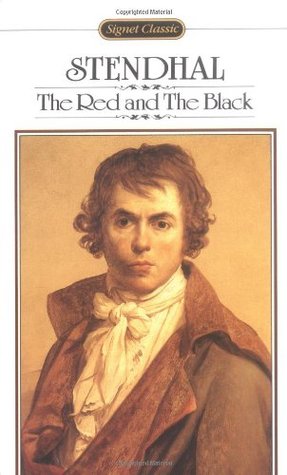
by
Stendhal
155
Let us leave this petty man to his petty fears. Why did he take a man of heart into his house, when what he wanted was the soul of a lackey? Why didn't he know how to pick his servants? The ordinary course of events in the nineteenth century is that when a powerful aristocrat finds a man of heart in his way, he kills him, exiles him, imprisons him, or so humiliates him that the latter is stupid enough to die of grief. By chance, it is not yet the man of heart who is suffering in this instance. The great misfortune of small towns in France, and of governments by election, like that of New York, is that you are never allowed to forget that fellows like M. de Renal exist in the world. In the midst of a city of twenty thousand inhabitants such individuals mold public opinion, and public opinion is a terrible thing in a country that has a constitution. A man endowed with a noble and generous mind, and who might have been your friend but lives a hundred leagues away, judges you according to public opinion in your town, which is shaped by the fools whom chance has caused to be born noble, rich, and conservative. Woe to anyone who stands out from the crowd!
wow
161
Mme. de Renal had begun to entertain gloomy thoughts. Despite her resolution, she had told Julien the whole business about the auction.* "He will make me forget all my vows," she reflected. . She would have sacrificed her life without hesitation to save her husband's had she seen him in danger. Hers was one of those noble and romantic souls for which to be aware of the possibility of doing a generous deed and not do it is a source of regret almost equal to that of a crime committed. Nevertheless, there were ill-fated days when she could not drive away a vision of the inordinate happiness she would taste if, on suddenly becoming a widow, she could marry Julien.
Mme. de Renal had begun to entertain gloomy thoughts. Despite her resolution, she had told Julien the whole business about the auction.* "He will make me forget all my vows," she reflected. . She would have sacrificed her life without hesitation to save her husband's had she seen him in danger. Hers was one of those noble and romantic souls for which to be aware of the possibility of doing a generous deed and not do it is a source of regret almost equal to that of a crime committed. Nevertheless, there were ill-fated days when she could not drive away a vision of the inordinate happiness she would taste if, on suddenly becoming a widow, she could marry Julien.
292
Except whoever might help to give his country a bicameral government, the young count considered that no one was worthy of his attention. He left Mathilde, the most fascinating woman at the ball, with pleasure, because he had seen a Peruvian general come in.
Despairing of Europe, poor Altamira had been reduced to the hope that when the nations of South America became strong and powerful, they might restore to Europe the liberty Mirabeau had sent them.
lol. sick
293
But neither the dance, nor the desire to please one of the handsomest men at court, nor anything else could divert Mathilde. It was impossible to be more popular. She was queen of the ball, which fact she took in coldly.
"What a dull life I shall lead with a fellow like Croisenois!' she said to herself as he led her back to her place an hour later. "Where lies pleasure," she went on sadly, "if, after an absence of six months, I cannot find it in the midst of a ball that is the envy of every woman in Paris? What is more, I am complimented on every side by a society that couldnt be better. None of the middle class is here, excepting a few peers, and one or two Juliens, perhaps. Then too,** she added with growing sadness, "what blessings has fate not bestowed upon me: an illustrious name, wealth, youth, everything, alas, but happiness.
"The most dubious of my advantages are precisely those which everyone has been pointing out to me all evening. Wit: I believe them, for it is obvious that they are all afraid of me. If they dare to broach a serious subject with me, at the end of five minutes conversation I see them, all out of breath and as if making a great discovery, arrive at the conclusion I have been repeating to them for the past hour. I am beautiful: I have that advantage for which Mme. de Stael would have sacrificed everything, and yet Is there any reason why I should be less bored if I changed my name for that of the I'm dying of boredom. Marquis de Croisenois?
312
What was there to wish for? Wealth, noble birth, intelligence, and beauty (so everyone said, and so she believed), all had been lavished on her by the hand of chance.
What was there to wish for? Wealth, noble birth, intelligence, and beauty (so everyone said, and so she believed), all had been lavished on her by the hand of chance.
318
Daughter of a man of parts who might become a minister and give back the clergy their forests, Mile, de La Mole had been an object of the most excessive flattery at the Convent of the Sacred Heart. The harm done this way can never be offset. She had been persuaded that with all her advantages of birth, fortune, etc., she ought to be happier than anyone else. This notion is the source of the boredom of princes, and of all their follies.
Mathilde had not escaped the baneful influence of this idea. However intelligent one may be, one cannot at ten be on one's guard against the flattery, apparently so wellfounded, of a whole convent.
378
(Here the author wanted to insert a page of dots. "That would be in bad taste," said the editor, "and in a piece of writing as frivolous as this, bad taste is death."
"Politics," replied the author, "are a millstone around the neck of literature and will sink it in less than six months. Politics in the midst of imaginary concerns is like a pistol shot in the middle of a concert. The noise is ear-splitting without being energetic. It does not harmonize with the sound of any instrument. The politics here will mortally offend one half of the readers and bore the other, who will have found them far more convincing and energetic in the morning paper."
"If your characters don't talk politics," the editor rejoined, "they are not Frenchmen of 1830, and your book is not the mirror you claim it to be. . ."
Julien's minutes were twenty-six pages long; here is a pale extract of them; for it was necessary, as usual, to delete the absurdities, the excess of which would have seemed odious or unrealistic to the reader (e.g., The Police Gazette).
omg
496
At the moment he most regretted that adored woman's absence, he heard Mathilde's footstep. "The worst thing about being in prison," he thought, "is that you can't shut your door to anyone." No matter what Mathilde said, it . . . only irritated him.
lol. also thinking of randy in cryptonomicon
At the moment he most regretted that adored woman's absence, he heard Mathilde's footstep. "The worst thing about being in prison," he thought, "is that you can't shut your door to anyone." No matter what Mathilde said, it . . . only irritated him.
lol. also thinking of randy in cryptonomicon
528
As these samples show, Stendhal the narrator is rarely absent for long. He is glad to tell us what he thinks and what we should think about many subjects: the weaknesses of the French, notably the bourgeoisie, provincials and Parisians alike; the desiccating oppressiveness of the Restoration; and, above all, about his protagonists: what they feel, why they feel so, and why they are acting well generation or badly, wisely or- more often foolishly. later, Flaubert's reaction against Romantic effusiveness will lead him to seek not too successfully to keep himself out of his books. Stendhal's reaction is found not in self-exclusion but in his dry ironic tone. He likes to talk to his reader, quietly, urbanely, as a man of the world. Again and again, as in the seduction scene just quoted, he comments on the actions of his heroes: "How fine and how foolish!" His admirers, the ''happy few" who are now legion, enjoy him as one of the wittiest and most perceptive of moralists.
As many critics have noted, Stendhal is the founder of the modern realism that shows man working out his destiny amid the economic, political, and social forces that shape his time. The France of 1830 is always there in all these aspects, both as a whole and in its two parts, Paris and la province. Much of that France is symbolized in Valenod, the man on the make, one-time would-be lover of Mme. de Renal and would-be employer of Julien, who by cheating the poor and affecting the right politicoreligious attitudes rises from his position as director of the poorhouse to supplant Renal as mayor of Verrieres and become a baron and future prefect. Julien is shown (11:13) as "the unhappy man at war with all society"; and it is his disgust with society, as represented by Valenod, that leads him at his trial to make the bitter speech that transforms his sentence, as one critic has put it, from a condemnation into a stoic suicide.
531
Yet he is often only a would-be egoist; his heart, as he recognizes (11:42), is easily touched. Despite his hard for Mme. de Renal, principles, he is capable of love for her children, for Abbe Pirard, for his devoted friend Fouque, even for a time and in his way for Mathilde. Mme. de Renal is not deluded in seeing tender- ness and great idealism in him. Stendhal makes it abundantly clear that if Julien is at war with his society, one reason is that that society is corrupt.
Yet he is often only a would-be egoist; his heart, as he recognizes (11:42), is easily touched. Despite his hard for Mme. de Renal, principles, he is capable of love for her children, for Abbe Pirard, for his devoted friend Fouque, even for a time and in his way for Mathilde. Mme. de Renal is not deluded in seeing tender- ness and great idealism in him. Stendhal makes it abundantly clear that if Julien is at war with his society, one reason is that that society is corrupt.