
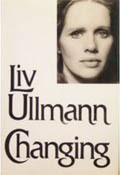
by
Liv Ullmann
221
The collaboration between a director and an actor, if it is a good one, is extremely intense, and very often there is a touch of aggression—usually from the actor. If you are ordered about for a whole day by a director—to walk and stand and talk, look a certain way, take the lunch break now and finish for the day now (even if spoken by a genius)—there are times when you think: Shoot the man. I want to be free, feel free. I hate him.
Then you let your anger out in small clouds of steam, and everyone knows that it doesn’t mean a thing.
The collaboration between a director and an actor, if it is a good one, is extremely intense, and very often there is a touch of aggression—usually from the actor. If you are ordered about for a whole day by a director—to walk and stand and talk, look a certain way, take the lunch break now and finish for the day now (even if spoken by a genius)—there are times when you think: Shoot the man. I want to be free, feel free. I hate him.
Then you let your anger out in small clouds of steam, and everyone knows that it doesn’t mean a thing.
224
I love close-ups. To me they are a challenge. The closer a camera comes, the more eager I am to show a completely naked face, show what is behind the skin, the eyes; inside the head. Show the thoughts that are forming.
To work with Ingmar is to go on a journey of discovery within my own self. To be able to realize all the things I dreamed of as a girl.
Discard the mask and show what is behind it.
The camera comes so close—and there is much of myself that is captured.
Closer to the audience than in any other medium—the human being is shown on the screen.
The camera meets me more exposed than the lover who thinks he has read my thoughts.
Even when I tell myself that I am expressing a role, I can never completely hide who I am, what I am.
The audience, at the moment of identification, meets a person, not a role, not an actress.
A face which confronts them directly:
This is what I know about women. This is what I have experienced, have seen. This is what I want to share.
It is no longer a question of make-up, of hair, of beauty.
It is an exposure that goes way beyond.
When the camera is as close as Ingmar’s sometimes gets, it doesn’t only show a face, but also what kind of life this face has seen.
Thoughts behind the forehead, something the face didn’t know about itself, but which the public will see and recognize.
Privately we long for exactly this kind of recognition: that others should perceive what we really are, deep inside.
To make a film with Ingmar is, for me, to have this experience.
I love close-ups. To me they are a challenge. The closer a camera comes, the more eager I am to show a completely naked face, show what is behind the skin, the eyes; inside the head. Show the thoughts that are forming.
To work with Ingmar is to go on a journey of discovery within my own self. To be able to realize all the things I dreamed of as a girl.
Discard the mask and show what is behind it.
The camera comes so close—and there is much of myself that is captured.
Closer to the audience than in any other medium—the human being is shown on the screen.
The camera meets me more exposed than the lover who thinks he has read my thoughts.
Even when I tell myself that I am expressing a role, I can never completely hide who I am, what I am.
The audience, at the moment of identification, meets a person, not a role, not an actress.
A face which confronts them directly:
This is what I know about women. This is what I have experienced, have seen. This is what I want to share.
It is no longer a question of make-up, of hair, of beauty.
It is an exposure that goes way beyond.
When the camera is as close as Ingmar’s sometimes gets, it doesn’t only show a face, but also what kind of life this face has seen.
Thoughts behind the forehead, something the face didn’t know about itself, but which the public will see and recognize.
Privately we long for exactly this kind of recognition: that others should perceive what we really are, deep inside.
To make a film with Ingmar is, for me, to have this experience.
227
I am furious at Ingmar, who lets me go through this, and when the bell sounds for lunch I race out of the studio. To his wife in the corridor I shout in passing that I hate her husband.
Later that afternoon I go to find Erland, a cherished colleague and confidant. I march into his room without knocking, the anger and humiliation still raging within me. Full of aggression, I tell him secrets about Ingmar, lies about him. Reveal that the truth about Ingmar’s solitary lunches is a heap of tabloids he doesn’t want to be caught reading.
Erland has such a strange expression on his face; doesn’t look at me, doesn’t answer me. There is an abrupt silence, and I turn and look in the direction where Erland’s eyes are focused. Ingmar is sitting in a corner wearing a strange little smile, and looking sad.
Standing there, I die a little and exclaim, “This I can’t handle!” I bolt from the room, out of the Film Institute, far out into the courtyard until I see a small crate with a lid. I crawl into it, although I am much too big, pull the lid down over me and decide to stay there for the rest of my life.
Cilla arrives, peers down at me and asks me to come out.
Erland tries to persuade me. But I never want to reappear. I will have to sit where I am forever.
Finally—after a long, long time—Ingmar comes and knocks on the lid.
He waits to open it until I whisper, “Come in.” He asks me, “Do you want to be friends again?” and his face is kind.
Ullmann crawls out and work can continue.
<3
I am furious at Ingmar, who lets me go through this, and when the bell sounds for lunch I race out of the studio. To his wife in the corridor I shout in passing that I hate her husband.
Later that afternoon I go to find Erland, a cherished colleague and confidant. I march into his room without knocking, the anger and humiliation still raging within me. Full of aggression, I tell him secrets about Ingmar, lies about him. Reveal that the truth about Ingmar’s solitary lunches is a heap of tabloids he doesn’t want to be caught reading.
Erland has such a strange expression on his face; doesn’t look at me, doesn’t answer me. There is an abrupt silence, and I turn and look in the direction where Erland’s eyes are focused. Ingmar is sitting in a corner wearing a strange little smile, and looking sad.
Standing there, I die a little and exclaim, “This I can’t handle!” I bolt from the room, out of the Film Institute, far out into the courtyard until I see a small crate with a lid. I crawl into it, although I am much too big, pull the lid down over me and decide to stay there for the rest of my life.
Cilla arrives, peers down at me and asks me to come out.
Erland tries to persuade me. But I never want to reappear. I will have to sit where I am forever.
Finally—after a long, long time—Ingmar comes and knocks on the lid.
He waits to open it until I whisper, “Come in.” He asks me, “Do you want to be friends again?” and his face is kind.
Ullmann crawls out and work can continue.
<3
237
Life experiences become acting experiences, which in turn become life experiences.
I scream with Jenny in front of the camera and feel tremendously relieved afterward.
Think what experience one could bring to one’s work after death, not to speak of the experience it would bring to living.
heh
Life experiences become acting experiences, which in turn become life experiences.
I scream with Jenny in front of the camera and feel tremendously relieved afterward.
Think what experience one could bring to one’s work after death, not to speak of the experience it would bring to living.
heh
238
Jenny has a daughter fourteen years old. Today it is her scene.
The young actress is soft and delicate, with a clear voice. It is easy to recognize Linn in her a few years hence, to discover this with tenderness and wistfulness.
I try to picture to myself how I was when I was that young, but I find that my recollection doesn’t go back that far.
Sometimes I feel an anger that I shall never be her again, soft again, have all life’s potential within me. And before me.
How strange it is to sit looking at her and know that I am close to middle age, to see in her eyes that she doesn’t understand that I, too, am fourteen, and wish only for a short time to be her.
Years pass by so quickly and already form a cleft of time that cannot be recrossed between me and what I once was.
Two little girls are sitting and talking together—but one of them is not seen by the other.
Jenny has a daughter fourteen years old. Today it is her scene.
The young actress is soft and delicate, with a clear voice. It is easy to recognize Linn in her a few years hence, to discover this with tenderness and wistfulness.
I try to picture to myself how I was when I was that young, but I find that my recollection doesn’t go back that far.
Sometimes I feel an anger that I shall never be her again, soft again, have all life’s potential within me. And before me.
How strange it is to sit looking at her and know that I am close to middle age, to see in her eyes that she doesn’t understand that I, too, am fourteen, and wish only for a short time to be her.
Years pass by so quickly and already form a cleft of time that cannot be recrossed between me and what I once was.
Two little girls are sitting and talking together—but one of them is not seen by the other.