
project/stunt-story
Jennifer Egan,
Percival Everett,
James Salter,
Miranda July,
Vladimir Nabokov,
Ingmar Bergman,
Mavis Gallant,
Clifford Odets,
Jenny Erpenbeck,
Jay McInerney

Amanda grew up smack in the heart of the heartland. You met her in a bar and couldn’t believe your luck. You never would have worked up the hair to hit on her, but she came right up and started talking to you. As you talked you thought: She looks like a goddamned model and she doesn’t even know it. You thought of this ingenuousness as being typical of the heartland. You pictured her backlit by a sunset, knee-deep in amber waves of grain. Her lanky, awkward grace put you in mind of a newborn foal. Her hair was the color of wheat, or so you imagined; after two months in Kansas you had yet to see any wheat. You spent most of your time at zoning-board meetings duly reporting on variances for shopping malls and perc tests for new housing developments. At night, because your apartment was too quiet, you went to bars with a book.
You keep meaning to cultivate an expertise in spectator sport. More and more you realize that sports trivia is crucial to male camaraderie. You keenly feel your ignorance. You are locked out of the largest fraternity in the country. You’d like to be the kind of guy who can walk into a bar or an eatery and break the ice with a Runyonism about the stupidity of a certain mid-season trade. Have something to hash out with truck drivers and stockbrokers alike. In high school, you went in for lone-wolf sports—tennis and skiing. You’re not really sure what a zone defense is. You don’t understand the sports metaphors in the political columns. Men don’t trust a man who missed the Super Bowl. You would like to devote a year to watching every athletic event on ABC and reading all fifty-two issues of Sports Illustrated. In the meantime your strategy is to view one playoff game in each sport so as to manage remarks like, “How about that slap shot by LaFleur in the third period against Boston?” Third quarter?
i want him to be a little like this
In the top drawer you discover two empty rectangular packets. Actually, one of them is not quite empty; inside the black paper is a fine dusting of white. You scrape it onto the desk with a credit card, using the edge of the card to rake up two clean lines. You look over at Megan. She’s reading. You could quietly hoover the lines and she’d never know the difference. You extract a bill from your wallet and roll it into a tight cylinder between thumb and forefinger. One apiece isn’t going to do much for either of you. On the other hand, two won’t do much for you, either; one will make you want another, and another will only intitiate a chain reaction of desperate longings. Is this self-knowledge? In any case, you want to do something nice for Megan. For her it might be a treat, something out of the ordinary.
i like the 'is this self-knowledge' moment - MC has a similar feeling near the end?

Everett Chambers, a television casting director on NBC’s Philco Playhouse and subsequently a good friend, said Cassavetes was the most persistent unemployed actor he ever saw. Cassavetes would come to his office; Chambers would, only half-facetiously, yell at him to get out and throw a telephone book at him; and Cassavetes would return the next week without fail. At one point, Cassavetes chained himself to a radiator at CBS to force them to give him a walk-on in You Are There. Underneath the nutty behavior, it was an extremely discouraging time. Cassavetes later said he could never afterward bear to ride the New York subway because it reminded him of these days of round-making. The problem Cassavetes and his friends were up against was that Actors Studio graduates were the only ones taken seriously by the early television producers.
lol
The film is utterly without interest and the action-centered plot allowed Cassavetes to do almost no memorable acting, with the single exception of his final scene on screen – in which he came up with the idea of playing the most evil lines he has in the entire film with diabolical gentleness. As proof that he was under no illusions about the nature of the project, during a scene in which Amy Irving said she needed a few minutes to ponder the ‘motivation’ for one of her speeches, Cassavetes turned to Kirk Douglas and sarcastically remarked loud enough for everyone to hear: ‘She thinks she’s playing Joan of Arc.’
amazing
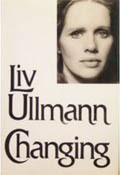
Life experiences become acting experiences, which in turn become life experiences.
I scream with Jenny in front of the camera and feel tremendously relieved afterward.
Think what experience one could bring to one’s work after death, not to speak of the experience it would bring to living.
heh

He should have waited another semester before summoning her. He realized that only after she had quit her job as a salesgirl, packed her two suitcases’ worth of belongings, slammed the door on her ragpicker father, and moved across the country into his tiny studio apartment at the foot of the Hollywood Hills. The glamour of spotlights sweeping the night sky to announce movie premieres made her feel as if she had just fallen off a turnip truck.
She had never heard of television, and no matter how many times he explained its workings, she didn’t understand how a moving picture could be seen without a projector.
He began to make new friends and she just didn’t fit in. She was both too serious, and not serious enough. His crowd, mostly women and a few lucky fellows with 4Fs, grew up around the movie business. They spoke about the war in a way that upset her. Her war began with the Nazis rounding up the Jews. Their war had begun in Spain six years earlier, after Franco encouraged German war planes to incinerate the town of Guernica and the West did nothing to retaliate. They rallied enthusiastically in favor of a Soviet-American war effort.

Rory knew before he came to New York what sort of life he would have. He’d read about it in novels by hip young authors who lived there. He saw the apartment, small but high-ceilinged, a tall, sooty window with a fire escape twisting past a chemical-pink sky. Nights in frantic clubs, mornings hunched over coffee in the East Village, warming his hands on the cup, black pants, black turtleneck, pointed black boots. He’d intended to snort cocaine, but by the time he arrived, that was out. He drank instead.
lol
“It’s strange,” she says. “Going back.”
“To them?” Jann gestures at the group. “Or back?”
“Both,” she says.
Later today they will fly to Nairobi. Tomorrow morning, New York. Two weeks from now she leaves for Argentina.
“Everything fades the minute you’re somewhere else,” Bernadette says. It’s a mistake to say these things. “It fades.”
You must be logged in to see this comment.
“When I was eighteen,” her father said, “I bought a motorcycle and rode around Europe for months.”
Ellen had never heard this before. “Was it fun?” she asked.
“I lived like a maniac.”
She paused, unsure whether this was good or bad. “Was it fun?” she asked again.
“Fun. Was it fun.” He stared across the miles of dead grass and shook his head. “It was the best time of my life.”
Ellen felt suddenly shy. She followed her father’s gaze to the horizon, where faded earth nudged a faded sky. It looked like the edge of something hidden, a place he alone had explored.