
by
Anna Wiener
View all notes
Available query params: commented=1, untagged=1

I was always looking for the emotional narrative, the psychological explanation, the personal history. Some exculpatory story on which to train my sympathy. It wasn’t so simple as wanting to believe that adulthood was a psychic untangling of adolescence, willful revisionist history. My obsession with the spiritual, sentimental, and political possibilities of the entrepreneurial class was an ineffectual attempt to alleviate my own guilt about participating in a globally extractive project, but more important, it was a projection: they would become the next power elite. I wanted to believe that as generations turned over, those coming into economic and political power would build a different, better, more expansive world, and not just for people like themselves.
Later, I would mourn these conceits. Not only because this version of the future was constitutionally impossible—such arbitrary and unaccountable power was, after all, the problem—but also because I was repeating myself. I was looking for stories; I should have seen a system.
I was lucky. Draining my bank account to exercise my stock options was only tenable because I knew I could borrow money from family, or from Ian. Some of my coworkers, largely women in nontechnical roles whose work had been foundational to the company, but whose salaries did not allow them to save much in the city with the highest cost of living in the country, had been offered generous stock grants that they were unable to exercise after they left the company. Some women, I had heard, were promised extensions on their exercise windows, only to have the extensions vetoed by the board after the grants had expired. The acquisition was a once-in-a-lifetime bonanza. It passed them by.
Flat structure, meritocracy, non-nonnegotiable offers. Systems do work as designed.

Having declared that language is ultimately self-referential, Barth has also affirmed that novels themselves, because they do not refer directly to a knowable reality, unavoidably refer instead to other novels. This latter idea directly informs his essay "The Literature of Exhaustion," discussed at greater length in chapter 1. Briefly, Barth argues that all the advances in novelistic technique introduced by the modernist masters—from stream-of-consciousness to spatial form—were originally designed to provide a more accurate access to reality. Now that "reality" is understood to be nothing more than a construct of language. Since all literary conventions have been "exhausted" from overuse and have been undermined by recent theories concerning the relationship between language and the world, the postmodern novel would employ literary conventions self-consciously, thereby warding off the "death of the novel" by writing novels that dramatize that death. The end result would be a fiction that overcomes exhaustion by dramatizing it. Or, as Barth explains, "An artist may paradoxically turn the felt ultimacies of our time into material and means for his work—paradoxically, because by doing so he transcends what had appeared to be his refutation, in the same way that the mystic who transcends finitude is said to be enabled to live, spiritually and physically, in the finite world."'
I put a post-it flag on this page so I apparently thought this paragraph was worth saving but I'm not entirely sure why
Metafiction fails because it does not invite us inside but rather makes us stand back and watch the author look at his own reflection; the reader is left outside, alone, and the one thing Mark hates more than anything in the world is "to believe he is alone. Solipsism affects him like Ambrosian metafiction affects him. It's the high siren's song of the wrist's big razor" (303). [...] Wallace's work, conversely, seeks not to depict solipsism but rather to overcome it.
Even more importantly, Hal possesses a quality that Kierkegaard would call "hiddenness" and that most intensely identifies the aesthete. In Kierkegaard's analysis, aesthetes use self-conscious thinking in order to hide from themselves. Likewise, Hal, in hiding his marijuana smoking from his friends and family, also in a sense hides it from himself. As the narrator explains, "Hal likes to get high in secret, but a bigger is secret is that he's as attached to the secrecy as he is to getting high" (49).
He is, in many ways, the fulfillment of Lacan's characteristic dictum, "Le desir de l'Homme, c'est le desire de l'Autre,"which is often translated to read, "Man's desire is for the Other to desire him."
relevant to the CF-type character who realises how dumb it is to define himself by the desire he inspires in others
A footnote to the endnote cites a scholarly article titled "Has James O. Incandenza Ever Even Once Produced One Genuinely Original or Unappropriated or Nonderivative Thing?" (990nn), the answer being, "No."
an idea for a fake review of my DFW story (from Infinite Jest)
Whereas the postmodern work of his forebears firmly grounds itself in a literary tradition whose grip it feels it cannot shake, Wallace's work demonstrates how the original postmodernists' reliance on self-consciousness, parody, and irony has now become a culture-wide phenomenon: not only is our pop culture equally self-reflexive and self-aware, but so are the people of Wallace's generation, for whom irony is a weapon and a badge of sophistication.
Irony is also a cage the doors of which his work wants to spring. He opens the cage of irony by ironizing it, the same way he uses self-reflexivity to disclose the subtle deceptions at work in literary self-reflexivity. The purpose behind this layered strategy is to create a space outside his work where direct, "single-entendre" principles can breathe and live.
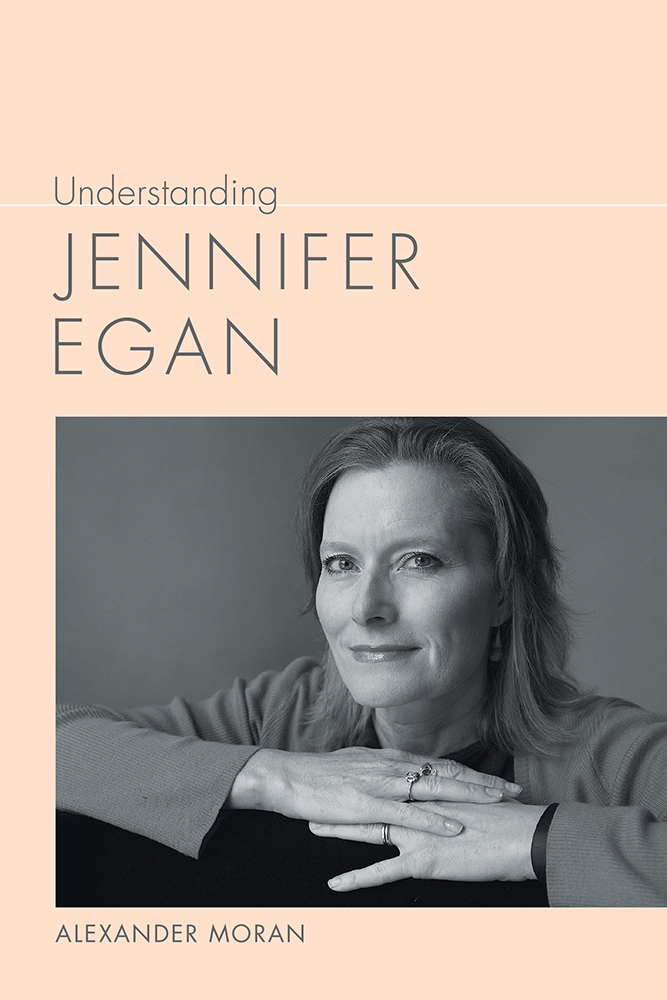
The LA Times piece was not the only controversy in which Egan found herself during the literary awards season. After winning the Pulitzer Prize in 2011, she was interviewed by Julie Steinberg for the Wall Street Journal. Steinberg asked her if she felt female writers are treated differently by the press than their male counterparts. In response, Egan briefly referred to the writer Kaavya Viswanathan, who had recently been found to have plagiarized the chick lit authors Sophie Kinsella, Meg Cabot, and Megan McCafferty. Egan’s complaint was not that Viswanathan had plagiarized, but that “she had plagiarized very derivative, banal stuff. This is your big first move? These are your models?” She went on to say, “My advice for young female writers would be to shoot high and not cower” (Steinberg). These comments annoyed and angered many, with author Jennifer Weiner being particularly perturbed that Egan appeared to be dismissing all chick lit, and Jamie Beckman glibly asking Egan to “not step on other women as you make your way to the podium.” Egan immediately regretted her comment, and later described them as “really stupid, ill-informed, and unfortunate” (Ohlson). Egan was also deeply affected by the accusation of sexism, as this was the type of gender-based dismissal and misrepresentation that she has battled throughout her career. As she discussed with Laura Miller a decade earlier in 2001: “I hate about myself the fact that I tend to model myself consciously after male writers. And I think that’s because again there’s this association that I’m very suspicious of that somehow men take on the big topics more than women do, which I don’t think is necessarily true.” Egan also spoke of her frustration with the critical response to her first novel, The Invisible Circus (1994), saying, “I’m a woman and it was a story about sisters so there was an immediate assumption that there certainly couldn’t be anything very intellectual going on there” (Miller). Egan has challenged such simplistic assumptions about women’s writing throughout her career. Furthermore, in their formal experiments and stylistic diversity, her texts also challenge what contemporary fiction can do.
relevant to my convo w helen about classiness after her event lol
[...] The point is that postmodern fiction does not have a claim to all formal experiments, and a study of Egan’s writing illuminates a broader picture of literary history than is often told. She often cites Edith Wharton, The House of Mirth (1905) in particular, as a huge influence, and has written a thoughtful introduction to a recent edition of Wharton’s classic, as well as George Eliot’s Middlemarch (1871). She is also an acolyte of Don DeLillo and introduced DeLillo when he won the National Book Foundation’s Medal for Distinguished Contribution to American Letters in 2015 (Egan, “Fiction”). Also among her favorite authors are Robert Stone, Doris Lessing, Shirley Hazzard, Ralph Ellison, and Joyce Carol Oates, a more varied collection of influences than many of her contemporaries would cite (“Top Ten”). This unusual cast of influences is another reason why her works sit uneasily within many of the aforementioned paradigms suggested to define contemporary fiction.
However, she is not completely divorced from her peers. This book also seeks to compare Egan to David Foster Wallace in regard to their respective treatments of the sixties protest era; Colson Whitehead, Michael Chabon, and Jonathan Lethem in terms of genre; George Saunders in connection to the recent wave of historical fiction; and Susan Choi, Dana Spiotta, Christopher Sorrentino, and Rachel Kushner in relation to their depictions of terrorism. Moreover, a focus on Egan does not result in the naming of a new movement, mode, or ideal to define the contemporary; as Egan herself wrote in 2014, “Personally, I could do without any further ‘isms’ (is anyone actually drawn to fiction called ‘postmodern’?), but I’m stirred by the question of how novels and short stories will evolve to accommodate and represent our ongoing cultural transformation” (“Introduction: Short Stories” xviii). Egan’s work therefore reflects what Andrew Hoberek describes as “the heterogeneity of contemporary fiction,” a phrase which captures the diversity of modes, genres, and forms used by writers in recent years (236).