
View all notes
Available query params: commented=1, untagged=1
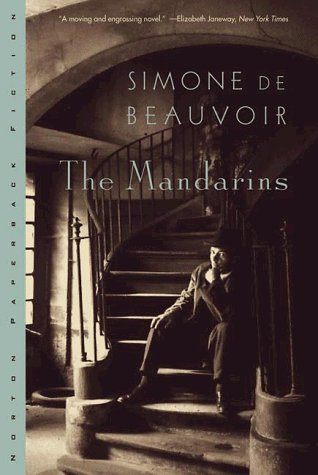
We went back inside. Lewis had lost all his cheerfulness. He drank a great deal and replied with grunts to the questions they asked him. He sat down beside me and listened to the conversation disapprovingly. I said to Murray that a good many writers in France were wondering what point there was in writing in this day and age. Thereupon everyone began discussing the subject animatedly. Lewis's face grew darker and darker. He hated theories, systems, generalizations. I knew why: for him, an idea wasn't merely a collection of words; it was a living thing. Those he accepted stirred in him, upset everything. He was forced to exert a great effort to restore a semblance of order in his mind; that frightened him a little. In that domain as well, he had a yearning for security, detested feeling lost. Often, he withdrew completely. It was obvious -that he was withdrawing now. And then, suddenly, he exploded.
'Why does one write? For whom does one write? If you begin asking that, you stop writing! You write, that's all. And people read you. You write for the people who read you. It's writers nobody reads who ask themselves questions like that!'
ooof
'A line which the failure of the SRL has doomed and which has become anachronistic,' Samazelle said. 'Remaining neutral in regard to the Communists is out of the question nowadays; you've got to be emphatically for or against.' He tried to force one of his jovial laughs. 'Considering the way they've been treating you, I'm surprised that you stubbornly continue to try to get along with them.'
‘I’m surprised that men who call themselves leftists can support the party of the capitalists, the militarists, and the Church,' Henri said.
'Let's get a few things straight,' Samazelle said. 'All my life I've fought against militarism, against the Church, and against capitalism. But you've got to recognize the fact that de Gaulle is something quite different from a militarist, that the aid of the Church is necessary today to defend the values we cherish, and that Gaullism can very well be an anti-capitalist movement if men of the left assume positions of command in it.'
Henri shrugged his shoulders. 'What good did it do? The right used the camps to discredit the Communists, as if it was completely justified in doing so. As soon as you talk about exploitation, unemployment, famine, they answer you with "and how about the slave labour camps?" If they didn't exist, they would have invented them.'
They sat down in an outdoor cafe. It was a beautiful night; people seated at the little tables were laughing. What were they talking about? Tiny cars zigzagged along the street; young people passed by, arm in arm; under the sidewalks, in smoky cellar clubs, couples were dancing and the echo of first-rate jazz drifted up into the street. Of course, there were many other things in this world besides politics and films - for other people.
Henri was silent. The bitches who slept with the Germans had, until now, belonged to a different world, a world for which there could be only one possible feeling: hate. But Lucie was talking, he was listening; that contemptible world was his world; there was only one world. Josette had slipped into his arms from those of the German captain.
'You're so nice!' Josette said, clinging to him and offering him her mouth. He turned his face away. 'I disgust you?' she murmured in a voice so humble that Henri felt suddenly ashamed, ashamed of being on the side of right. He was a man facing a woman, a man with money, a name, culture, and, above all, principles! A little tarnished lately, those principles, but they still gave the illusion of being there. At times, he himself was taken in.
He kissed the mouth stained with salty tears. 'No, I disgust myself,' he said.
'You?'
She looked at him with eyes that understood nothing, and he kissed her again, feeling pity well up in him. What principles had they given her? What weapons? What hopes? There had been the slaps from her mother, the vulgarities of men, the humiliating beauty, and now there had been planted in her heart a remorse which bewildered her.
ohhhh man
She let out a sigh and put her head on Henri's shoulder. He fondled her hair. False testimony: the thought horrified him. But what of it? In perjuring himself, he would do no one any harm. Of course, he would save Mercier's head and that was regrettable, but there were so many others who deserved to be dead and who were walking around hale and hearty! If he refused, Josette would be quite capable of doing away with herself, or, in any event, her life would be ruined. No, he couldn't hold back: on the one side, there was Josette, on the other, qualms of conscience. He twisted a lock of her hair around his finger. At any rate, there was damned little to be gained from having a clear conscience. The thought wasn't new to him: you were just as well off being frankly in the wrong. Now he was being offered a fine opportunity to say to hell with morality; he wasn't going to let it go by.
He withdrew his hand and ran it over his face. Playing the part of the devil didn't suit him. He would give that false testimony because he couldn't do otherwise, that's all. 'How did I ever come to this?' It seemed to him at the same time both completely logical and absolutely impossible. Never had he felt sadder.
She smiled at him sadly and unlocked the door. When she disappeared, he stood there for a long moment looking at the little lighted window above the door. Yes, perhaps it was merely jealousy; it would have been unbearable to take her in his arms tonight. 'I'm not being fair,' he said to himself. But fairness had no part in this; you don't sleep with a woman out of fairness. He drove away.
'I didn't invent anything,' Lambert said. 'Good God!' he added. 'What a fool I've been! I always thought you were so honest, so unbiased ... It frightened me! I thought I had to be loyal to you. Talk about loyalty! You're always passing judgment on everyone, but scruples don't hold you back any more than the next person.'
[...] he was far less moved than he would have thought possible. Going down the stairs, he said to himself vaguely, 'It's the price you have to pay.' The price for what? Sleeping with Josette? Wanting to save her? Trying to hold on to a private life when political action requires a man's whole being? Insisting on engaging in politics when he didn't give himself to it without reservations? He didn't know. And even if he had known, it wouldn't have changed anything.