
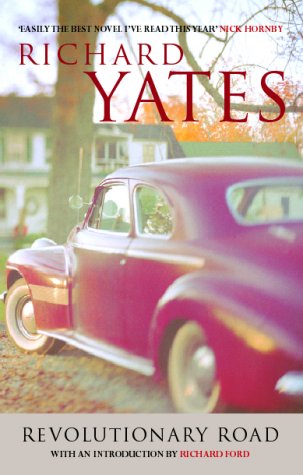
There are moments in reading Revolutionary Road when I'm made to wonder exactly which human qualities its author would finally sponsor as both virtuous and practicable. What would prove adequate to hold the fabric together long enough to get through life in one acceptable piece? Clearly something more's required than the standard livelihood protocols -- the train, the office, advancement, collegiality -- since all lead to other postures of controlled collapse. Marriage qua marriage is also plainly not adequate. Likewise parenting. Paris-the old, fragrant dream of freedom-seems out of reach.
Clearly some more straitened form of life is required, one in which what we say strictly corresponds to what we mean. We also might not care to ask very much of others. And there might not be that much fun around. Indeed, Yates's dark humor seems calculated less to please us than, as with any satire, to soften us up for sterner truths.
And there's definitely no escaping stern truth here. But goodness knows there's so much along the way to like and admire that, stern truths or no, you're sorry when it's over-sorry in more ways than one. Mostly Revolutionary Road is just so smart and keen and shockingly inventive about everything it turns its imagination to: about being young and blissfully rudderless in New York City before the responsibilities of marriage and family cloud the sky; about entertaining the awful neighbors; about long, long business lunches; about being thirty and feeling middle-aged; about fearing change when you know change could save you; even about the pink light seen through a poor man's earlobe, palely summing up all of humanity's frailty and failure: