
by
n+1
View all notes
Available query params: commented=1, untagged=1
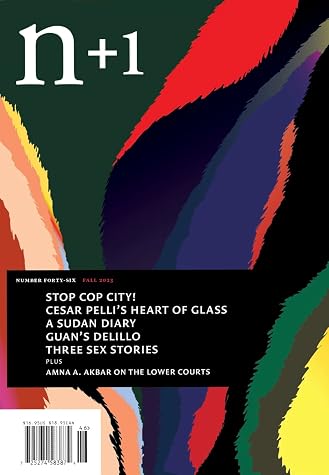
Growing up, I thought that real politics was collective struggle, but over the past decade I’d begun to fear the era of mass movements had come to an end. My political life had desiccated. I briefed diplomats and wrote angry missives for the United Nations and Swiss NGOs about brutal government military campaigns in South Sudan. Increasingly, I became convinced that the diplomats who were the primary audience for my reports were deeply uninterested in changing their positions. For over a decade, they had backed a predatory government intent on pillaging South Sudan while the country descended into a low-intensity conflict, often fought along ethnic lines. I struggled to know how to position myself—neither ethnic militias nor diplomats are my constituency—and felt expectant about my trip to Sudan. If South Sudan was a land of ethnic violence and indifferent diplomats, Sudan, I told myself, was a country of political parties and street protests—protests so effective they had brought down Bashir. It was in Khartoum, I thought, that I would find the sort of collective politics I could recognize as my own.
We were at Ozone, a café in Khartoum 2, an area of the city popular with expats. I didn’t like the place. It was a well-watered fantasy, full of Khartoum’s favored families and the busy heads of humanitarian agencies. Yet there I was. Everyone wanted to meet at Ozone. The best waffles in the world, people said. Another such café, in a nearby neighborhood, is called Atmosphere, and I couldn’t help but think that the nomenclature reflected a dimly repressed awareness of the vast distance separating these spaces from the world outside. Diplomats often asked me with furrowed brows what “the street” wanted, as if it were a mysterious Sphinx whose motivations were unknowable to mere humans. The street, I wanted to tell them, was literally just beyond the café’s walls—you could walk there, if your driver wasn’t picking you up. At Ozone, politics was a soap opera played out by high-profile individuals, to be gossiped about over lattes. Will Hamdok make a speech? Is Minnawi still high?
She was enthusiastic about investing in human rights training for the Sudanese police. Unfortunately, she said, according to the embassy’s local perception studies, “people don’t trust the police, and we don’t want to invest irresponsibly.”
“Imagine,” she said, sighing, “a country where people don’t trust the police.”
“Imagine,” I said.
heh
One friend, whom I will call Fatima, told me her answer later, as we sat in the quiet garden at the Ethiopian embassy eating decent kitfo away from prying eyes. It was a fantasy to think that the transition would have gone anywhere without the international community, Fatima told me. Revolution might sound nice to our Marxist friends, but it is a theory from another era. Name a single mass movement in the past twenty years that has successfully taken power and held it, she said. I was silent, and she continued. “When we formed the transitional government, we were facing institutions that were full of kayzan intent on blocking our plans. We needed allies.” If Mohamed thought the Sudanese elite had allied with international financial institutions to continue Bashir’s neoliberal policies, Fatima thought this same alliance was the only way to fight against the persistence of the old regime. It was an almost textbook disagreement. In what aspects of the state did the old regime persist? Was it in the combination of austerity politics and militarized economics that characterized the transitional government? Or was it in the kayzan’s continued dominance of Sudan’s institutions?
The protest had been the biggest of the transitional period, and Hamdok lost no time in claiming it as his own. That night, he gave a statement. The Sudanese people have made it clear, he said, that there is no going back to the old regime. The next morning, back at Ozone, one diplomat plaintively asked me: “But do they favor Hamdok?” The question seemed absurd. The previous day’s protests had not been about political machinations but about recapturing the energy of the 2019 revolution. Real politics, seen from the perspective of the protest, was not that of institutions but that of movements, of the joyful confidence that comes from a mass of people feeling their own power. Demonstrations, I wanted to tell the diplomats, have their own realism.
[...] Late one night, over shisha in a half-ruined building, one friend told me, “I am a new species. They cannot take what happened from us. I have no fear. We cannot go back, because we have already come so far. The revolution is still happening.”
At such a conjuncture, in which de jure wins have produced new monstrosities, our own quintessential forms of protest might be the strategies and gestures that move ordinary people to disrupt their routines and take action against the ruling class. The riot, the encampment, and the blockade: Occupy, Ferguson, Standing Rock, the Oakland dockworkers, Stop Cop City. Place matters too. It was in unemployment offices, soup kitchens, and flophouses that Communist Party members organized what became the Unemployed Councils of the 1930s. Now, Joshua Clover observes the freeway and port shutdowns as central sites of circulation struggles, indicating how capital is moving and where it is vulnerable.
To that list we might add the courts. Prison abolitionist organizing has clarified that any understanding of “criminal law,” or even the legal system writ large, must start with the arc of the policeman’s baton, the disproportionate budget of the local jail, and the flow of money from the corporation to the university and the police foundation and back. Each of these institutions can be disrupted, and the long relational chains that legal processes depend on offer many nodes of contact. Disruption happens through protest, but also through building relationships, solidarity, and organization.
For a city of mirrored skyscrapers, of fifteen-lane highways, of five million people and building ever faster, Atlanta is run like a small town, or a bloated feudal palace, royal families overseeing serfs sitting in traffic. For almost a century, a not-so-secret compact has governed the city town council–style, bequeathing positions in the power structure along dynastic lines. The roles at the table are fixed: mayor, city council, Chamber of Commerce, Coca-Cola, the police, the local news, and, uniquely and importantly in Atlanta, miscellaneous magnates of a Black business class. The biracial, bipartisan, business-friendly, media-savvy, moderate, managerial tradition the group perfected during the golden age of American capital is called the Atlanta Way.
This coalition steered the city through the tumultuous 20th century, holding things together with the blossoming optimism of economic growth. Desegregation happened in Atlanta unevenly, incompletely, but relatively uneventfully—which does not mean without shocking drama, racist recrimination, or moments of lurid violence. But compared with Montgomery or Memphis, the city was never bloodied in Civil Rights struggle. Even Martin Luther King Jr., its most famous martyr, was assassinated elsewhere. Jim Crow, white flight, gentrification all happened under a top-down, lockstep, synchronized city administration depressurizing the national conflict compromise by compromise: a golf course here, a swimming pool there, neighborhoods blockbusted one at a time.
cool
On a Tuesday in early September, the city council hosts a public meeting over Zoom where Atlantans speak on the record for seventeen hours. At least two-thirds object to the police academy plans. Neighbors hate the snap-crackle-pop of gunshots from the firing range the APF has already built on the property, and just imagine how much louder and more frequent this will be when the police move the whole arsenal over. A public school teacher asks why the police department let their last training center collapse. What are their priorities? DSA members pose the decision as an existential question, not only for Atlanta, but for America. The old ultimatum of socialism or barbarism has been reframed by young organizers as care or cops. They accuse the city council of divesting from public services, sowing poverty and desperation, and then swelling the ranks of the police to keep it under control.
The following day, the city council votes ten to four to approve the lease of the land to the Atlanta Police Foundation anyway. The mayor makes a statement: It “will give us physical space to ensure that our officers and firefighters are receiving 21st-century training, rooted in respect and regard for the communities they serve.” We blink past the obvious hypocrisy, drawn instead to that watchword training, deceptively neutral, the ostensible justification of a million liberal reforms, because who could argue against training? The police after all are like dogs: best when they obey. But obey what?
We stay overnight in New York, which feels like Cop City already. Military men in bulletproof pants march in formation through Penn Station, intimidating weary people waiting for trains: no benches, no sitting on the floor. The TSA beeps our belongings. We shuffle along an endless line to fly from one concrete desolation to another, fart carbon into the ozone, and return to our cruel city to defend the damaged landscape we’ve been doomed to love.
We take off into the morning. Manhattan grubs greedily into the sky. Container ships queue up out into the ocean, minuscule on the roof of the gleaming deep. Babylon sprawls: Philadelphia, Baltimore, DC. The view from the air turns industry into entomology. We watch aloof, above, transfixed, as out the window something almost glorious rusts and crumbles into landfill, and colorless cube metastasizes over green world.
:(