
View all notes
Available query params: commented=1, untagged=1

[...] Does not capitalism, in conceding that abolishing the hierarchy and giving free rein to initiative and collaboration are the real requisites of productive creativity, embark on the road to the free association of workers, impelled by its inherent tendency? If indeed the artist is a possible and desirable avatar of the worker, and from capital’s own point of view, then the very idea of employment as a relation of hierarchical subordination is fundamentally called in question.
The constitution of enterprising capitalist communities have had, so far, all the structures of the employment relation and the monetary economy with a division of labour in its favour. The question of how individuals enter into it is resolved rather simply: primarily under the effect of material necessity – not because they spontaneously want to join. [...] Assisted by all the structures of capitalist enlistment that affirm its right to capture, the master-desire views enlistment into its cause as self-evident and fails to even notice anymore its inability to pursue the enterprise, which exceeds its means of power, without the contributions of other powers that it variously obtains. For how many capitalist enterprises would remain if people were freed from material necessity? [...]
[...] If the communist idea is essentially about equality, the question then is how to understand the nature of an equality that accompanies a substantial, recognised inequality among contributors, and does not deny the asymmetry of those situations where the force of an initial proposition objectively gives the other contributions an auxiliary character. One formulation of what we might call the communist equation could therefore be as follows: what form of equality can be realised under the legacy of the division of labour – and notably under the most onerous of its legacies, to wit, the primary separation between ‘conception’ and ‘execution’?
the example he gives involves the production of a play, where the playwright's contributions are inherently unequal to those of the electrician or costume designer or actor
But the sequence of causes and effects is in principle fully compatible with change. Stars die that once shone; the earth that was calm suddenly opens up; hills that used to be part of the landscape collapse in an earthquake – and are no longer there. None of this, which can only be called ‘change’, is an exception to the laws of determinism, or requires the disruptive intervention of a freedom (but perhaps the defenders of novelty intend to appeal to the will of God). The same is true in the historical and social world, whose phenomena of both reproduction and transformation are likewise produced, namely, determined to occur by some or other causal sequence, even though, unlike dying stars and sliding hills, these sequences are the product of human action. For these actions are no less caused. And these causal sequences have no other motors than the conative energies and passions that steer them. Collective human life reproduces itself, or begins to change, solely as a consequence of the interplay of people’s inter-affections, or, to say this in the simplest way possible, out of the effect they have on one another, but always through the mediation of institutions and social relations.
kinda poetic
[...] For Spinoza there is no power that is not immediately and fully actual. In other terms, there is no reserve in the Spinozist ontology. There is no unfulfilled or uneffectuated power that stands back, available for activation. Even when it can do very little, the conatus is always exhausting what it can do. [...]
for Spinoza, that's what complete immanence is
food for thought
[...] the social landscape of capitalism has profoundly mutated. From the moment when, despite being ‘capital’s men’, top executives became employees, the original Marxian theory was in trouble. And this trouble kept on growing with what could be called the rise of management: the growing number of employees who partially crossed over symbolically to the ‘side of capital’.
What could it mean to ‘symbolically cross over to the side of capital’, when materially one does not in fact belong to the side of capital, other than that the affective composition of the individuals in question shifted largely to the joyful end of the scale, and they found themselves enthusiastically bringing their power of acting to the enterprise, that is, ultimately, aligning it with the desire of capital? Marxism’s trouble is aggravated by the fact that this crossing is not an all-or-nothing affair, but a matter of degrees that can be laid out in a continuum, going from the lowest – the sullen employee who does the least, and reluctantly – to the highest – those who, albeit instrumentally, devote the totality of their working life, at times their whole life, to the success of the enterprise. The landscape of class is therefore the double of the passionate landscape of employment, and fully reflects the history of its affective enrichments. It has lost the simplicities of its beginnings, and is blurred by the employment relation’s gradient of commitment, which in the final analysis is an affective gradient, a gradient of the employee’s joy (or sadness) at living the life of an employee. This is where Spinoza meets Marx – and changes him, for the transformation can be described synthetically by borrowing from the lexicons of both: to ‘symbolically cross over to the side of capital’ is to have a joyful ‘real subsumption’.
the "side of capital" phrase comes from this book
[...] despite being individually experienced, there is nothing subjective about affects. They are objectively caused and they produce the movements of the conatus just as objectively. [...]
[...]
[...] Common affects do not fall from the sky; one must still ask what prior common affection produced them. In the present case it is rather on the side of capital that one must look, not so much capital as an antagonistic class – of which a solid core remains thoroughly identifiable, although its contours and periphery have become fuzzier – but capital as social relation, and ultimately as the very form of social life.
The end of the social relations of capitalism does not mean the end of our passionate servitude. It does not by itself free us from the disorderly violence of desire and the efforts of power. It is perhaps on this precise point that the Spinozist realism of the passions is most useful to the Marxian utopia: as a sobering-up. The extinction of politics by the final dissolution of classes and the conflict between them, transcending all antagonisms by the victory of the working class, that non-class without any class interest, are post-political phantasmagoria, perhaps Marx’s deepest anthropological error, which consists in dreaming of a final eradication of violence – when there is no horizon except the search for the least destructive ways of organising it. Spinoza makes the point that if all people were wise, namely, led by reason, they would need neither laws nor political institutions. But wise is precisely what they are not, which is why they have no choice but to take into consideration the passionate movements of the conatus, which, of itself, ‘is not opposed to strifes, hatred, anger, treachery, or, in general, anything that appetite suggests. Neither the recommune nor transcending capitalism liberates us from this element of violence, nor does it exempt us from reinventing institutional regulations for it. That is why, if we use the word to mean radical liberation, we must recognise that communism is a long patience, a continuous effort, and perhaps only, to speak again like Kant, a regulative idea. Let us not even mention, in keeping with the illusions of subjectivity, a liberation in the sense of the sovereignty of a perfectly autonomous ego. Passionate exo-determination is our irremissible condition. Let us also not dream of the final abolition of relations of dependence. It is impossible for the interest of one to never have to pass through another, and that no effect of domination would follow: love-interests, whether in erotic form or that of the desire for recognition, pass by their very nature through chosen others, individual or collective. These desires-interests, the very expression of the amorous logic of the conatus and of its passionate servitude, imperiously and at times violently cut a path for themselves, and neither transformations in the forms of ownership nor the generalisation of associative relations could fully disarm them. If true communism consists in living ex ductu rationis, it is better to recognise that it is a horizon and forego early the illusions of the radiant society.
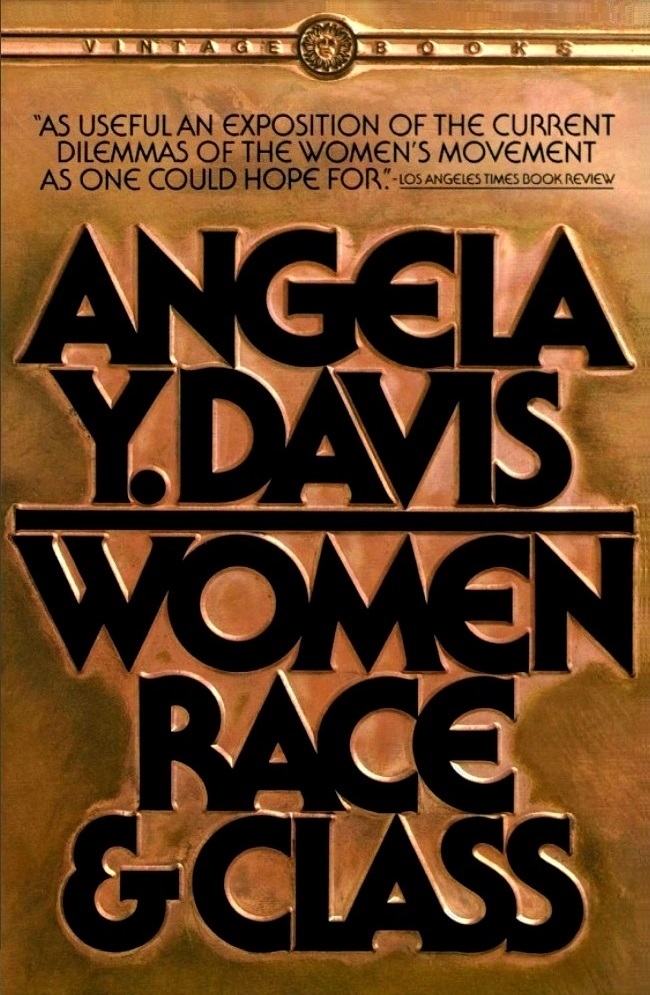
Proportionately, more Black women have always worked outside their homes than have their white sisters. The enormous space that work occupies in Black women’s lives today follows a pattern established during the very earliest days of slavery. As slaves, compulsory labor overshadowed every other aspect of women’s existence. It would seem, therefore, that the starting point for any exploration of Black women’s lives under slavery would be an appraisal of their role as workers.
hell yeah
While it is hardly likely that these women were expressing pride in the work they performed under the ever-present threat of the whip, they must have been aware nonetheless of their enormous power—their ability to produce and create. For, as Marx put it, “labor is the living, shaping fire; it represents the impermanence of things, their temporality.” It is possible, of course, that this traveler’s observations were tainted by racism of the paternalistic variety, but if not, then perhaps these women had learned to extract from the oppressive circumstances of their lives the strength they needed to resist the daily dehumanization of slavery. Their awareness of their endless capacity for hard work may have imparted to them a confidence in their ability to struggle for themselves, their families and their people.