
View all notes
Available query params: commented=1, untagged=1
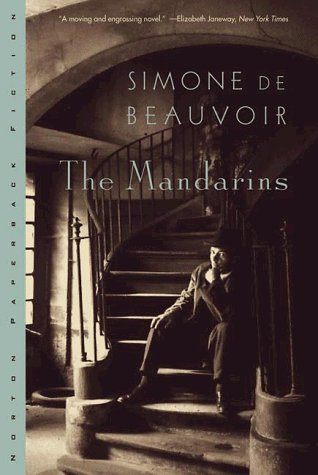
'Oh, I know what it is to be harried by one's work,' Guite said. 'I never go out either. It's quite by chance that you see me here!' Her laugh insinuated that I was pleasantly deluded, that in truth she wasn't there at all. 'But this would be different — just a simple little dinner... And I'd invite only men,' she added in a confidential tone. 'I don't care for the company of women; I feel completely lost with them. Don't you?'
'No, I get along very well with women.'
She gave me a look of dismayed reproof. 'Curious, very curious .... It must be I who's abnormal.'
In her books she willingly proclaimed the inferiority of her sex. But she herself, she imagined, escaped it by the virility of her talent. And she believed she was even superior to men, since, gifted with the same qualities as they, she had in addition the singular and charming merit of being a woman. That trick irritated me. In a professional tone, I said, 'You're not at all abnormal. Almost all women prefer men.'
Her face froze solidly, and not too pointedly but deliberately she turned towards Huguette Volange. Poor Guite! She was torn between the desire to see justice rendered to her merits and to evade any reproach of narcissism. She therefore attempted to dictate to others what she wanted them to say about her. But if they didn't say it? Would she have to resign herself to being misunderstood? It was a painful dilemma.
oof
I was astonished at how little she understood me, but as a matter of fact I didn't understand her very well either. She believed that, for us, work was nothing but a means of achieving fortune and success, and I was vaguely convinced that all those snobs would have gladly traded their social position for intellectual talents and accomplishments. When I was a child, a teacher seemed to me a much greater person than a duchess or a millionaire, and through the years that hierarchy had not changed appreciably. Claudie, however, believed that the supreme reward for an Einstein would be to be received in her salon. We-could hardly reach any real understanding.
'I get the impression that she's living on two different planes at once,' I said. 'She's perfectly lucid, and at the same time she tells herself that you're madly in love with her and that she could have been the greatest singer of the century. I think that her lucidity will win in the end. But what's going to become of her then?'
'Ah! That I don't know!' Henri replied. 'I don't want to be a bastard, but I'm not made to be a martyr, either. Sometimes the situation seems simple to me: when you're not in love any more, you're just not in love any more. But at other times, it seems unfair to have stopped loving her; after all, she's the same Paula.'

Which was exactly what Madeleine wanted. She’d become an English major for the purest and dullest of reasons: because she loved to read. The university’s “British and American Literature Course Catalog” was, for Madeleine, what its Bergdorf equivalent was for her roommates. A course listing like “English 274: Lyly’s Euphues” excited Madeleine the way a pair of Fiorucci cowboy boots did Abby. “English 450A: Hawthorne and James” filled Madeleine with an expectation of sinful hours in bed not unlike what Olivia got from wearing a Lycra skirt and leather blazer to Danceteria. Even as a girl in their house in Prettybrook, Madeleine wandered into the library, with its shelves of books rising higher than she could reach—newly purchased volumes such as Love Story or Myra Breckinridge that exuded a faintly forbidden air, as well as venerable leather-bound editions of Fielding, Thackeray, and Dickens—and the magisterial presence of all those potentially readable words stopped her in her tracks. She could scan book spines for as long as an hour. Her cataloging of the family’s holdings rivaled the Dewey decimal system in its comprehensiveness. Madeleine knew right where everything was. The shelves near the fireplace held Alton’s favorites, biographies of American presidents and British prime ministers, memoirs by warmongering secretaries of state, novels about sailing or espionage by William F. Buckley, Jr. Phyllida’s books filled the left side of the bookcases leading up to the parlor, NYRB-reviewed novels and essay collections, as well as coffee-table volumes about English gardens or chinoiserie. Even now, at bed-and-breakfasts or seaside hotels, a shelf full of forlorn books always cried out to Madeleine. She ran her fingers over their salt-spotted covers. She peeled apart pages made tacky by ocean air. She had no sympathy for paperback thrillers and detective stories. It was the abandoned hardback, the jacketless 1931 Dial Press edition ringed with many a coffee cup, that pierced Madeleine’s heart. Her friends might be calling her name on the beach, the clambake already under way, but Madeleine would sit down on the bed and read for a little while to make the sad old book feel better. She had read Longfellow’s “Hiawatha” that way. She’d read James Fenimore Cooper. She’d read H. M. Pulham, Esquire by John P. Marquand.
definitely cheesy but i can still relate ofc
[...] Going to college in the moneymaking eighties lacked a certain radicalism. Semiotics was the first thing that smacked of revolution. It drew a line; it created an elect; it was sophisticated and Continental; it dealt with provocative subjects, with torture, sadism, hermaphroditism—with sex and power. [...]
lol
“Better cold than sentimental,” Thurston said.
“Do you think? Why?”
“Because we’ve read the sentimental, filial account of a cherished dead parent before. We’ve read it a million times. It doesn’t have any power anymore.”
“I’m doing a little thought experiment here,” Leonard said. “Say my mother killed herself. And say I wrote a book about it. Why would I want to do something like that?” He closed his eyes and leaned his head back. “First, I’d do it to cope with my grief. Second, maybe to paint a portrait of my mother. To keep her alive in my memory.”
“And you think your reaction is universal,” Thurston said. “That because you’d respond to the death of a parent a certain way, that obligates Handke to do the same.”
“I’m saying that if your mother kills herself it’s not a literary trope.”
Madeleine’s heart had quieted now. She was listening to the discussion with interest.
Thurston was nodding his head in a way that somehow didn’t suggest agreement. “Yeah, O.K.,” he said. “Handke’s real mother killed herself. She died in a real world and Handke felt real grief or whatever. But that’s not what this book’s about. Books aren’t about ‘real life.’ Books are about other books.” He raised his mouth like a wind instrument and blew out bright notes. “My theory is that the problem Handke was trying to solve here, from a literary standpoint, was how do you write about something, even something real and painful—like suicide—when all of the writing that’s been done on that subject has robbed you of any originality of expression?”
What Thurston was saying seemed to Madeleine both insightful and horribly wrong. It was maybe true, what he said, but it shouldn’t have been.
“Who’s your father?” he asked Madeleine. “Is it Virginia Woolf? Is it Sontag?”
“In my case,” Madeleine said, “my father really is my father.”
“Then you have to kill him.”
“Who’s your father?”
“Godard,” he said.
lol
What she hadn’t expected when it came to a fraternity was a sunny-haired silent type like Dabney, learning his lines in a folding chair, in parachute pants, shoeless. Looking back on their relationship, Madeleine figured she’d had no choice. Dabney and she had been selected for each other in a Royal Wedding kind of way. She was Prince Charles to his Princess Di. She knew he couldn’t act. Dabney had the artistic soul of a third-string tight end. In life Dabney moved and said little. Onstage he moved not at all but had to say a lot. His best dramatic moments came when the strain on his face from remembering his lines resembled the emotion he was trying to simulate.
lol
When Dabney returned from his review with Churchill, he looked even more self-contented than usual.
“So?” Madeleine asked. “How did it go?”
“He says I’m perfect for soaps.”
“Soap commercials?”
Dabney looked peeved. “Days of Our Lives. General Hospital. Ever heard of those?”
“Did he mean that as a compliment?”
“How else could he mean it? Soap actors have it made! They work every day, make great money, and never have to travel. I’ve been wasting my time trying to get all this advertising work. Screw that. I’m going to tell my agent to start lining up some auditions for soaps.”
Madeleine was silent at this news. She’d assumed Dabney’s enthusiasm for modeling was temporary, a tuition-earning scheme. Now she realized he was in earnest. She was, in fact, dating a model.
lmao
“Man, am I ever lucky,” Dabney said. “What would I do if you weren’t around? You have to catch all the subtleties for me, don’t you? You and your flair for catching subtleties. It must be nice to be rich and sit around all day catching subtleties. What do you know about needing to make a living? It’s fine for you to make fun of my ad. You didn’t get into college on a football scholarship. And now you have to come in here and run me down. You know what? This is bullshit. This is total bullshit. I’m sick of your condescension and your superiority complex. And Churchill’s right. You can’t act.”
In the end Madeleine had to admit that Dabney was far more fluent than she’d ever expected. He was capable of portraying a range of emotions, too, anger, disgust, wounded pride, and of simulating others, including affection, passion, and love. He had a great career in the soaps ahead of him.