
View all notes
Available query params: commented=1, untagged=1
I’m in my pyjamas, but just as I was getting into bed, I suddenly remembered the source of all the current changes in my life, the ones I’m trying to bring about and stick to. This diary has helped me to reflect and remember; until now I’ve never had a clear sense of the events leading up to the current situation with Chl, let alone the ways I was responsible for what happened. It only became clear when I wrote the whole story down (so slowly, and so painfully). And I realised that my computer addiction and other unhelpful behaviour patterns were a way of expressing my sense of abandonment. On the one hand, yes, I was trying to run away from my pain; but on the other, crucially, I was pushing things to extremes because I wanted someone to set me limits. I realised I was behaving the way badly adjusted children do, children whose parents don’t know how to set them limits, or don’t want to, or have no interest in doing so. They push things further and further, and every step is a cry for attention. Then I said to myself: as long as my transgressions only affect me, nobody’s going to set me any limits. Not only was my behaviour inappropriate, but it was useless at what it was trying to achieve; my actions were doomed to failure in every sense. The hole I was digging was becoming deeper and deeper, and by then it was almost impossible to get out. In the end I decided that if a part of me was demanding limits, I’d try to set some myself; I’d listen to my demands insofar as they were reasonable and fair, but fight energetically to stop them escalating into that nebulous infinity. Limits. Strict, precise. But necessary.
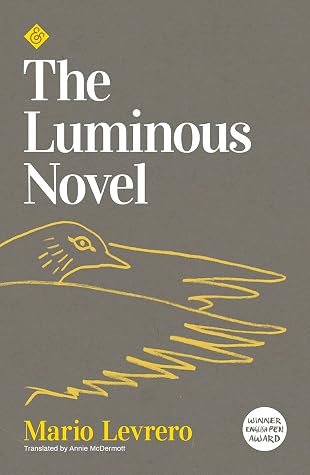
The topic of the dead pigeon as a symbol still needs to be addressed. I should explain to the reader, or remind them if they already know, that a few years ago I wrote a text called Diary of a Swine. I wrote it in Buenos Aires. My initial impulse had been to continue the ‘luminous novel’ (take note of that detail, because the luminous novel – or rather, its completion – is the project covered by this grant), and as soon as I sat down to write it, I began having problems with birds. First, a baby pigeon fell into the narrow back garden of my ground-floor apartment, and when it managed to fly away another one fell in, not a pigeon this time but a baby sparrow, and the presence of those fallen birds became the main focus of what I was writing, which by then was almost a minute-by-minute account of the events unfolding in my back garden. I realised that this bird-based epiphany was symbolic; sometimes so-called objective reality takes on a strong symbolic charge. And I realised that somehow, by starting to write, I’d set those events in motion. I still haven’t changed my mind after all this time, though I’d like to add for the record that I don’t think you could call it a miracle. A little magical, perhaps, if we understand magic as a technique that can be explained. The Unconscious can do all kinds of things our poor conscious self would never dream were possible.
And now, as I begin the project of continuing the luminous novel, and even receive a grant that means I can devote all my time to the task, lo and behold: more strange bird-related occurrences. A dead bird appears, then the possible widow appears and behaves very oddly. Might this, I’ve been thinking recently, be a symbol as well? A symbol of my dead spirit, which no widow (my conscious self, let’s say) will be able to revive in spite of her best efforts. If this is the case, Mr Guggenheim can give up on the idea that his grant will produce the expected results.
Imagine for a moment, if you will, that you grow flowers for a living, and suddenly you inherit a chain of supermarkets. You have no interest in supermarkets and know nothing about them. You’d be quite content to collect the considerable profits every so often and spend them as you see fit, whilst continuing to devote your days to growing flowers, which is your main interest in life. However, the moment comes when you’re seized by curiosity, or perhaps by fear. Since you know nothing about supermarkets, you could easily be exploited, robbed or deceived by the people running the businesses that legally belong to you. Or perhaps it just gives you a strange feeling, collecting all that money as if it’s growing on trees, and you think you ought to do something in return. Whatever it is, you gradually take more of an interest in the business, and suddenly you’re completely absorbed in a mass of information that your brain needs to process: organisational diagrams, recruitment of personnel, the legs of the cashiers in their nylon tights, the price of tea leaves and toothpaste, the names and surnames of your immediate colleagues, etc. Little by little, you realise you actually find it interesting, and that after all, it’s not without its creative side. Ideas occur to you, and you start experimenting with this, that and the other. You find that making certain intelligent changes allows you to increase your profits, and that other changes mean you make a loss. The whole thing is turning into a game you can’t stop thinking about, and one day you realise you’ve completely abandoned the flowers. You think about them rather wistfully, and even a little guiltily, because you feel like you’re betraying your true calling in life. However, you’re trapped in a system, and although no one’s stopping you leaving, you can’t do it. You’ve probably become addicted to the intense cerebral activity, so different to the leisurely activity of growing flowers. Your whole life has changed beyond recognition. You’re not the person you used to be, but neither are you anyone else. You feel possessed by a conflict, or inhabited by something slightly alien to you.
In the early hours of yesterday morning, I began. Although really I should say ‘I continued’, since I’ve decided to use the small amount I wrote in January too. It’s been happening for a while now that when I get into bed, I work on the text in my head, or rather I work on the images, or the mood, of what I want to write, and often I find myself mentally putting it into words. Early yesterday morning I was outlining yet again how I’d continue the story I began in January, when I saw quite clearly that I was going round in circles and getting nowhere; that I was forever thinking, ‘I’ll write it tomorrow,’ the way you might think about beginning a diet or a plan to quit smoking. But today I said: ‘Tomorrow doesn’t exist and it never will. The project won’t happen at this rate. I need to write down what I’m thinking this instant, because when I wake up tomorrow I’ll get tangled up in the thousand things I get tangled up in every day and the text will go on being postponed until it’s time to go to bed and … ’ And although I was already wearing the clothes I sleep in, I turned the computer on – configured to the user who’s a writer – and started to type. I don’t know how it turned out, but when I went to bed seventy minutes later I’d stopped feeling guilty.
[...] in situations like this, the first thing I do is develop a strange kind of nostalgia, a nostalgia for something completely unfamiliar to me. It’s not curiosity in the usual sense, by which I mean that I’m not interested in learning details about the people. But there’s a kind of global curiosity, so to speak; curiosity about the workings of a whole system of interpersonal relations, but also about details, though not just any details, and a curiosity about the history, or rather the present-day stories that mingle together in the place. For example, if I spend a few days at a hotel in a seaside town, at some point I’ll discover the activity of some ants and become profoundly, genuinely, passionately interested in where these ants have come from and where they’re going. In the same way, if anyone from that place discusses personal details with anyone else, or asks about their family, using specific names, in no time I’ll be eavesdropping on their conversation, trying not so much to keep hold of the details as to produce a sort of sketch, something like a series of threads or invisible lines that turn into a single line connecting the person who’s talking and the people and places they’re talking about; and I attempt to put together a kind of diagram of the speaker’s life based on those small snippets of information. I don’t manage, of course, and nor is it possible to manage just like that, so I get upset. It gives me that feeling of yearning for something lost, for a world where I’ll never set foot.
<3
More computer-related catastrophes, now in terms of software. I don’t remember if I’ve written here about the monitor exploding and being replaced with another monitor that’s no good, followed by another one that’s no good either. And now, while waiting to sort out the monitor, I’ve started having problems with the software – of which some of the more serious, I have to confess, were caused by me. To cut a long story short, a series of errors that had been building up for a long time culminated in all the programs I’ve made in Visual Basic being deleted. Fortunately, most of the project files were saved. I was able to reconstruct almost everything, but it took a lot of work, on a sweltering hot night, and now I’m shattered.
;p;
The world of the computer has already been very much invaded by the wretched, and the cheaper things get, the more wretched it becomes. Not because the poor are necessarily wretched (though they often are, sometimes even as much as the rich), but because cunning people will use the wonders of technology to further brutalise the poor, the kind of poor who live in tin shacks with television antennae on the roof. And in doing so, they, i.e. ‘the powerful people’, also brutalise themselves. They’ve always been brutes, in one sense, and now they’ll become even more brutal, thanks to technology. The internet will leave the cultural sphere where it began once and for all, and will instead be under the control of businesses and states. But even so, the structure of the computer, and the intelligence of the human race who made it work, will always be there. It will always be a world to be untangled, a world you can converse with, because it must necessarily be governed by logic. Without logic, the machine doesn’t work. Even if the person using it isn’t logical. These days a drooling football fan can press a few buttons and get a few results. Soon he’ll be able to do a lot more, with even less intellectual effort. Nevertheless, there may always be a few individuals who’d rather converse with the inner workings of an operating system on Christmas Eve, indifferent to the firecrackers and drunken revels. Of course I find this solitude somewhat painful; things could easily have been another way. Of course I submerge myself in the world of the computer to numb the pain, which is more nostalgia than pain, or a kind of nostalgia, the kind you find in tangos, which doesn’t need to relate to a concrete fact or a real-life experience. Nostalgia for what a race, or a country, could have been. Ah, people …
damn. prescient
The manufacturer was a Texan man, and he turned out not to be particularly nice. I wrote him a very interesting, entertaining, agreeable email, explaining the difficulties I had in getting to the post office because of my advanced years, and how people here steal any money you post anyway, and how I was poor and didn’t have a credit card; and I offered to send him some amusing stories in exchange for the codes that would get rid of that damn box. The whole thing was a huge effort because my English isn’t very good, and back then it was even worse (because now the internet has made me practise a lot). But I couldn’t soften his hard Texan heart; he responded briefly, coldly, and even went so far as to say that whenever he gave things away, people forgot to say thank you. As if that man had ever given anything away. In an attempt to win him over to humanity a little, I wrote back, thanking him for having replied, and ended up repeating ‘thank you’ in a sarcastic-sounding way. I was very frustrated, and obsessed with finding a solution. There was no similar program online; nothing matched what I was looking for. I tried making a dialler myself, but I didn’t have Visual Basic back then, and nor did I know enough to be able to do it.
lmao
I think I’m not strictly a thief; I don’t have the right mindset for it. So why do I steal programs?
In response to that, I’d say that I don’t steal programs, but rather the right to use them. The program isn’t a physical thing; it’s information, a kind of information, just as one of my novels is a kind of information. It doesn’t bother me if one person lends another a book I’ve written, and if that borrowed book is passed around many more people; on the contrary, it’s a practice I approve of and try to encourage. In the same way, it doesn’t bother me if people make photocopies of my books. I’m even tempted to publish my books online, so they can be downloaded for free. It bothers me if a publisher steals from me, and they do, often, as they do from all writers, one way or another.
i'm with you!
When I ‘steal’ a program I’m exercising my right to culture, which isn’t anyone’s private property. The programs I ‘steal’ don’t earn me any money; on the contrary, they make me waste time. I don’t derive any material benefit from them. Culture, the product of intelligence and sensibility, is something that should circulate freely, with no charge; it can’t be anyone’s private property, because the mind isn’t anyone’s private property. If I was able to read in the mind of an unknown Texan a procedure that let me use his program, that means something. If I write a story and then destroy it because I feel like it’s not ‘mine’ (and a long time afterwards I find material proof that it wasn’t ‘mine’), that means something. A text I’ve written isn’t ‘mine’ because I own it; it’s ‘mine’ in the way a child might be ‘mine’.
We ought to find a system that would allow writers to survive without needing to traffic in copyright; we ought to destroy this rotten system of blood-sucking publishers, of books as objects, of penalties for photocopying or pirating work. It’s true: a writer who hits on something that matches popular taste can get rich overnight (unlikely in this country, of course), and writers of software even more so. But as we all know, becoming rich like that is also a way of becoming poor, and anyway, if people want to be part of that system, fine, I’ll leave them to it.