
View all notes
Available query params: commented=1, untagged=1
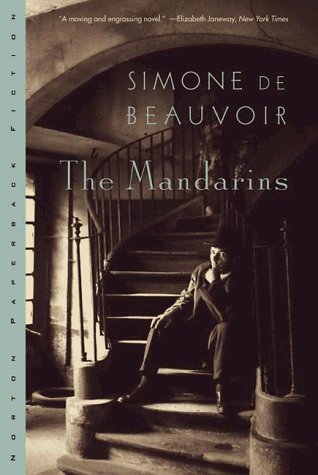
'I know, but...' Once more Lambert paused, seemed embarrassed. 'For example, your series on Portugal is very good, but I remember those pages you once wrote on Sicily, It makes you feel a little sad not to find anything like them in what you're writing now.'
'If you ever go to Portugal, you won't feel very much like describing pomegranates in bloom,' Henri said.
'I wish you'd feel that way again,' Lambert said urgently. 'Why not? You certainly have the right to stroll along the seaside without worrying about the price of sardines.'
'But the fact is that I couldn't,' Henri replied.
'After all,' Lambert continued vehemently, 'we fought in the Resistance to defend the individual, to defend his right to be himself and to be happy. It's time now to reap what we sowed.'
'The trouble is that there are several hundred million individuals for whom that right still doesn't exist,' Henri said, shrugging his shoulders. 'I think it's precisely because we began to take notice of them that we can no longer stop.'
'Then everybody has to wait for the whole world to be happy before trying to be happy?' Lambert said. 'And art and literature must be put off until that golden age? It's now, right now, that we need them!'
aaaahhhh
'If that fellow does finance L'Espoir, he'll want to stick his nose into it,' Henri said.
'Completely out of the question!' Dubreuilh replied. 'He will positively not intervene in the management of the paper. As a matter of fact, you'd be much more independent with a silent partner like him. After all, you are tied down to a certain extent by the fear of losing your readers.'
'Your shoemaker seems to be a funny kind of philanthropist.'
'If you met the man, you'd understand right off,' Dubreuilh said.
'Nevertheless, I can't bring myself to believe he won't impose any conditions,' Henri persisted.
'Absolutely none. I guarantee it. That's one thing you can be certain of.'
lmao the age-old question
Henri's bitterness slowly dissipated as he listened to Paula's protests; their very vehemence made clear the frivolous motives which lay behind them. And they were the very same objections Henri himself had been turning over in his mind. 'I'm rebelling because I'm afraid of being eaten up by politics, because I dread the thought of taking on new responsibilities, because I'd like some leisure, and especially because I want to stay master in my own house.' All quite trifling reasons. On his way to the paper the next day, he hoped from the bottom of his heart that Luc would furnish better ones.
you're allowed to pay attention to your feelings!
[...] The world was wavering between war and peace, the future depended perhaps on an imponderable; it would be a crime not to try anything and everything to sway the balance in favour of peace. Henri looked at his desk, his chair, the walls; he listened to the purrings of the presses; and suddenly it seemed to him as if he had just awakened from a long, futile dream. Up to now he had considered L'Espoir a sort of toy, a complete set of equipment for the little junior editor — life-size. A magnificent plaything! But it was in fact an instrument, a weapon; people had the right to hold him to account for the way he used it. He walked over to the window. Oh, he was exaggerating a little, of course; it hadn't been as futile as all that. The September euphoria had long since been dissipated. He had been quite emotional about this paper, but nevertheless he had always believed there was no one to account to but himself. He couldn't have been more wrong. 'It's funny,' he said to himself, 'but whenever you do the decent thing, instead of it giving you certain rights it only creates more obligations.' He had founded L'Espoir, and now that act was forcing him to throw himself body and soul into the political arena. Even now he could imagine Samazelle's intrusions, his harangues, Dubreuilh's telephone calls, the conversations, the conferences, the arguments, the deals. I won't let myself be eaten up, he had promised himself. Well, the die was cast; he was going to be eaten up. He left his office and went down the stairs. Wrapped in fog and darkness, the city seemed to him like a huge station. There was a time when he had liked fogs, stations, but now he liked nothing; already he had let himself be eaten up. Yes, that was why he found so little to say when he tried to write about himself. There are things you value; tell us which. Which? He loved neither Paula nor Nadine, and travelling hardly tempted him; he never listened to music any more, took walks, never read for pleasure. He no longer did anything at all for pleasure alone, no longer stopped on street corners to look about idly, no longer took time to savour an old memory. People to see, things to do; he was living like an engineer in a mechanical world. No wonder he had become as dry as a stone. He quickened his pace. It terrified him, that dryness. At Christmas Eve he had promised himself so firmly that he would find himself again. And he had found nothing. In the bargain he felt constantly uneasy, constantly on the defensive, tense, irritable, irritated. He knew only too well he was acquitting himself poorly of all those drudgeries he inflicted upon himself; they brought him nothing but remorse. 'I don't know enough, don't see things clearly, take sides too lightly; I haven't enough time, I'll never have enough time.' It was unbearable, that refrain. And now it would grow even louder, he would never stop hearing it; everything was going to be worse than before, infinitely worse. Eaten up, devoured, picked clean to his very bones. Writing would be out of the question, for writing is way of life and he was about to choose another; he would longer have anything to communicate to anyone. 'That's not what I want; I don't want it,' he said to himself with revulsion. No, his repugnance wasn't frivolous; on the contrary, with only a little pathos, he could have told himself that the thing was matter of life or death, his life or death as a writer. He had assert himself. 'After all, the SRL doesn't hold the fate humanity in its hands,' he thought. 'Nor do I hold the fate of the SRL in mine.' [...]
jesus
[...] 'Reap what you've sown,' Lambert had said. Try to be happy without waiting for everyone else in the world to achieve happiness. Why not? Henri imagined a solid country home, pine trees, the smell of the scrub. 'But what will I write?' He continued walking, his head empty. 'The trap is well laid,' he said to himself. 'Just when you think you're escaping, it slams down on you.' To recapture the past and preserve the present with words is all very fine. But it can be done only if there is someone to read them; there's no sense to it except if the past, if the present, if life counts for something. If this world has no importance, if other men mean nothing, what point would there be to writing? There would be nothing left to do but yawn in boredom. Life can't be bought piecemeal; it has to be purchased in bulk — all or nothing. Only there isn't time enough for everything, that's the tragedy of it. Once more the refrain began repeating itself insistently in Henri's head. He was strongly attached to that paper, and his concerns about war, peace, and justice weren't just idle nonsense; throwing all that overboard was out of the question. And yet he was a writer, he wanted to write. Up to now he had managed more or less to reconcile everything, rather less than more. But if he gave in to Dubreuilh, he'd never be able to extricate himself. What then was he to do? Give in? Not give in? Get involved in politics? Write?
AHHHH
He would have willingly taken more interest in the magazine, for he enjoyed helping Dubreuilh gather articles and make selections. But it was always the same refrain: he needed time to go through the manuscripts, to write to the authors, to talk things over with them. And that was out of the question; he had to limit himself to skimming hastily through anonymous writings. 'I skimp everything,' he thought, sitting down behind the wheel of the little black car. 'I can't even take time out to do justice to a beautiful day like this. In the end I'll just hurry through my whole life.'
‘I'll take your word for it,' Henri said. When you were with Dubreuilh, a stroll along the quays became as exciting as an expedition to the North Pole; Henri and Anne would often laugh together over this. The thing was that he didn't distinguish between seeing and discovering; no eye before his had ever seen a waterfall, no one knew what water was, what black and white were. By himself, Henri certainly would never have noticed all the details of that play of mist and foam, the shape-shifting, the ghostly apparitions, the tiny whirlpools which Dubreuilh scrutinized so closely, as if he were trying to determine the destiny of each drop of water. 'You can get annoyed at him,' Henri thought, looking at Dubreuilh affectionately, 'but you can't get along without him.' When you were with him, everything seemed important, living became a great privilege — and you lived twice as much. He transformed that leisurely trip across the French countryside into a voyage of discovery.
'You'd really surprise your readers,' Henri said, smiling at Dubreuilh who, completely absorbed, was contemplating the last rays of the sun.
'Why?' Dubreuilh asked in that shocked voice he always affected whenever someone spoke to him about himself.
'You get the impression from your books that only people interest you and that nature counts hardly at all.’
‘People live in nature, don't they?'
<3
Henri hesitated. 'Suppose you see a string of lights at night along the bank of a river. It's a pretty sight. But when you know they light up cities where people are dying of hunger, they lose all their poetry, become nothing but a mirage. You'll tell me I can write about other things, about those people who are dying of hunger, for example. But I'd rather discuss those things at meetings, or in articles.'
'I wouldn't tell you that at all,' Dubreuilh said spiritedly. 'Those lights shine for everyone. Obviously, the basic need is to have food to eat, but what good is eating if you're denied all the little things that make life worth living? Why, for instance, are we taking this trip? It's because we believe that landscapes aren't mirages.'
'All right,' Henri said. 'Let's admit that some day everything will make sense again. But just now, there are so many things which are so much more important.'
'But it makes sense just now,' Dubreuilh said. 'Since it means something in our lives, it's going to mean something in our books.' He said, beginning to sound annoyed, 'To hear you talk, you'd think the left is dedicated to propagandist literature only, in which each and every word must enlighten the reader.'
The real reason is that your hatred of Russia has gone to your head,' Henri said. 'You twist facts, spread all sorts of lies. It's a filthy business! By attacking Russia, you're attacking socialism in general.'
'You know damned well that Russia and socialism have nothing to do with each other any more,' Scriassine said, his voice thickening.
'Don't tell me that America is any closer to socialism!' Henri said. Scriassine looked at Henri with eyes red with anger. 'You call yourself my friend! And you defend a regime that's condemned me to death! The day they shoot me, you'll explain in L'Espoir that they had good reasons for doing it.'
'My God!' Henri said. 'The old veterans and their war stories weren't bad enough! Now we're going to start hearing about the executions of the future!'
damn
'It's true it isn't easy to be young in these times, ' Henri said to himself. He made up his mind to have a serious talk with Lambert one of these days. 'And just what would I say to him?' He began undressing. 'If I were a Communist or a Christian, I'd be less at a loss. An ethical system based on universal values, yes, you can try to impose it on others. But the meaning one gives to one's own life is another story. I couldn't explain that in a few sentences; Lambert would have to be made to see the world through my eyes.' Henri sighed. And that's precisely where literature is useful - to show the world to others as you yourself see it. Only he had tried and he had failed. 'Did I really try?' he asked himself, lighting another cigarette and sitting down on the edge of the bed. He had wanted to write a book for his own pleasure, a book which would serve no purpose, was not needed, had no reason for being. No wonder he had become fed up with it so quickly. He promised himself he would be honest, but he had only been complacent. He had pretended to talk about himself without setting himself in either the past or the present. But the truth of one's life is outside oneself, in events, in other people, in things; to talk about oneself, one must talk about everything else. He got up and drank a glass of water. At the time, it had suited him to believe that literature no longer had any meaning, but nevertheless it hadn't prevented him from writing a play that satisfied him. A play set in a definite place, at a definite time, a play that meant something. And that was precisely why he was satisfied with it. Then why not undertake a similar novel; why not tell a story of today in which the readers would find their own worries, their own problems? Neither demonstrate nor exhort, but bear witness. It took him a long time to fall asleep.
<3<3